Blue Bridge over the Moika River
You might cross the world's widest bridge without ever noticing its remarkable scale.
Full story unlocks in the tour
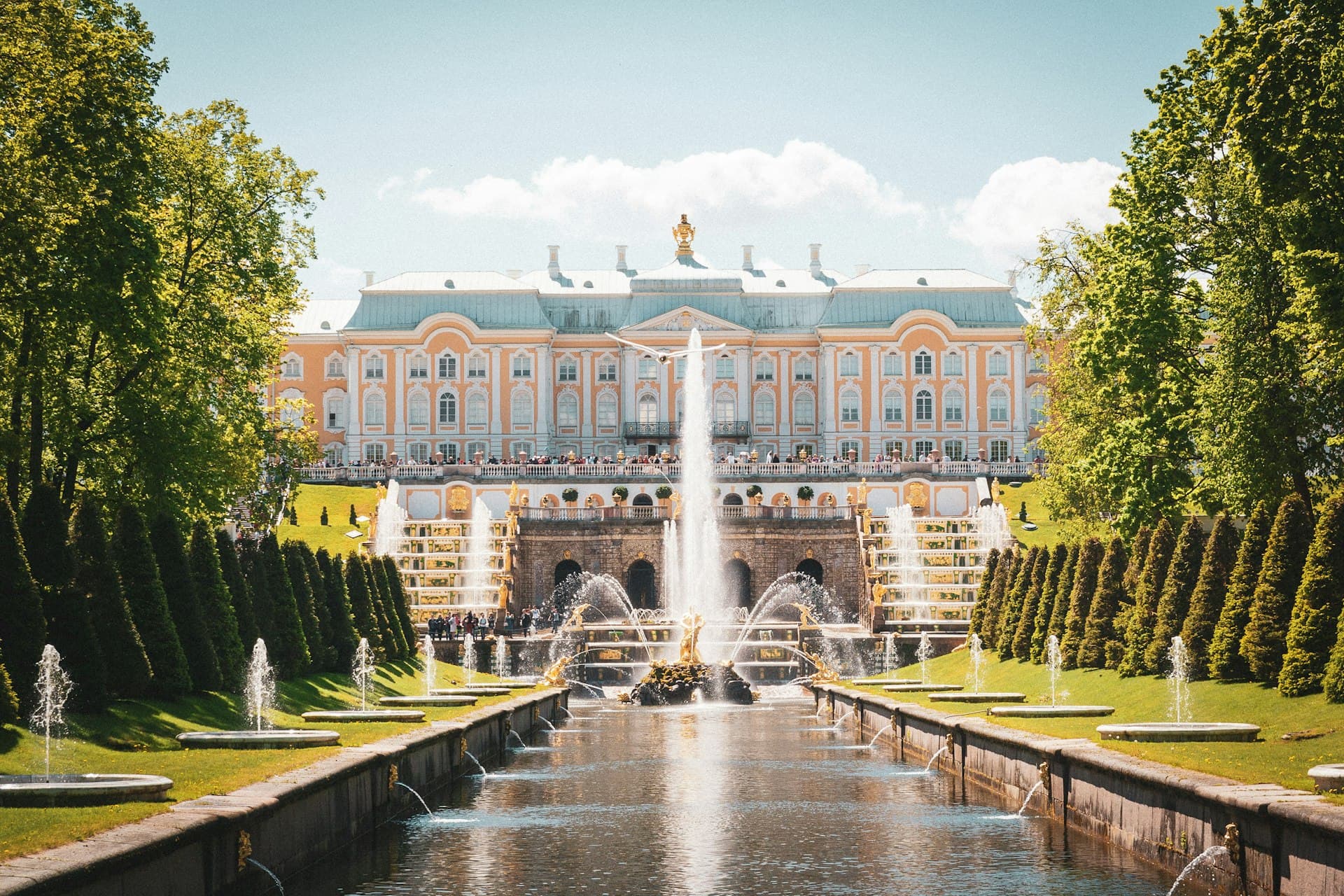 Photo: Dimitry B / Unsplash
“Imperial grandeur, revolutionary spirit, and canals that carry the city's story.”
Not the postcards. The stories even locals don't know — whispered in your ear, right where they happened.
You might cross the world's widest bridge without ever noticing its remarkable scale.
Beneath the city's elegant surfaces, a subterranean realm holds a remarkable distinction.
The city's founder, Peter the Great, resided in a surprisingly modest dwelling for a Tsar.
Discover every secret of Saint Petersburg
Every address, every reveal in full — in your ear, right where it happened.
You pick your stops. You walk. The voice reveals what the others miss.
No tours available yet. Check back soon — we're preparing them.
Saint Petersburg, often known as the "Window to Europe" or "Venice of the North," stands as Russia's second-largest city and its cultural heart. Founded by Tsar Peter the Great in 1703, it served as the capital of the Russian Empire for over two centuries. The city's design, shaped by European architects, features an extensive network of canals and architecture inspired by Western Europe, all interwoven with its Russian heritage.
Constructed on marshland at the head of the Gulf of Finland on the Baltic Sea, Saint Petersburg's dramatic layout, grand palaces, and gilded cathedrals were conceived to project Russia's wealth and influence. It is a city that has inspired countless artists, writers, and poets, and continues to impress visitors with its singular blend of imperial history and dynamic cultural life.
Saint Petersburg's story begins on May 27, 1703, when Tsar Peter the Great established the city on the site of a captured Swedish fortress. His ambition was to forge a new capital that would serve as Russia's "window on Europe," a strategic seaport intended to modernize and Westernize the nation. The initial construction was the Peter and Paul Fortress, built on Zayachy (Hare's) Island. Peter mandated that all stone construction elsewhere in Russia cease, ensuring that stonemasons contributed their skills to his ambitious new city.
In 1712, Saint Petersburg officially became the capital of the Russian Empire, a designation it maintained for over 200 years, with a brief interlude between 1728 and 1730 when the capital temporarily returned to Moscow. Under Peter I and subsequent rulers like Elizabeth I, the city rapidly expanded with numerous palaces and cathedrals, including the Winter Palace and Peter and Paul Cathedral, designed to rival Europe's grand cultural centers. By 1900, Saint Petersburg had developed into one of Europe's largest industrial centers and an important international hub of power, commerce, and politics.
The 20th century brought profound transformations. In 1914, with the outbreak of World War I, the city was renamed Petrograd due to its German-sounding name. It became the focal point of the 1917 revolutions, which ultimately led to the fall of the Romanov dynasty and the transfer of the capital back to Moscow in 1918. After Lenin's passing in 1924, the city was renamed Leningrad in his honor. During World War II, Leningrad endured a devastating 900-day siege, the most lethal in history, yet its citizens never surrendered. In 1991, shortly before the dissolution of the Soviet Union, a city-wide referendum supported restoring its original name, Saint Petersburg.
Saint Petersburg offers a wealth of architectural wonders and cultural institutions. The Hermitage Museum, situated within the opulent Winter Palace, stands as one of the world's largest art museums, holding over three million items. Allow generous time to explore its extensive collections and grand interiors. The Church of the Savior on Spilled Blood, with its distinctive onion domes, marks the site where Emperor Alexander II was assassinated and is celebrated for its intricate mosaics.
St. Isaac's Cathedral is Russia's largest cathedral, providing expansive city views from its colonnade. The Peter and Paul Fortress, the city's oldest architectural structure, contains the tombs of Russian tsars within its cathedral and offers insights into the city's founding. Consider a canal cruise to appreciate why Saint Petersburg is called the "Venice of the North," observing the city's many bridges and pastel-colored facades from the water. Beyond the city center, a day trip to Peterhof Palace is recommended, known for its elaborate gardens and golden fountains.
The most pleasant time to visit Saint Petersburg is during the peak season from June to August. Summers are agreeable, with temperatures typically between 15-25°C (59-77°F), ideal for exploring. This period also includes the renowned "White Nights," when daylight extends past midnight, creating a unique and romantic atmosphere. May and September offer comfortable weather with fewer crowds, and autumn brings beautiful foliage. Winters, from November to April, are cold with snowfall, providing a quieter experience and scenic snow-covered landmarks, though outdoor activities can be challenging.
The official currency in Saint Petersburg is the Russian Ruble (RUB). While some larger hotels and businesses might accept euros or dollars, direct payment in foreign currency for transactions is not permitted. It's advisable to exchange cash (euros or dollars) upon arrival for better rates or use ATMs, which are widely available. Most hotels, restaurants, and shops accept major credit cards, particularly Visa and MasterCard.
Public transportation is extensive, encompassing a metro system, buses, trolleybuses, and trams. The metro is notably deep, and tokens or smart cards are used for travel. Taxis are readily available, and it is recommended to agree on the fare in advance. English is not universally spoken, especially outside of tourist areas, but residents are generally welcoming and helpful. For most foreign travelers, a valid Russian visa is necessary, though cruise passengers may qualify for a 72-hour visa-free visit.