Beneath a popular scenic viewpoint, a construction project in 1995 uncovered a secret that reshaped the city's ancient narrative.
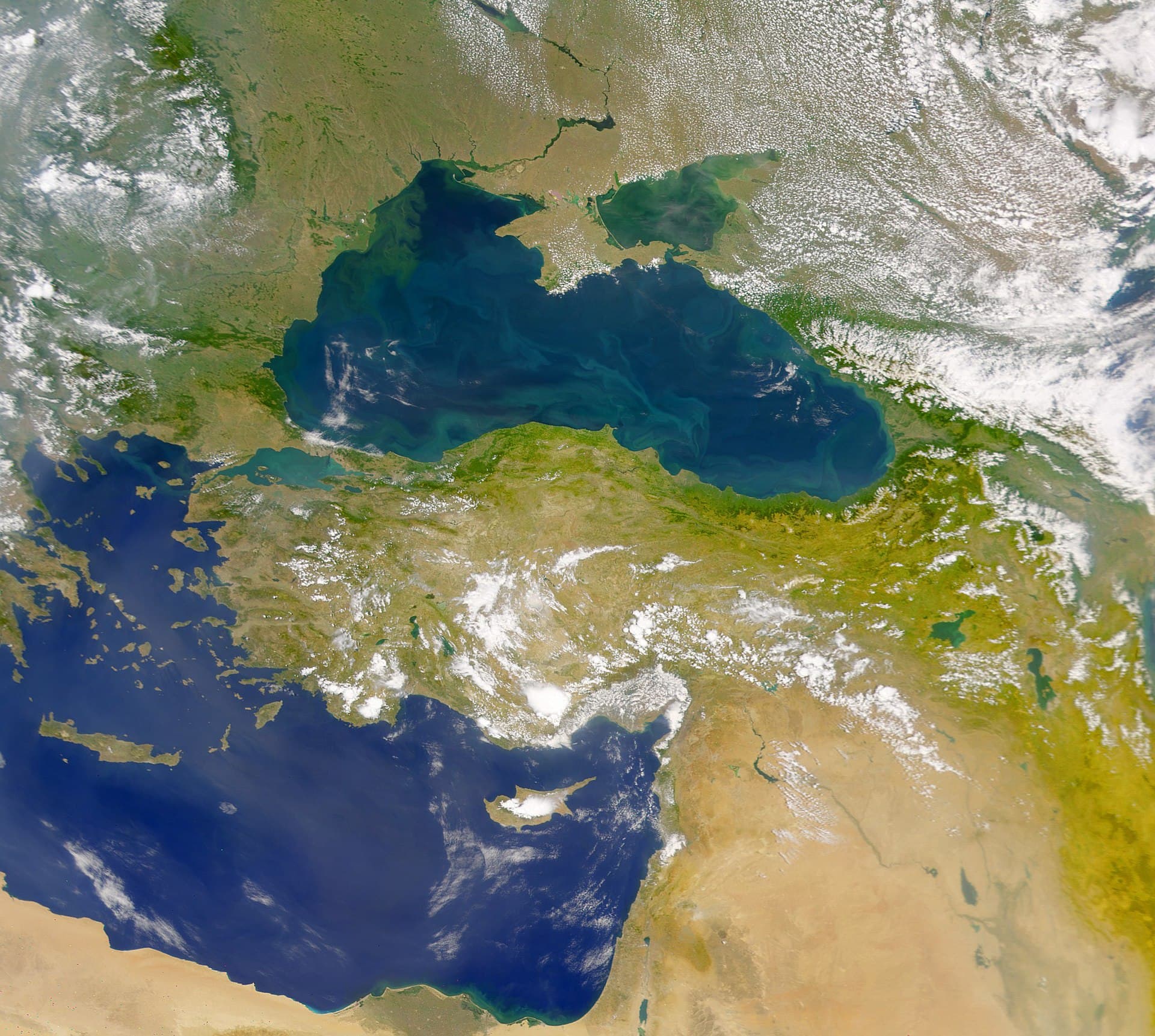
The SeaWiFS Project / public domain, via Wikimedia CommonsSamsun
Self-guided audio walking tour of Samsun — GPS route, offline playback, story-driven narration in 32 languages.
“Where the Black Sea murmurs tales of ancient Amazons and a nation's renewal.”
Samsun, as no one tells it.
Not the postcards. The stories even locals don't know — whispered in your ear, right where they happened.
The ship that launched a nation's independence wasn't the original vessel, yet its replica holds a surprising detail about its predecessor.
On the road into Samsun, a local culinary secret for finding the finest traditional breakfast dish isn't about accolades or elaborate reviews.
Discover every secret of Samsun
Every address, every reveal in full — in your ear, right where it happened.
You pick your stops. You walk. The voice reveals what the others miss.
How long do you have in Samsun?
Your self-guided audio tour of Samsun is ready — pick your landmarks, choose your language, and start the moment you arrive.
BuyThe story of Samsun
Samsun, a significant port city on Turkey's northern Black Sea coast, presents a fusion of historical depth, natural splendor, and contemporary urban life. Known as the "Capital of the Black Sea," it functions as a major commercial and cultural center for the region. The city extends along a broad bay, situated between the fertile deltas of the Kızılırmak and Yeşilırmak rivers, which contribute to its verdant landscapes.
Beyond its strategic geographical position, Samsun occupies a pivotal place in Turkish history as the starting point of the Turkish War of Independence. On May 19, 1919, Mustafa Kemal Atatürk arrived here, initiating the national struggle that culminated in the foundation of the modern Turkish Republic. This event is commemorated annually, rendering Samsun a symbol of national resurgence and a revered city for the Turkish people. The city's temperate oceanic climate, influenced by the Black Sea, provides moderate temperatures year-round, making it an appealing destination for those who appreciate green scenery and a coastal atmosphere.
From Ancient Amisos to Ottoman Port
The origins of Samsun stretch back to deep antiquity, with the first significant settlement, then known as Amisos, established by Greek colonists from Miletus in the 7th century BCE. This strategic location, with its fertile ground and access to shallow waters, allowed Amisos to thrive as a prominent trading colony on the Black Sea. Evidence of its early importance includes the city minting its own coins and being referenced by ancient historians.
Following Alexander the Great's conquests, Amisos came under the rule of the Pontus kings in the 4th century BCE, continuing its prosperity until its capture and burning by the Romans in 71 BCE. Under the Byzantines, it was still known as Amisos, but the Seljuq Turks, upon taking the city in the second half of the 12th century, renamed it Samsun. During Seljuq rule, Samsun surpassed Sinope as a trade hub connecting Europe and Central Asia, leading to the establishment of a large Genoese trading colony.
Ottoman Era and Tobacco Boom
The city was briefly captured by the Ottoman sultan Bayezid I in the late 14th century, lost after the Ottoman defeat by Timur in 1402, and then permanently re-conquered by the Ottomans in 1420. During the later Ottoman period, Samsun became a significant center for tobacco production, particularly the local Samsun-Bafra variety, known for its small, aromatic leaves and high price. The connection to the railway system in the latter half of the 19th century further propelled the tobacco trade, contributing to the city's economic growth and modernization.
The Birthplace of a Republic
Samsun's most profound historical significance in modern Turkey dates to May 19, 1919. On this day, Mustafa Kemal Atatürk, a general in the Ottoman army, arrived in Samsun aboard the SS Bandırma. Defying the orders of the occupying Allied powers, Atatürk and his colleagues declared the beginning of the Turkish national movement, effectively launching the Turkish War of Independence. This event marked a turning point in the nation's destiny, transforming the remnants of the Ottoman Empire into the modern Republic of Turkey. Samsun is thus celebrated as the symbolic starting point of Turkish independence, and May 19th is commemorated annually as a national holiday dedicated to Atatürk, youth, and sports.
Samsun offers a variety of attractions that interweave its historical importance with natural splendor. A visit to the Bandırma Ferry Museum is essential; it's a full-size replica of the ship that brought Mustafa Kemal Atatürk to Samsun in 1919, marking the start of the Turkish War of Independence. You can explore the recreated cabins and observe wax figures of Atatürk and his companions.
For sweeping city and Black Sea views, ride the cable car up to Amisos Hill. This archaeological site also features ancient rock tombs. The Statue of Honor in Atatürk Park, a monument commissioned by local residents and created by Austrian sculptor Heinrich Krippel, commemorates Atatürk's landing and the commencement of the War of Independence.
Explore Batı Park, an expansive coastal area with walking paths, green spaces, and distinctive sculptures inspired by the legend of the Amazons, who are said to have once inhabited the region. History enthusiasts can also visit the Samsun City Museum for insights into the city's social, historical, cultural, and economic life. Those who appreciate nature might consider a trip to the Kızılırmak Delta Bird Sanctuary, one of Turkey's largest bird habitats, located about 51 km from Samsun, offering opportunities for birdwatching and cycling.
Samsun experiences a temperate oceanic climate, influenced by the Black Sea, resulting in mild and humid conditions year-round. Summers (June to August) are warm and sunny, with average temperatures in the low to mid-20s Celsius (low to mid-70s Fahrenheit), making it ideal for beach activities and exploring the city's coastal areas. July and August are the warmest and sunniest months. Spring and autumn offer pleasant transitional weather, with cooler temperatures and a mix of sunshine and occasional rain. Winters (December to February) are cool and humid, with temperatures generally between 5 and 10 degrees Celsius (41-50 Fahrenheit), and while snowfall is possible, prolonged freezing weather is rare.
Samsun Çarşamba Airport (SZF) is located approximately 23 kilometers east of the city center, with frequent flights to Istanbul and other major Turkish cities. From the airport, you can reach the city center via direct buses, taxis, or rental cars. Public transportation within Samsun is convenient, utilizing an extensive network of public buses, shared taxis (dolmuş), and a tram system. To use public transport, you'll need a rechargeable "Samkart," available at tram stations and kiosks. The tram line connects key areas, including Ondokuz Mayıs University and Samsun Stadium.
Accommodation in Samsun is generally more affordable than in major Turkish tourist destinations, with a range of options from budget-friendly to mid-range hotels, particularly around Cumhuriyet Square and the Atakum district for those seeking coastal stays. The Black Sea climate can be unpredictable, so packing layers and a lightweight rain jacket or umbrella is advisable year-round. Comfortable walking shoes are also recommended for exploring the city's extensive coastal promenade.
- What is Samsun best known for?
- Samsun is primarily known as the city where Mustafa Kemal Atatürk landed on May 19, 1919, initiating the Turkish War of Independence and leading to the establishment of the modern Republic of Turkey.
- Are there any ancient legends associated with Samsun?
- Yes, ancient myths suggest that the eastern delta of Samsun was once home to the Amazons, a legendary tribe of female warriors.
- What is the local currency and how do I pay for public transport?
- The local currency is the Turkish Lira. For public transport, you'll need a rechargeable "Samkart," which can be purchased at tram stations and kiosks.
- What is the climate like in Samsun?
- Samsun has a temperate oceanic climate with moderate temperatures and noticeable Black Sea influence, resulting in warm, humid summers and cool, damp winters.
- What is Çakallı Menemen?
- Çakallı Menemen is a traditional Turkish breakfast dish, a local specialty in the Çakallı town near Samsun.
- Is Samsun a good destination for nature lovers?
- Yes, Samsun offers natural beauty with its Black Sea coastline, green forests, mountains, and the Kızılırmak Delta Bird Sanctuary, a protected reserve for migratory birds.