Chapelle de Santa Crescenzia
En approchant de San Vito Lo Capo, une petite chapelle de style mauresque se dresse tel un gardien silencieux.
L'histoire complète se débloque dans le tour
 Roberto Fontana from Mantova, Italia / CC BY 2.0, via Wikimedia Commons
Visite audio autoguidée de San Vito Lo Capo — parcours GPS à pied, lecture hors ligne, narration en 32 langues.
“Là où la mer Tyrrhénienne rencontre les pierres anciennes et où le parfum chaleureux des épices flotte dans l'air.”
Pas les cartes postales. Les histoires que même les habitants ignorent — soufflées à l'oreille, là où elles se sont passées.
En approchant de San Vito Lo Capo, une petite chapelle de style mauresque se dresse tel un gardien silencieux.
L'église centrale de la ville ressemble davantage à une forteresse qu'à un simple lieu de culte.
Juste à l'extérieur de la ville, une ancienne usine de transformation du thon se dresse comme un monument silencieux à une époque révolue.
Découvrez tous les secrets de San Vito Lo Capo
Chaque adresse, chaque révélation en entier — dans ton oreille, là où elle s'est passée.
Tu choisis tes lieux. Tu marches. La voix te révèle ce que les autres ignorent.


Votre visite audioguidée de San Vito Lo Capo vous attend — choisissez vos lieux, votre langue, et lancez-vous dès votre arrivée.
AcheterLume intègre un guide en réalité augmentée. Levez votre téléphone : sa caméra montre la rue devant vous, avec une flèche lumineuse posée sur l'image réelle qui pointe toujours vers votre prochain arrêt — aucune carte à déchiffrer, aucun mauvais virage. Comme tout dans Lume, ça fonctionne entièrement hors-ligne.
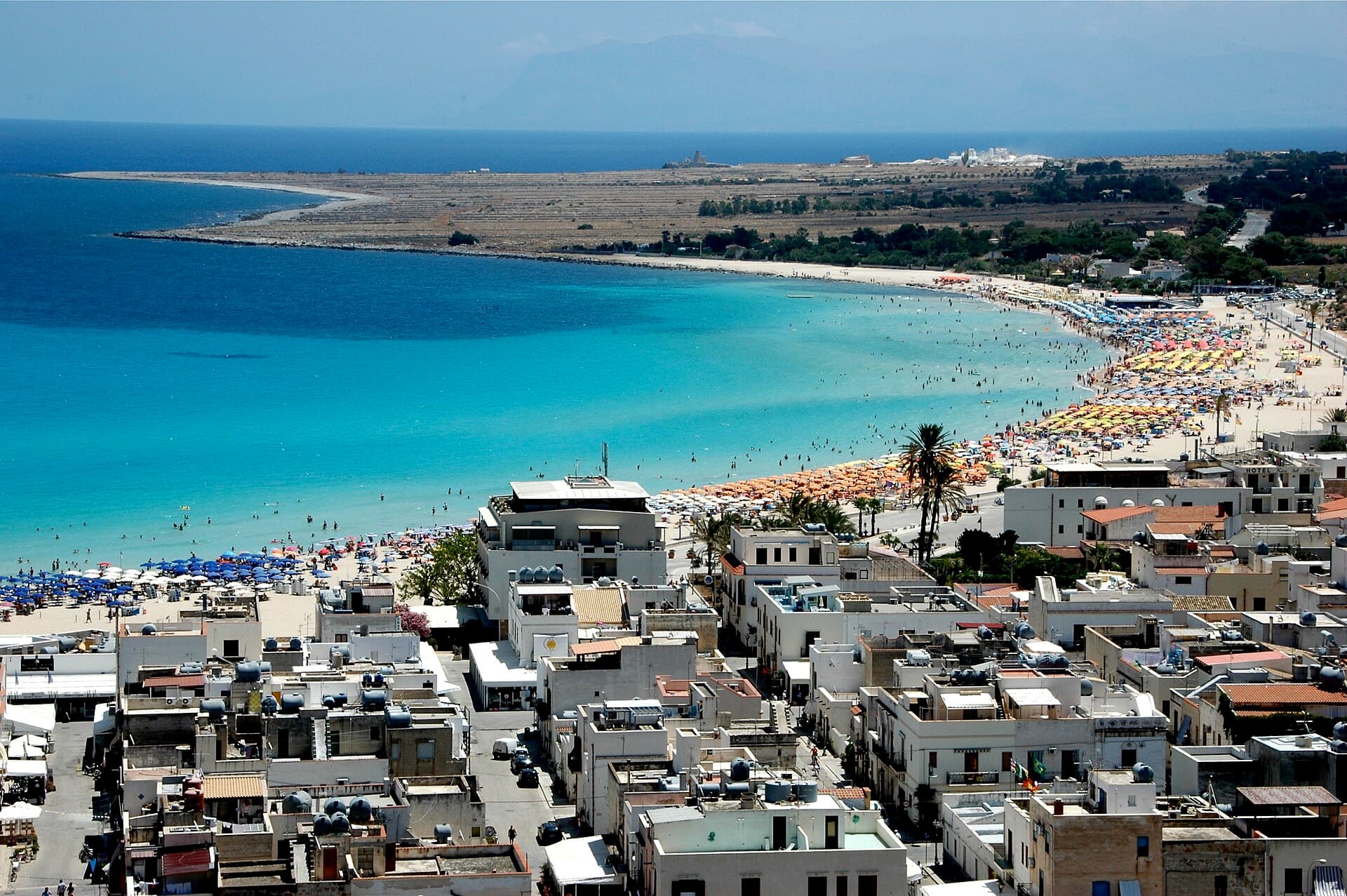
San Vito Lo Capo, une ville côtière ensoleillée située à la pointe nord-ouest de la Sicile, offre un mélange captivant de splendeur naturelle, d'histoire ancienne et de délices culinaires. Son atout le plus célèbre est une étendue de sable blanc de près de trois kilomètres, régulièrement classée parmi les plus belles d'Italie, où la mer Tyrrhénienne scintille de nuances turquoise. Encadré par le spectaculaire Monte Monaco à l'est et le Monte Cofano à l'ouest, le paysage évoque ici une atmosphère caribéenne plutôt que méditerranéenne.
Au-delà de ses rivages accueillants, San Vito Lo Capo est un centre d'aventure en plein air, de l'escalade sur ses falaises côtières à la randonnée dans la réserve naturelle de Zingaro toute proche. La ville elle-même, avec ses maisons blanchies à la chaux et ses promenades bordées de palmiers, dégage une atmosphère méditerranéenne détendue et intemporelle. C'est un endroit où la vie ralentit au rythme des vagues, et l'air transporte les senteurs mêlées d'épices, de maquis méditerranéen et de brise marine.
San Vito Lo Capo possède également une identité culinaire unique, notamment son couscous de poisson, un plat qui reflète des siècles d'échanges culturels entre l'Afrique et la Sicile. Cette tradition est célébrée avec passion chaque septembre lors du Cous Cous Fest, un festival international de gastronomie et de culture qui transforme la ville en une scène animée pour des compétitions culinaires, de la musique et des repas partagés.
La présence humaine dans la région de San Vito Lo Capo remonte à au moins 1000 av. J.-C., comme en témoignent les nombreuses grottes creusées dans les falaises côtières. Des découvertes archéologiques dans la Grotta dell'Uzzo, située dans la réserve naturelle de Zingaro, indiquent une habitation humaine dès la période mésolithique, il y a environ 10 000 ans. D'anciennes peintures rupestres dans la Grotta del Cavallo et des gravures dans les grottes d'Isulidda attestent également de communautés préhistoriques.
Les origines plus récentes de la ville sont liées à la légende de Saint Guy, un jeune patricien romain qui, avec sa nourrice Crescenzia et son tuteur Modesto, a fui les persécutions au IIIe siècle après J.-C. Ils ont débarqué dans le golfe alors connu sous le nom d'Egitarso. Selon la tradition, une petite église dédiée à Saint Guy a été construite vers 300 après J.-C. à l'emplacement actuel du Sanctuaire. Cette structure initiale a évolué au fil des siècles, devenant finalement un sanctuaire fortifié à la fin du XVe siècle, conçu pour offrir l'hospitalité aux pèlerins et les protéger des bandits et des corsaires barbaresques.
Au début du XVIIIe siècle, les premières maisons ont commencé à apparaître autour du Sanctuaire, formant la ville naissante de San Vito Lo Capo. La tour carrée de l'église-sanctuaire-forteresse a été ajoutée vers 1600. Au XVIIIe siècle, le gouvernement royal a encouragé l'établissement en confiant des terres à ceux qui les mettraient en valeur, avec l'obligation d'y résider. Cela a conduit à l'établissement formel de San Vito Lo Capo, ainsi que des hameaux voisins de Macari et Castelluzzo.
Un autre élément historique important est la Tonnara del Secco, une ancienne pêcherie de thon dont l'activité est documentée depuis 1412, lorsque le roi Ferdinand a accordé la permission de pêcher le thon dans les eaux locales. La présence de bassins de cetariae du IVe siècle av. J.-C. à proximité indique que la transformation du poisson, y compris du thon, pour des produits tels que le garum (sauce de poisson), était une pratique dans cette région bien avant la tonnara moderne. La tonnara a cessé ses activités au milieu du XXe siècle. Le phare de San Vito Lo Capo, un symbole proéminent de la ville, a été construit en 1859 sous la domination bourbonienne du Royaume des Deux-Siciles, pour améliorer la sécurité de la navigation.
San Vito Lo Capo offre une variété de sites, de sa célèbre plage aux structures historiques et réserves naturelles. L'attraction principale est sans aucun doute la plage de San Vito Lo Capo, une longue étendue de sable blanc avec des eaux peu profondes, claires et turquoise, idéales pour la baignade et les bains de soleil. La plage est adossée au Monte Monaco, offrant une vue spectaculaire.
Dominant le centre-ville se trouve le Sanctuaire de San Vito Martire, une église fortifiée construite à la fin du XVe siècle. À l'intérieur, les visiteurs peuvent explorer un hypogée du IVe siècle et monter à la terrasse du musée pour des vues panoramiques. Juste à l'extérieur de la ville, la petite chapelle de Santa Crescenzia de style mauresque, datant du XIIIe siècle, est un point de repère distinctif.
Le phare de San Vito Lo Capo, une tour cylindrique de 38 mètres de haut construite en 1859 par les Bourbons, est un phare actif et un endroit romantique pour une promenade, surtout au coucher du soleil. Pour un aperçu du passé de la région, visitez la Tonnara del Secco, une ancienne pêcherie de thon désaffectée située à environ 3 km du centre-ville.
Les amoureux de la nature trouveront beaucoup à explorer. La réserve naturelle de Zingaro, la première réserve naturelle de Sicile, offre 7 km de côtes préservées avec des sentiers de randonnée, des criques tranquilles et une flore et une faune diverses. Vous pouvez y accéder depuis San Vito Lo Capo ou Scopello. D'autres attractions naturelles incluent le point de vue de Macari pour des vues côtières panoramiques, et les criques de Bue Marino et Isulidda, Bue Marino ayant été nommée la plus belle plage d'Italie en 2015. La réserve du Monte Cofano offre également des possibilités de trekking et de VTT avec des sentiers côtiers et des sites archéologiques.
San Vito Lo Capo bénéficie d'étés longs et chauds, rendant les vacances à la plage possibles d'avril à fin octobre. Les mois intermédiaires de mai, juin et septembre sont souvent considérés comme les meilleures périodes pour visiter. Pendant ces périodes, le temps est agréable, la mer est chaude et les plages sont moins bondées qu'en plein été. Juillet et août sont les mois les plus chauds et les plus fréquentés, avec de nombreux Italiens en vacances. Septembre est particulièrement attrayant en raison des eaux chaudes et du célèbre Cous Cous Fest. Le printemps est également excellent pour le trekking et les sports de plein air en raison des températures plus fraîches.
San Vito Lo Capo est une petite ville plate, facilement praticable à pied, avec le centre et la plage accessibles en 10 à 15 minutes de marche depuis la plupart des zones. En été, une navette gratuite avec deux lignes urbaines est disponible. Louer un vélo est un autre excellent moyen de se déplacer.
Pour ceux qui arrivent en voiture, il est conseillé de se garer à votre hébergement ou d'utiliser les parkings payants en dehors du centre-ville piétonnier, car le stationnement peut être difficile en haute saison. San Vito Lo Capo se trouve à environ 1 heure et 15 minutes en voiture de l'aéroport de Palerme (PMO) et à environ 1 heure de l'aéroport de Trapani-Birgi (TPS). Les transports en commun, en particulier les bus, relient San Vito Lo Capo à Trapani et Palerme, bien que les itinéraires vers les aéroports puissent nécessiter des correspondances et soient moins fréquents pour Palerme.
Il est fortement recommandé de réserver à l'avance les hébergements, les parasols de lido et les excursions en bateau, surtout pour l'été et le Cous Cous Fest en septembre, afin de garantir de meilleurs tarifs et une meilleure disponibilité. La ville offre un éventail d'options de restauration, avec des spécialités locales telles que le couscous de poisson, les pâtes busiate et le pesto alla trapanese.
San Vito Lo Capo en coréen, en chinois ou en hébreu — et dans 29 autres langues, chaque étape narrée par une voix native. La plus large gamme de langues de tous les audioguides autoguidés.
Disponible en :