The Name 'Switzerland'
The very name of the country you're in, 'Switzerland' (or 'Schweiz' in German), has a surprising origin.
Full story unlocks in the tour
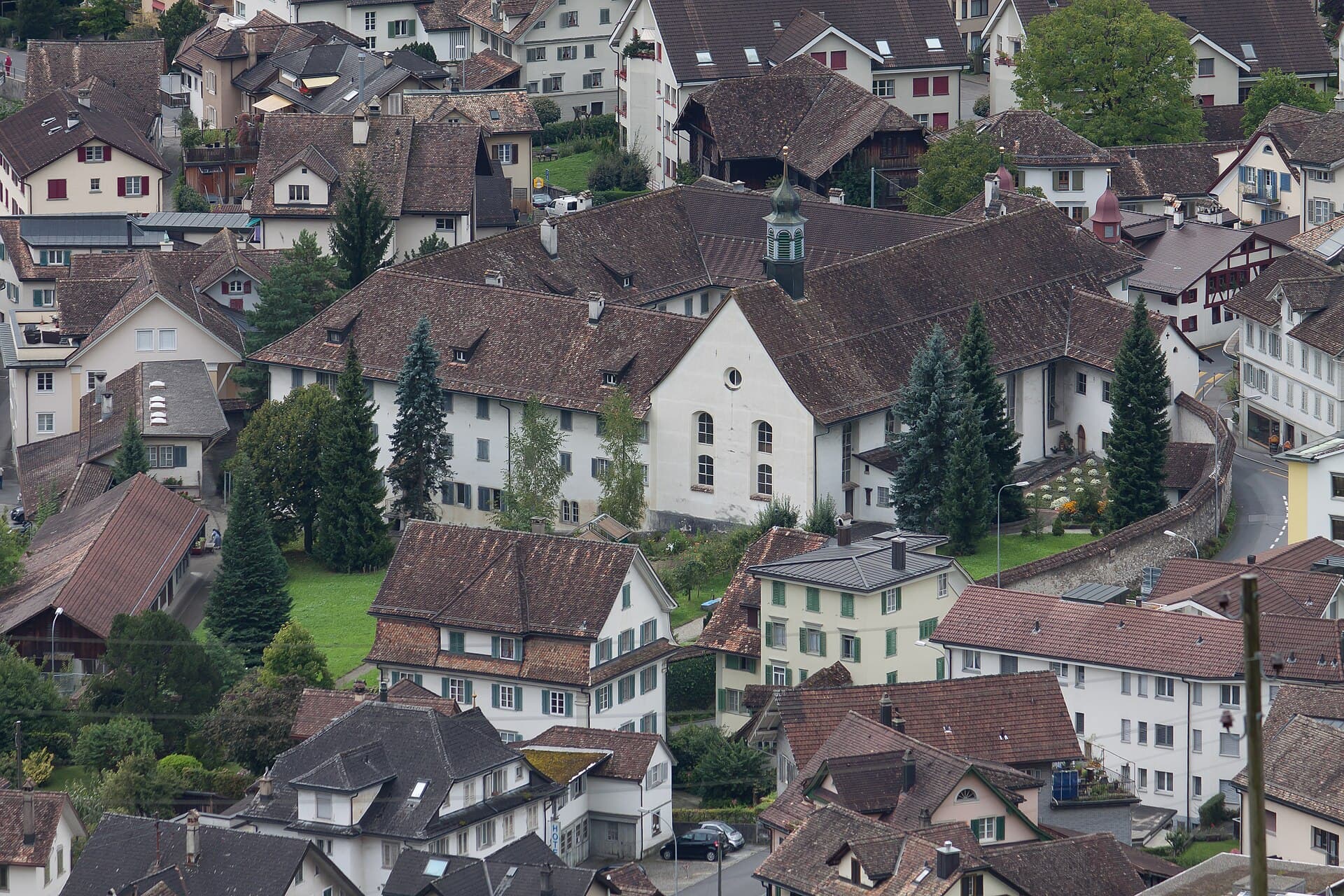 www.f64.ch / CC BY-SA 3.0, via Wikimedia Commons
“Where Switzerland began, a valley of quiet power and profound history.”
Not the postcards. The stories even locals don't know — whispered in your ear, right where they happened.
The very name of the country you're in, 'Switzerland' (or 'Schweiz' in German), has a surprising origin.
The iconic red multi-tool, known globally as the Swiss Army Knife, has a specific birthplace you might not expect.
Among Schwyz's historic buildings stands a wooden house that holds a remarkable title.
Discover every secret of Schwytz
Every address, every reveal in full — in your ear, right where it happened.
You pick your stops. You walk. The voice reveals what the others miss.
No tours available yet. Check back soon — we're preparing them.
Schwyz, the capital of its eponymous canton, sits at the heart of Switzerland, both geographically and historically. Framed by the jagged peaks of the Mythen mountains and situated between Lake Lucerne and Lake Lauerz, it offers a dramatic landscape that belies its tranquil atmosphere. This is a place where the foundational story of Switzerland comes alive, a town that lent its very name to the nation it helped create.
Despite its compact size and a population of around 15,000, Schwyz holds immense cultural significance. Its town center, rebuilt in a patrician style after a devastating fire in 1642, features grand 17th and 18th-century buildings, giving it an urban, almost aristocratic feel amidst its rural surroundings. Beyond its historical weight, Schwyz today is a lively town known for its cherry orchards and specialties, and as the home of the famous Swiss Army Knife.
The history of Schwyz stretches back to the early Middle Ages, with its first documented mention as 'Suittes' in 972. Early development was shaped by its strategic location at the foot of the Mythen massif, between lakes, and its control over trade routes leading to the St. Gotthard Pass. The economy was primarily based on Alpine livestock farming, fostering a unique way of life and a strong desire for autonomy.
A pivotal moment arrived in 1291 when representatives of Schwyz, Uri, and Unterwalden signed the Federal Charter, a foundational document that laid the groundwork for the Swiss Confederation. This charter, now preserved in the Bundesbriefmuseum in Schwyz, symbolizes the birth of Swiss statehood. Emperor Frederick II had granted Schwyz a charter of liberties in 1240, giving its residents independence from local counts. When Rudolf IV of Habsburg later refused to recognize these privileges, Schwyz took the lead in forming the Everlasting League.
Schwyz's leadership in the early confederation was so significant that its name, in the dialectical form 'Schweiz,' was applied to the three founding cantons by 1320 and to the entire confederation by 1352, becoming the official name after 1803. The canton's militia famously secured a decisive victory over Habsburg forces at the Battle of Morgarten in 1315, further cementing their freedom. The town experienced a major fire in 1642, which led to a significant reconstruction in stone, giving the center its distinctive Baroque and patrician architectural character seen today. Schwyz also played a role in later historical events, opposing the Protestant Reformation and joining the Sonderbund (separatist Roman Catholic league) in 1845.
The main square, Hauptplatz, is often considered one of Switzerland's most beautiful Baroque squares. Here, you'll find the impressive St. Martin's Parish Church and the historic Town Hall with its painted facade.
For a deep dive into Swiss origins, visit the Bundesbriefmuseum (Museum of the Swiss Charters of Confederation), which houses the original Federal Charter of 1291 and other crucial historical documents. The Forum of Swiss History, located in a restored 18th-century granary, offers an interactive journey through everyday life in the Middle Ages, with multimedia stations and opportunities to dress up as knights.
The surrounding Mythen mountains, Grosser Mythen and Kleiner Mythen, offer hiking opportunities with expansive views of the lakes. For a unique experience, take the Stoosbahn funicular, the steepest funicular in the world, to the car-free village of Stoos, which offers memorable ridge hikes and views of ten lakes. Additionally, the Hofstatt Ital Reding, a manor house dating from 1609, is considered one of Switzerland's most magnificent secular buildings.
Schwyz offers distinct attractions throughout the year. For hiking and outdoor activities, the warmer months from June to August are ideal, with comfortable daytime temperatures around 20-22°C. Spring (March to May) brings blooming landscapes and fewer crowds, perfect for exploring villages and trails. Autumn (September to November) showcases golden foliage and local festivals. Winter (December to February) transforms the region into a snowy landscape, suitable for skiing and festive markets. Be prepared for precipitation year-round; May and summer months see higher rainfall.
Schwyz is easily accessible. From Zurich Main Station, you can reach Schwyz by train in about an hour. If driving, take the A4 motorway to the 'Schwyz' exit. Parking is available at the Hofmatt multi-storey car park near the Forum of Swiss History. Zurich Airport (ZRH) is the most convenient international arrival point, about 50-60 minutes away by car or train.
The town is very safe, with low crime rates. Public transport is efficient; taxis should be ordered in advance. Renting a bike is a good option for shorter trips in warmer weather. Note that shops generally close by 6:30 PM on weekdays and 4:00-5:00 PM on Saturdays, with most establishments closed on Sundays, adhering to 'Sonntagsruhe' (Sunday rest).