The fjord itself
During World War II, a British oil tanker met a dramatic end in the calm waters of Seyðisfjörður.
Full story unlocks in the tour
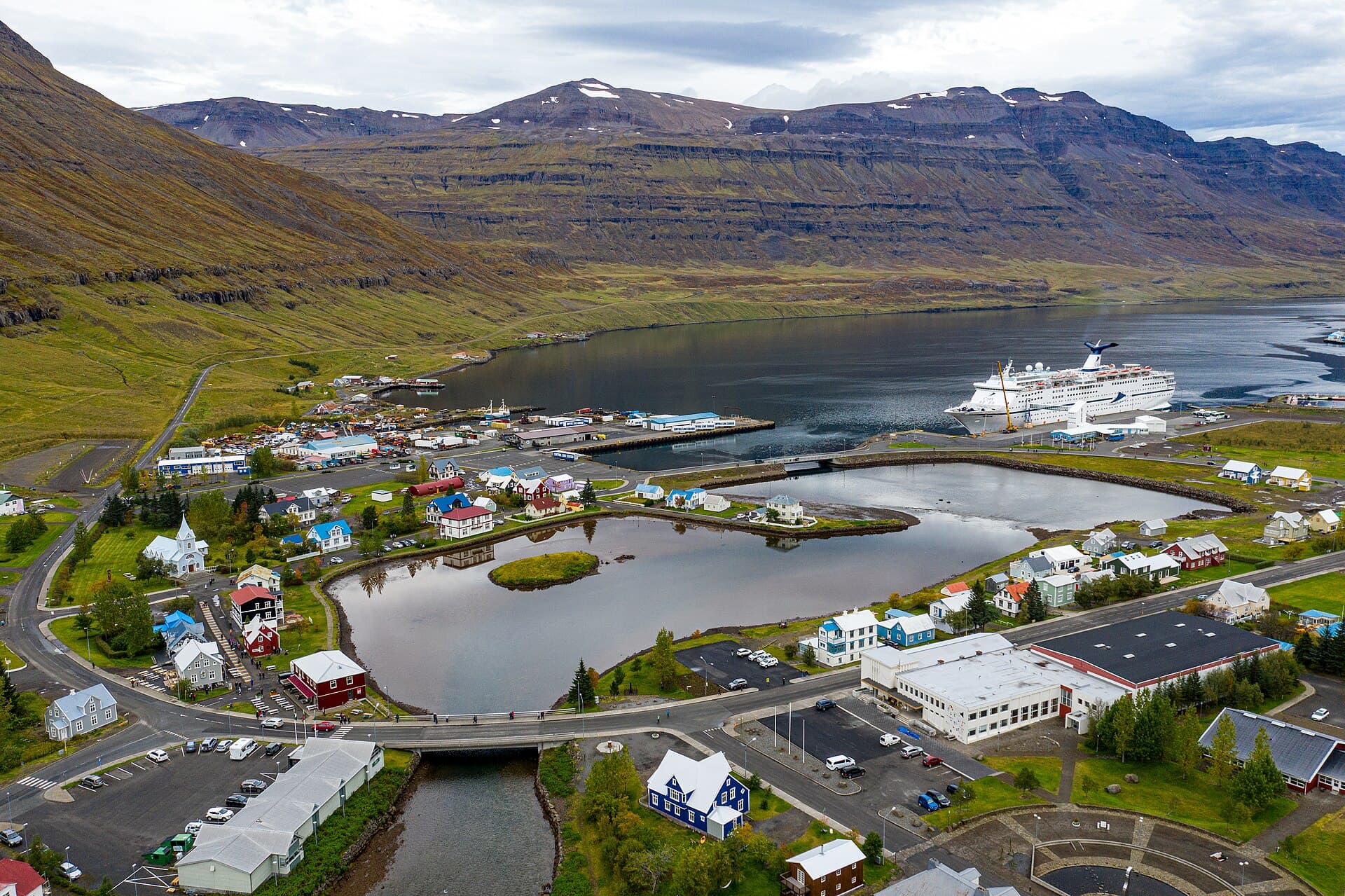 Kasa Fue / CC BY-SA 4.0, via Wikimedia Commons
“Where art’s pulse meets the raw grandeur of the Eastfjords.”
Not the postcards. The stories even locals don't know — whispered in your ear, right where they happened.
During World War II, a British oil tanker met a dramatic end in the calm waters of Seyðisfjörður.
High on a hillside, five concrete domes invite visitors to step inside and discover a unique auditory experience.
The colorful street leading to the iconic blue church wasn't always a permanent fixture.
Discover every secret of Seyðisfjörður
Every address, every reveal in full — in your ear, right where it happened.
You pick your stops. You walk. The voice reveals what the others miss.
No tours available yet. Check back soon — we're preparing them.
Seyðisfjörður, a town of roughly 700 inhabitants in Iceland's Eastern Region, sits at the innermost point of a fjord of the same name. Surrounded by steep mountains like Mt. Bjólfur to the west and Strandartindur to the east, the town's dramatic setting is complemented by its collection of colorful wooden houses and a flourishing arts scene.
Often described as one of Iceland's most visually striking towns, Seyðisfjörður offers a distinct contrast to more bustling destinations. Its singular blend of raw nature and lively culture makes it an unforgettable stop for those exploring the Eastfjords.
The town serves as a crucial entry point to Iceland, being the port for the Norröna car and passenger ferry, which connects the island to Hirtshals in Denmark and Torshavn in the Faroe Islands.
The history of Seyðisfjörður dates back to Iceland's early settlement period, with the first settler, Bjólfur, occupying the entire fjord. Archaeological excavations in 1998-1999 uncovered the ruins of a burned-down stave church at Þórunnarstaðir, carbon-dated to the 11th century.
The modern town settlement began in 1848 with the arrival of Norwegian fishermen. They established a prosperous herring fishery, which significantly contributed to the town's growth and saw the construction of many of the distinctive wooden buildings that still characterize Seyðisfjörður today.
Seyðisfjörður played a pivotal role in Iceland's communication history. In 1906, it became the landing site for the first undersea cable connecting Iceland to Europe, making it an international telecommunications hub for decades. A few years later, in 1913, a dam was built on the Fjarðará river, harnessing power for the country's first high-voltage AC power plant and a distribution network for street lighting and home use—also a first for Iceland.
During World War II, Seyðisfjörður served as a base for Allied forces. Evidence of this period, including a former landing strip and the sunken British oil tanker El Grillo, can still be found in the fjord. While fishing remains a significant activity, the town's economy has increasingly shifted towards tourism, supported by its role as a ferry port and its growing reputation as a cultural center.
Begin your exploration on foot, wandering through the town's charming streets to admire the colorful, well-preserved wooden houses, many dating from the early 20th century. The most famous landmark is the Blue Church (Bláa Kirkjan), fronted by the lively Rainbow Street, a popular spot for photographs.
Seyðisfjörður possesses a strong arts scene. Visit the Skaftfell Center for Visual Art, a hub for contemporary art with exhibitions, an artist residency, and a bistro. Discover other creative spaces like the Joystick Art Gallery, where everything is made from found objects. For a unique artistic experience, hike to Tvísöngur, a sound sculpture by Lukas Kühne, offering panoramic fjord views and an immersive acoustic environment.
The surrounding nature offers numerous attractions. Gufufoss Waterfall, approximately 4 kilometers (2.5 miles) from town, is easily accessible and known for its misty, almost magical appearance. Hiking trails abound, leading to more waterfalls, scenic viewpoints, and even puffin colonies during the summer months. Consider a short hike to Vestdalsvatn, a mountain lake, for expansive fjord views.
The best time to visit Seyðisfjörður is during the summer months, from June to August. During this period, the weather is mild, daylight hours are long, and the town is lively with cultural events and outdoor activities. The shoulder seasons of May and September also offer pleasant weather with fewer crowds, showcasing spring blooms or autumn colors.
Winter (December to April) brings snow-covered landscapes, opportunities for skiing, and the chance to witness the Northern Lights. However, travel during these months can be challenging due to potential closures of the Fjarðarheiði mountain pass, the main road connecting Seyðisfjörður to the rest of Iceland.
Seyðisfjörður is accessible via Route 93, a scenic mountain pass from Egilsstaðir, which connects to Iceland's Ring Road (Route 1). The drive takes about 30 minutes, but allow extra time for photo stops. The town is also the sole Icelandic port for the Norröna car and passenger ferry, linking it to Denmark and the Faroe Islands.
Within Seyðisfjörður, you'll find a range of services including hotels, a camping ground, a swimming pool, a library, and a post office. The town has a population of approximately 648 people as of 2026. It's advisable to check road conditions at road.is, especially when traveling outside of summer, as the mountain pass can close due to snow and ice. Tap water in Seyðisfjörður is safe and excellent for drinking.