Scandal Point
The name 'Scandal Point' on Shimla's Mall Road isn't just for show; it marks a real-life drama involving royalty and forbidden love.
Full story unlocks in the tour
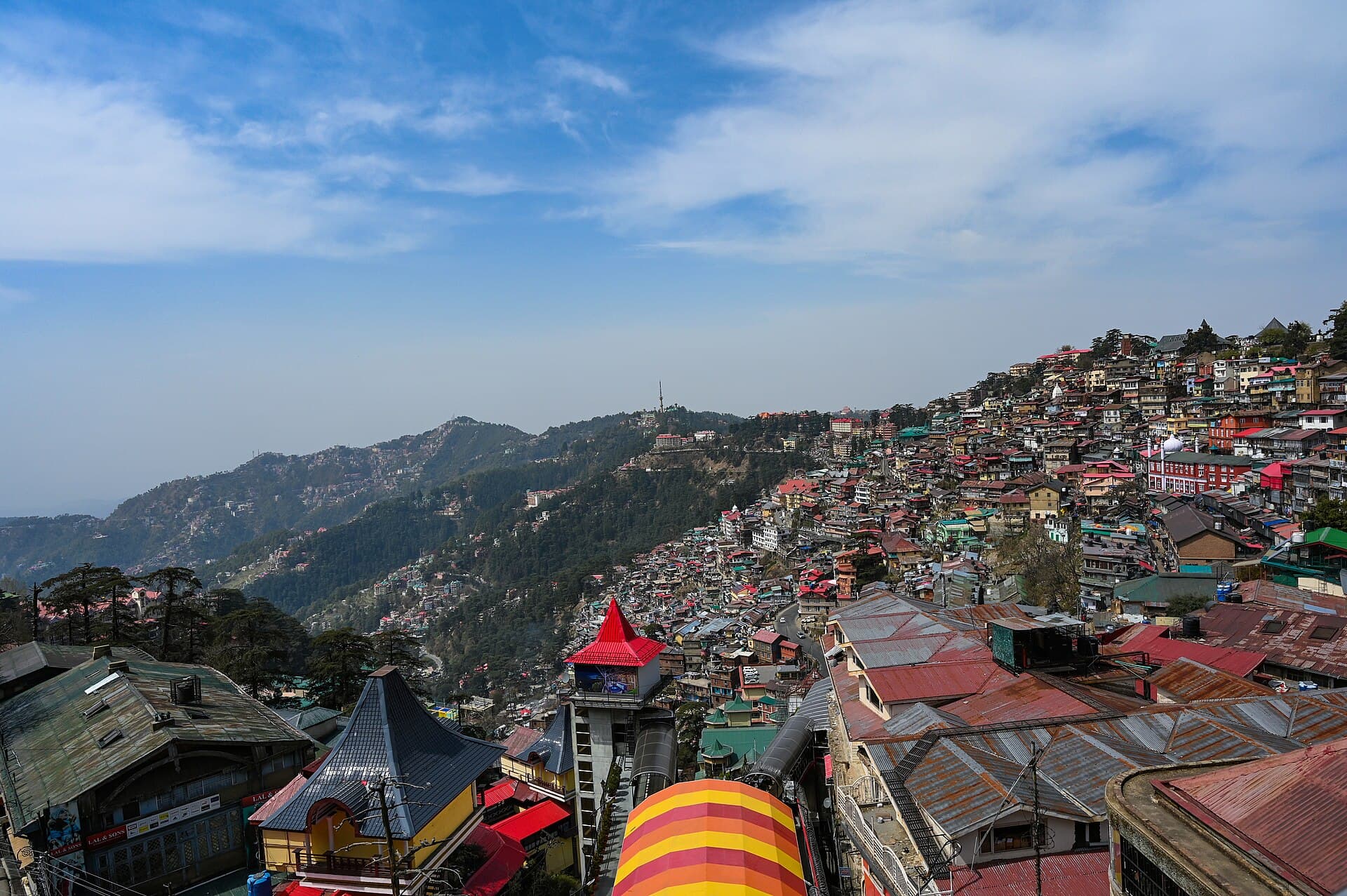 Navneet Sharma / CC BY-SA 4.0, via Wikimedia Commons
Self-guided audio walking tour of Shimla — GPS route, offline playback, story-driven narration in 32 languages.
“Where colonial echoes meet Himalayan whispers.”
Not the postcards. The stories even locals don't know — whispered in your ear, right where they happened.
The name 'Scandal Point' on Shimla's Mall Road isn't just for show; it marks a real-life drama involving royalty and forbidden love.
One of the longest tunnels on the Kalka-Shimla Railway is said to be haunted by the ghost of its original engineer.
Beneath this grand former residence of British Viceroys lie tunnels that once served a secretive purpose.
Discover every secret of Shimla
Every address, every reveal in full — in your ear, right where it happened.
You pick your stops. You walk. The voice reveals what the others miss.


Your self-guided audio tour of Shimla is ready — pick your landmarks, choose your language, and start the moment you arrive.
BuyLume has a built-in augmented-reality guide. Hold your phone up and its camera shows the street ahead of you, with a glowing arrow laid over the real view that always points to your next stop — no map to puzzle over, no wrong turns. Like everything in Lume, it works fully offline.
Shimla, once the summer capital of British India, is a city draped across a ridge in the Himalayan foothills, offering a distinctive blend of colonial heritage and natural grandeur. Named after Shyamala Devi, an incarnation of the Hindu goddess Kali, the city's origins trace back to dense forests with only a few scattered settlements and the ancient Jakhu Temple. The British, drawn by its temperate climate, transformed it into a significant administrative and social hub, a legacy still visible in its architecture and layout.
Today, Shimla serves as the capital of Himachal Pradesh and remains a popular escape, inviting visitors to wander its pedestrian-friendly Mall Road, marvel at its Gothic structures, and embark on the historic Kalka-Shimla Railway. The city's elevation, approximately 7,100 feet (2,200 meters), provides sweeping views of the surrounding snow-capped peaks and lush valleys, making it a destination that captivates with both its past and its present.
## From Forest to Imperial Retreat Before the 19th century, the area now known as Shimla was primarily dense forest, with the Jakhu Temple being one of the few signs of human presence. The region saw conflict in the early 1800s when Bhimsen Thapa of Nepal invaded, but British forces gained control after the Anglo-Nepalese War (1814–16), formalized by the Sugauli Treaty. The British East India Company then transferred control of the area to the Maharaja of Patiala, an ally during the war.
British political agents began visiting the area, constructing houses for accommodation, and by 1822, the first permanent house, 'Kennedy House,' was built by Lt. Charles Patt Kennedy. Its cool climate and scenic setting quickly made it a favored summer resort. In 1864, Shimla was officially declared the summer capital of British India, a status it held until 1939. This period saw significant development, including the planning of administrative offices, the Town Hall, a library, and theatres under Lord Lytton in 1876. The Kalka-Shimla Railway, an engineering marvel with over 100 tunnels and 800 bridges, was completed in 1903, greatly enhancing accessibility and popularity. This narrow-gauge railway was later recognized as a UNESCO World Heritage Site in 2008.
## Post-Independence Era After India gained independence in 1947, Shimla initially served as the capital of East Punjab until Chandigarh was built. In 1948, the state of Himachal Pradesh was formed through the integration of 28 princely states, and Shimla eventually became its capital. The city continued to play an important political role, hosting significant events such as the Simla Agreement of 1972. Today, Shimla is the largest and most developed city in Himachal Pradesh, serving as its principal commercial, cultural, and educational center.
Begin your exploration on the Mall Road, Shimla's central pedestrian thoroughfare, lined with shops, cafes, and colonial-era buildings. Adjacent to it is The Ridge, a large open space offering views of the Himalayan landscapes and hosting cultural events. From The Ridge, you can see the distinctive Christ Church, North India's second oldest church, known for its neo-Gothic architecture.
A short hike or a scenic ropeway ride leads to Jakhu Hill, the highest point in Shimla, home to the Jakhu Temple dedicated to Lord Hanuman. The temple features a towering 108-foot statue of Hanuman. For a glimpse into the city's past, visit the Viceregal Lodge, now the Indian Institute of Advanced Study, a grand building that once served as the residence of the British Viceroy. Do not miss the Kalka-Shimla Railway, a UNESCO World Heritage Site, for a picturesque 'toy train' journey through tunnels and bridges, offering valley and mountain views.
Shimla offers distinct experiences across seasons. For pleasant weather and outdoor activities like hiking, paragliding, and camping, the summer months of March to June are ideal, with temperatures ranging from 15°C to 30°C. This is peak tourist season, so expect crowds. If you seek snowfall and a winter wonderland experience, visit from late December to January, when temperatures can drop significantly, sometimes to -7°C. October and November offer clear weather and fewer crowds, making it a good time for a quieter visit. The monsoon season, from July to September, brings lush greenery and misty landscapes but also heavy rainfall.
Shimla is well-connected by road, rail, and air. The nearest airport is Shimla Airport (Jubbarhatti), about 23 km from the city, though flights can be limited. Chandigarh Airport (IXC), about 120 km away, offers more reliable connectivity, with taxis and buses available for the 4-5 hour journey. The Kalka-Shimla Railway provides a scenic train journey, taking 5-6 hours from Kalka. If traveling by road from Delhi or Chandigarh, aim to start early to avoid traffic.
While exploring Shimla, comfortable walking shoes are essential, as walking is often the best way to navigate the city's hilly terrain and pedestrian zones like the Mall Road. Pack according to the season: light cottons and a jacket for summer evenings, and heavy woolens, thermals, and sturdy boots for winter, especially if you anticipate snow. It's advisable to book accommodations in advance, particularly during peak seasons and long weekends.
Shimla in Korean, in Chinese or in Hebrew — and 29 more languages, every stop narrated by a native voice. The widest language range of any self-guided audio tour.
Available in: