Cascade de Kbal Chhay
Cette merveille naturelle sereine a joué un rôle surprenant dans les services essentiels de la ville, avant de devenir un refuge.
L'histoire complète se débloque dans le tour
 Kiensvay / CC BY-SA 3.0, via Wikimedia Commons
Visite audio autoguidée de Sihanoukville — parcours GPS à pied, lecture hors ligne, narration en 32 langues.
“Sihanoukville : Là où le golfe de Thaïlande rencontre une ville en constante réinvention.”
Pas les cartes postales. Les histoires que même les habitants ignorent — soufflées à l'oreille, là où elles se sont passées.
Cette merveille naturelle sereine a joué un rôle surprenant dans les services essentiels de la ville, avant de devenir un refuge.
Le nom même de la ville, aujourd'hui synonyme de son identité côtière, n'était pas sa désignation originale.
Cet hôtel emblématique, autrefois symbole du modernisme et de la grandeur cambodgiens, a connu une période de profonde désolation.
Découvrez tous les secrets de Sihanoukville
Chaque adresse, chaque révélation en entier — dans ton oreille, là où elle s'est passée.
Tu choisis tes lieux. Tu marches. La voix te révèle ce que les autres ignorent.


Votre visite audioguidée de Sihanoukville vous attend — choisissez vos lieux, votre langue, et lancez-vous dès votre arrivée.
AcheterLume intègre un guide en réalité augmentée. Levez votre téléphone : sa caméra montre la rue devant vous, avec une flèche lumineuse posée sur l'image réelle qui pointe toujours vers votre prochain arrêt — aucune carte à déchiffrer, aucun mauvais virage. Comme tout dans Lume, ça fonctionne entièrement hors-ligne.
Sihanoukville, également connue sous le nom de Kampong Som ou Preah Sihanouk, est une ville portuaire côtière du sud-ouest du Cambodge, située sur une péninsule dans le golfe de Thaïlande. Autrefois une destination paisible pour les routards, réputée pour ses plages aux eaux claires, la ville a subi une transformation significative ces dernières années. Alors que le centre-ville a connu un développement rapide, y compris de nombreux casinos et des gratte-ciel, son véritable attrait réside souvent dans ses îles environnantes et la beauté naturelle qui subsiste.
La ville abrite le seul port en eau profonde du Cambodge, jouant un rôle crucial dans le commerce et le développement économique du pays. Malgré des périodes de construction et de changement intenses, Sihanoukville continue d'attirer les visiteurs en quête de détente côtière, d'excursions insulaires et de fruits de mer frais. Les voyageurs peuvent encore trouver des moments de tranquillité et explorer les paysages diversifiés, des rivages sablonneux aux forêts de mangroves et aux cascades.
Avant les années 1950, la région qui est aujourd'hui Sihanoukville était largement sous-développée, abritant des villages de pêcheurs ruraux. Le principal port du Cambodge à l'époque, Kampot, avait une capacité limitée. Suite à l'indépendance du Cambodge en 1953 et aux préoccupations stratégiques croissantes concernant le contrôle vietnamien du delta du Mékong, une initiative conjointe franco-cambodgienne a débuté en 1954 pour construire un port commercial en eau profonde à Kampong Saom. Les États-Unis ont financé la construction des infrastructures routières de soutien.
La construction du port a commencé en 1955 et il a officiellement ouvert au trafic maritime en 1956. La ville a été rebaptisée Sihanoukville en 1958, en l'honneur du roi Norodom Sihanouk, qui a imaginé et supervisé le projet pour assurer la souveraineté économique du Cambodge et un accès direct au commerce maritime international. En 1966, la ville avait développé des écoles, des parcs, des hôpitaux et une population de 14 000 habitants. Les années 1960 ont marqué l'apogée de Sihanoukville, devenant une destination pour l'élite et un centre d'architecture khmère moderne.
Pendant la guerre du Vietnam, le port de Sihanoukville a été utilisé par les deux camps. Le développement de la ville a été interrompu par le coup d'État de Lon Nol en 1970, et elle est tombée aux mains des Khmers rouges en avril 1975, servant de dernier site d'évacuation pour l'armée américaine. Les opérations du port ont été gravement perturbées pendant la guerre civile cambodgienne et le régime des Khmers rouges de 1970 à 1979. Après la chute des Khmers rouges en 1979, le port a joué un rôle crucial dans la reprise et le développement du Cambodge, reprenant ses activités avec des ressources minimales.
Dans les années 1990, Sihanoukville a commencé à connaître une résurgence du tourisme, attirant les routards avec ses plages attrayantes. Cependant, cette croissance a été temporairement freinée par des incidents tragiques, notamment les meurtres de routards et d'expatriés par les Khmers rouges en 1994.
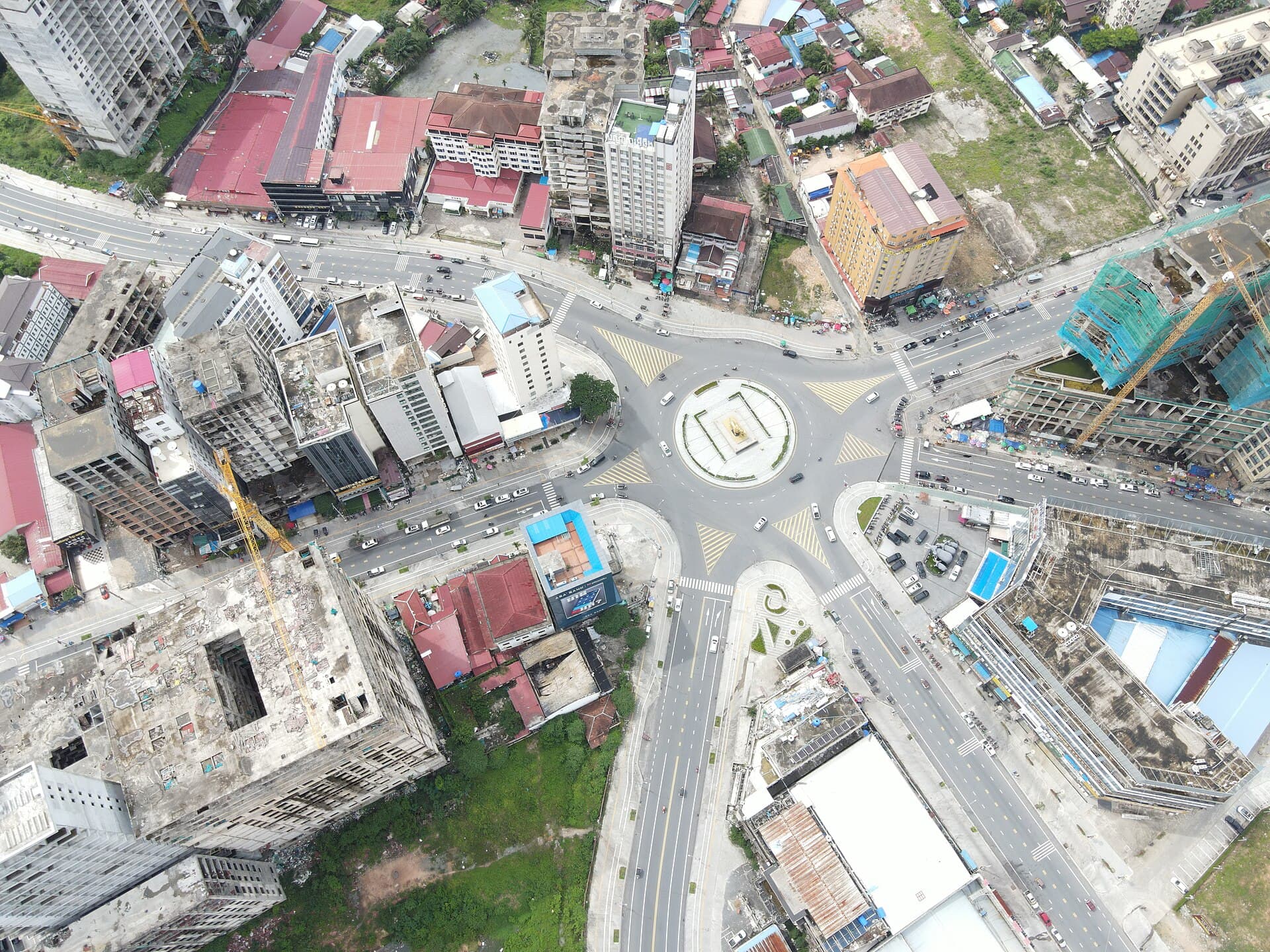
Le début du 21e siècle a vu Sihanoukville devenir un centre de commerce et de tourisme côtier. Une transformation significative a commencé vers 2013 avec un afflux d'investissements chinois, en particulier dans l'industrie du jeu. Début 2019, la ville comptait près de 100 casinos, et 90 % des entreprises étaient détenues et gérées par des Chinois. Ce boom a entraîné une construction rapide et une augmentation spectaculaire des prix des terrains et du coût de la vie.
En août 2019, le gouvernement cambodgien a interdit les jeux de hasard en ligne et les salles de jeux, entraînant un exode des investisseurs et des travailleurs chinois. Cela a eu pour conséquence de nombreux bâtiments inachevés, souvent appelés « bâtiments fantômes », et un ralentissement économique important pour la ville. Aujourd'hui, Sihanoukville s'efforce d'équilibrer son rôle de plaque tournante économique vitale et de destination touristique, avec des efforts pour améliorer les infrastructures et résoudre les problèmes environnementaux.
Sihanoukville offre un mélange d'attractions côtières et d'évasions naturelles. L'attrait principal reste ses plages et les îles voisines. Otres Beach est souvent recommandée pour son atmosphère plus détendue, Otres 2 étant particulièrement appréciée pour sa propreté et sa tranquillité. Ochheuteal Beach est une autre option populaire, connue pour ses restaurants et ses couchers de soleil. Pour une expérience plus calme, Independence Beach offre un cadre paisible.
Le véritable attrait de l'expérience de Sihanoukville se trouve souvent au large. Des bateaux rapides peuvent vous emmener vers des îles comme Koh Rong et Koh Rong Samloem en moins d'une heure. Koh Rong est connue pour ses longues plages, son ambiance animée pour les routards et ses opportunités de visites en bateau pour observer les lucioles. Koh Rong Samloem offre un rythme plus détendu, idéal pour des journées de plage tranquilles. Ces îles offrent des eaux claires, des récifs coralliens et d'excellentes conditions pour la plongée avec tuba et la plongée sous-marine.
Au-delà des plages, explorez le parc national de Ream, situé juste à l'est de Sihanoukville. Ce parc est une zone biodiversifiée avec des forêts de mangroves, des rivières, des plages et une faune variée, notamment des singes et diverses espèces d'oiseaux. Des excursions en bateau à travers les mangroves offrent une perspective différente de la beauté naturelle de la région. Une autre attraction naturelle est la cascade de Kbal Chhay, une cascade à plusieurs niveaux située à environ 16 kilomètres au nord de la ville, qu'il est préférable de visiter pendant la saison des pluies lorsque le débit d'eau est le plus fort. Pour un aperçu de la vie locale, le marché Phsar Leu dans le centre-ville est un endroit animé pour explorer et déguster des plats locaux.
La meilleure période pour visiter Sihanoukville est pendant la saison sèche, qui s'étend de novembre à avril. Pendant ces mois, les températures sont plus douces, oscillant généralement autour de 30 °C (86 °F), avec un ensoleillement constant et un ciel bleu clair. Cette période est idéale pour profiter des plages, nager et faire des excursions en bateau vers les îles, car la mer est plus calme. Cependant, préparez-vous à des foules plus importantes pendant cette haute saison touristique.
La saison des pluies, de mai à octobre, apporte des précipitations plus fréquentes, généralement sous forme de brèves et fortes averses l'après-midi. Bien que la pluie puisse affecter les projets extérieurs, en particulier les excursions sur les îles, elle signifie également moins de touristes et potentiellement des prix d'hébergement plus bas. La campagne est luxuriante et verte à cette période, et les cascades comme Kbal Chhay sont les plus impressionnantes.
Sihanoukville est bien connectée aux autres grandes villes cambodgiennes. Vous pouvez rejoindre Sihanoukville depuis Phnom Penh en 3 heures de route sur la nouvelle autoroute, ou en bus ou en minibus. Des vols sont également disponibles vers l'aéroport international de Sihanoukville depuis Siem Reap, Phnom Penh et d'autres villes d'Asie du Sud-Est. Une fois à Sihanoukville, les tuk-tuks sont facilement disponibles pour se déplacer, mais il est conseillé de convenir d'un prix avant de commencer votre trajet.
Bien que Sihanoukville ait connu un développement important, il est sage de gérer les attentes concernant l'apparence de la ville, car certaines zones présentent encore des signes de construction en cours. L'argent liquide est roi, et bien que des distributeurs automatiques soient disponibles, il est bon d'avoir des fonds de secours car ils peuvent parfois être capricieux. Le vol à la tire, en particulier sur les plages, est une préoccupation signalée, alors gardez toujours vos objets de valeur en sécurité et évitez de marcher seul sur les plages après la tombée de la nuit.
Pour l'hébergement, bien que les grands complexes hôteliers et les casinos soient nombreux, les petits hôtels de charme, en particulier sur Otres Beach, offrent des séjours plus paisibles. Pour les repas, Sihanoukville est réputée pour ses fruits de mer frais, avec de nombreux restaurants le long de la côte et sur les îles.
Sihanoukville en coréen, en chinois ou en hébreu — et dans 29 autres langues, chaque étape narrée par une voix native. La plus large gamme de langues de tous les audioguides autoguidés.
Disponible en :