St. Ursus Cathedral
The city's affinity for the number 11 extends even to its grandest structure, the St. Ursus Cathedral.
Full story unlocks in the tour
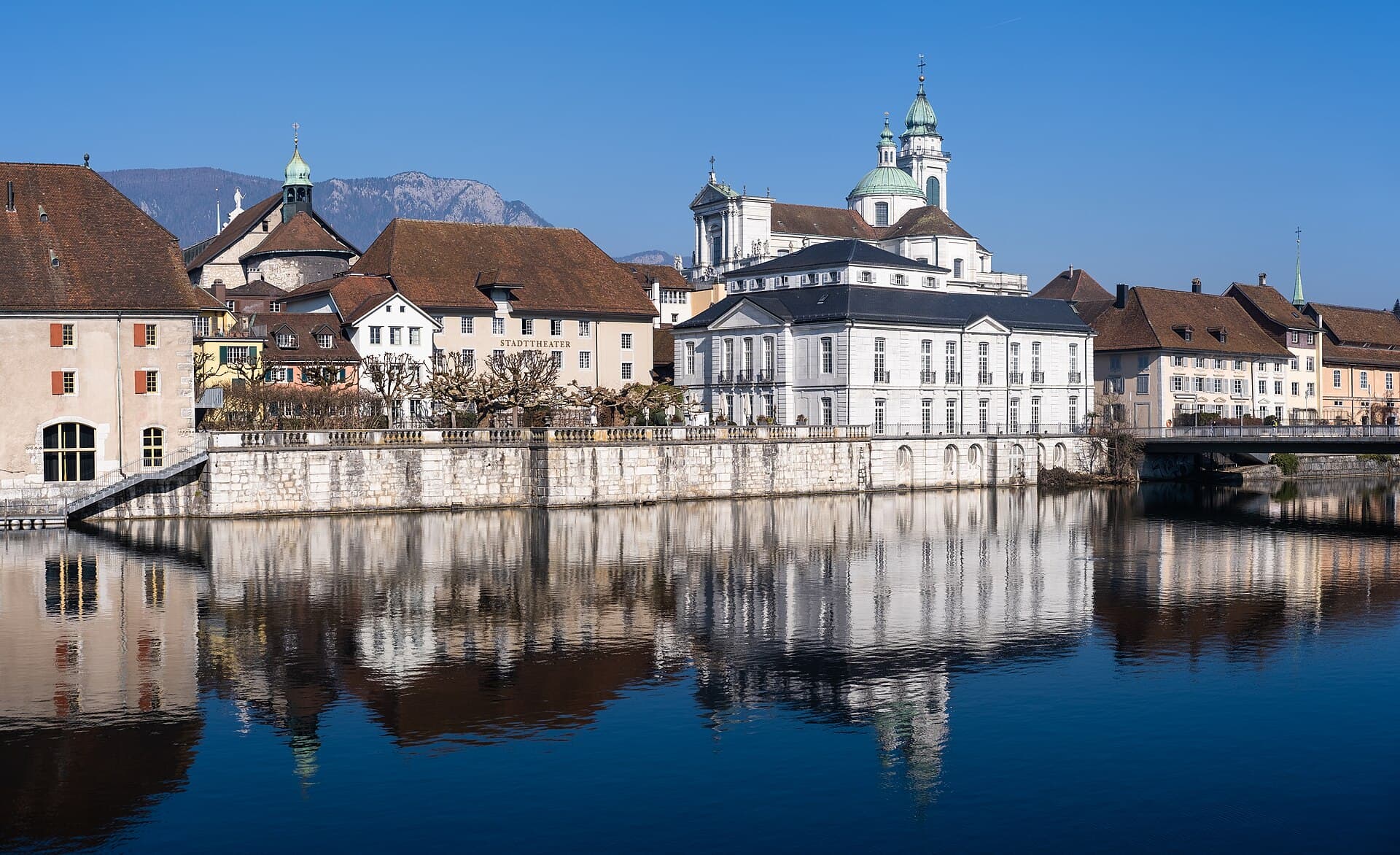 Christian David / CC BY-SA 4.0, via Wikimedia Commons
“Soleure: Where Baroque Grandeur Meets the Magic of Eleven.”
Not the postcards. The stories even locals don't know — whispered in your ear, right where they happened.
The city's affinity for the number 11 extends even to its grandest structure, the St. Ursus Cathedral.
Centuries ago, patients in Soleure's hospital were prescribed an unusual daily remedy.
Soleure has a clock that doesn't quite tell time like the others.
Discover every secret of Soleure
Every address, every reveal in full — in your ear, right where it happened.
You pick your stops. You walk. The voice reveals what the others miss.
No tours available yet. Check back soon — we're preparing them.
Soleure, known locally as Solothurn, is often celebrated as Switzerland's most beautiful Baroque city, a harmonious blend of Italian grandeur, French elegance, and Swiss precision. Situated on the Aare River at the southern foot of the Jura Mountains, its car-free Old Town invites exploration, with sun-drenched streets winding past historical buildings and lively squares. The city's relatively small population of around 17,000 people belies its lively atmosphere and cultural offerings, including significant film and literature festivals.
A fascinating and pervasive element of Soleure is its deep connection to the number 11, which locals consider almost magical. This numerical motif appears throughout the city's architecture and history, from its 11 churches, chapels, fountains, and towers, to the 11 years it took to construct the St. Ursus Cathedral. This unique characteristic adds a layer of intrigue to any visit, making a stroll through its ancient streets feel like a quest to uncover its many elevens. The city's charm extends beyond its historical core, offering scenic river walks along the Aare and expansive views from Mount Weissenstein, its local mountain.
The origins of Soleure trace back to the Roman era, when a settlement called Salodurum was established around AD 15-25. This early Roman presence was likely a station along a vital road connecting other significant Roman sites. A small community quickly developed around a fortified military camp, or castrum, with its existence first documented in 219 AD on the Eponastein. By the mid-5th century, Soleure was noted for the martyrdom of St. Ursus and St. Victor, who would later become the city's patron saints.
During the Early Middle Ages, Soleure was part of the Kingdom of Lotharingia and later the Second Kingdom of Burgundy. In 1033, it became part of the Holy Roman Empire, gradually gaining independence. The city was acquired by the dukes of Zähringen in 1127, and after their line died out in 1218, Soleure became a free imperial city directly under the Holy Roman Emperor. This period saw the construction of many medieval towers and fortifications, some of which still stand today.
Soleure joined the Swiss Confederation in 1481 as the eleventh canton, a fact that contributes to the city's enduring fascination with the number 11. From 1530 to 1792, Soleure served as the seat of the French ambassadors to Switzerland, an era that profoundly influenced its architectural landscape. This period saw the construction of magnificent Baroque palaces, churches, and patrician residences, giving the city its distinctive Baroque character. The St. Ursus Cathedral, a masterpiece of Baroque and Neoclassical design built between 1762 and 1773, stands as a testament to this influential period.
In the 19th century, after a brief period as part of the Helvetic Republic, Soleure became a liberal-democratic canton. Today, the city is recognized for its well-preserved architectural heritage, earning it the Wakker Prize in 1980.
Begin your exploration in Soleure's car-free Old Town, where Baroque and Renaissance buildings line sun-drenched streets. The St. Ursus Cathedral is a landmark, an 18th-century Baroque masterpiece with a white stone façade and a luminous interior. Ascend its tower for expansive views of the city and the Aare River. Nearby, the Jesuit Church showcases harmonious Baroque architecture.
Discover the city's unique connection to the number 11 by seeking out the 11 historic fountains, 11 churches and chapels, and 11 towers scattered throughout. Do not miss the Zytglogge (Clock Tower), the oldest building in the city, with its astronomical clock that sets figures in motion. Another intriguing clock, on Amthausplatz, famously displays only 11 hours.
Beyond the Old Town, take a cable car up Mount Weissenstein, Soleure's local mountain, for panoramic vistas stretching across the Swiss Plateau to the Alps. For a tranquil escape, stroll through the Verena Gorge to the hermitage. The Aare River offers pleasant promenades and opportunities for boat cruises. For those interested in history, the Old Arsenal (Alte Zeughaus) houses one of Europe's largest armor exhibitions.
Soleure is enjoyable year-round, with each season offering distinct experiences. The most pleasant weather for general outdoor activities typically runs from late June to early September, with comfortable temperatures between 19°C and 25°C. July is the warmest month, averaging 25°C during the day. These summer months are ideal for exploring the Old Town and enjoying river activities. Spring (March to May) brings blooming landscapes and fewer crowds, with temperatures gradually rising. Autumn (September to November) offers beautiful fall foliage and is excellent for hiking and cultural festivals. While Soleure has a notably wet climate, with May being the wettest month, rainfall occurs throughout the year.
Soleure is easily accessible thanks to Switzerland's efficient public transport network. While the city doesn't have its own airport, it's conveniently located about 82 km from Zurich Airport (ZRH) and 42 km from EuroAirport Basel-Mulhouse-Freiburg (EAP). Bern Station, approximately 30 km away, is the closest major train hub. The city's Old Town is largely car-free, making it ideal for walking or cycling. Many of Soleure's attractions, including the Museum of Fine Arts and the Natural History Museum, can be visited for free with a Libero Day Pass, which also covers public transport for a day. Remember that water from all public fountains in Switzerland is drinkable.