Sanctuary of Artemis Orthia
Spartan boys underwent a brutal ritual here to prove their endurance, but it wasn't just about physical pain.
Full story unlocks in the tour
 T8612 / CC BY-SA 4.0, via Wikimedia Commons
“Beyond the legend of warriors, a land of olives, Byzantine echoes, and forgotten rituals.”
Not the postcards. The stories even locals don't know — whispered in your ear, right where they happened.
Spartan boys underwent a brutal ritual here to prove their endurance, but it wasn't just about physical pain.
The legendary king Menelaus and Helen of Troy, figures from epic poetry, were honored at a shrine here. Their local cult, however, held a distinct character from their widespread renown.
The olive tree is deeply intertwined with Greek identity, and this museum holds evidence of its presence in Greece dating back tens of thousands of years.
Discover every secret of Sparte
Every address, every reveal in full — in your ear, right where it happened.
You pick your stops. You walk. The voice reveals what the others miss.
No tours available yet. Check back soon — we're preparing them.
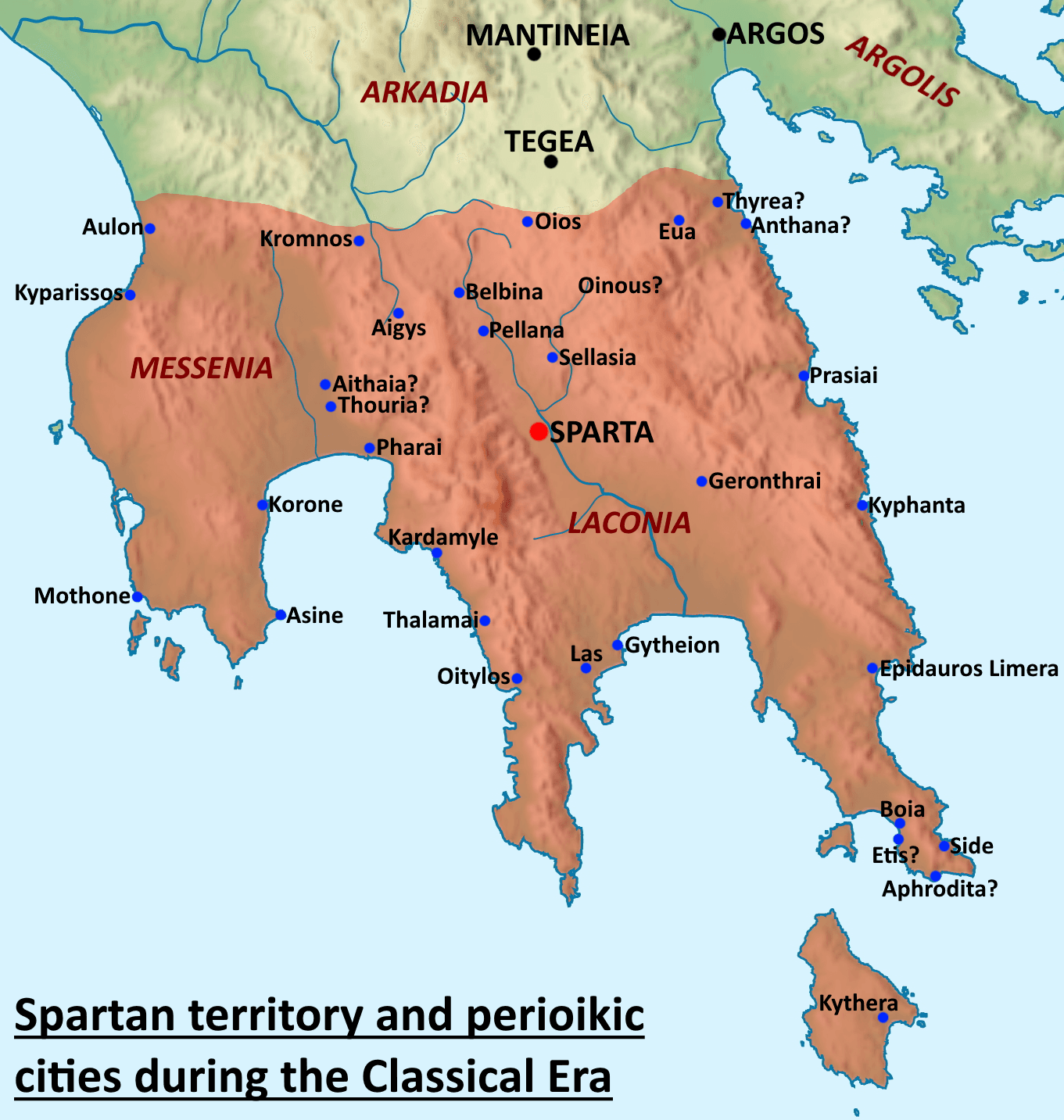
Sparta, in the southeastern Peloponnese, is a city often imagined through the lens of formidable warriors and unwavering discipline. While its ancient past as a dominant military power is undeniable, the contemporary city unfolds a different, more tranquil experience. Situated in the fertile Evrotas River valley, framed by the towering peaks of Mount Taygetos to the west and the Parnonas mountain range to the east, modern Sparta is a regional capital with expansive, tree-lined avenues and neoclassical structures.
Though few grand edifices remain from its ancient zenith, the city serves as a portal to understanding a civilization that prioritized austerity and military prowess. Visitors can explore archaeological sites that hint at its former splendor, alongside museums that delve into its broader timeline and the enduring significance of the olive in Greek culture. Sparta today is an inviting city, blending its storied heritage with a lively local rhythm, offering a singular perspective on Greece beyond its more frequented destinations.
## From Ancient Powerhouse to Roman Resort Ancient Sparta, known as Lacedaemon, ascended to prominence in Laconia around 650 BC, evolving into a significant military force in Greece. Its distinct social framework, attributed to the semi-mythical lawgiver Lycurgus, centered on a militarized society where citizens, known as Spartiates, dedicated themselves entirely to military training and physical development, to the exclusion of economic pursuits.
Sparta played a pivotal role in the Greco-Persian Wars, leading the unified Greek military and earning renown for King Leonidas I's stand at Thermopylae. Following its triumph over Athens in the Peloponnesian War (431–404 BC), Sparta briefly held sway over Greece. However, its authority waned after a defeat by Thebes at the Battle of Leuctra in 371 BC. Despite this, Sparta remained an independent state until the Roman conquest of Greece in 146 BC.
## Medieval Shift to Mystras and Modern Revival Under Roman dominion, Sparta experienced a period of renewed prosperity and became a destination for travelers. However, its decline persisted into the medieval era, particularly after being sacked by the Visigothic king Alaric in 396 AD. A considerable portion of its populace relocated to the nearby fortified town of Mystras, which became the capital of the Byzantine Despotate of the Morea in the 14th and 15th centuries. Mystras flourished as a hub of Byzantine scholarship and artistry, drawing in artists and intellectuals.
The contemporary city of Sparta was established in 1834 by King Otto of Greece on the ancient city's footprint. It was meticulously planned with a grid system, featuring expansive public squares and broad, tree-lined thoroughfares. Today, it serves as the capital of the Laconia regional unit, maintaining its role as the economic, administrative, and cultural heart of the region.
Begin your exploration at the Archaeological Museum of Sparta, one of Greece's oldest archaeology museums, housed in a building constructed in 1874. It exhibits artifacts spanning from the Neolithic to the late Roman period, including findings from the ancient Acropolis and various sanctuaries across Laconia.
Just north of the modern city lies the Acropolis of Ancient Sparta, offering an evocative walk among the remnants of the religious and administrative center. Here, you can observe the ruins of an ancient theater, the Sanctuary of Athena Chalkioikou, and later Byzantine churches. Close by, the Tomb of Leonidas, a rectangular structure crafted from poros stone, is traditionally linked to the legendary Spartan king.
Be sure to visit the Sanctuary of Artemis Orthia, situated east of Sparta near the Evrotas River. This significant religious site was central to the education of Spartan youth, known for its endurance rituals. A brief drive from Sparta leads to the UNESCO World Heritage Site of Mystras, a remarkably preserved Byzantine fortified town. Explore its palaces, churches, residences, and fortifications spread across the hillside, offering a singular window into medieval urban existence.
For a deeper understanding of local heritage, visit the Museum of the Olive and Greek Olive Oil, which illuminates the history and technology of olive oil production from prehistoric times to the early 20th century.
The most pleasant times to visit Sparta are during spring (April-May) and early autumn (September-October). In these months, temperatures are comfortable, ranging from 18-24°C (64-75°F) in spring and 22-28°C (70-82°F) in early autumn, ideal for exploring archaeological sites and hiking. Wildflowers adorn the landscape in spring. Summer (June-August) can be warm, with temperatures often surpassing 30°C (86°F), making morning site visits more agreeable. Winter (December-February) is mild but cooler and wetter, with some local businesses potentially closed.
Sparta is situated in the Peloponnese region of Greece. While it does not possess an airport, it is accessible by bus from Athens, a journey that typically spans a few hours. The modern city is laid out with wide avenues and expansive squares, making it straightforward to navigate on foot. Accommodation options, such as the Menelaion Hotel, are available in the city center, providing convenient access to local attractions, shops, and museums. Plan for a daily budget of approximately 45-75 euros for lodging, meals, and entrance fees, which is generally more modest than more frequented Greek destinations. Many archaeological sites are outdoors, so comfortable walking shoes, sun protection, and water are advisable, particularly during warmer months.