Castillo de San Marcos
The formidable walls of this Spanish fortress conceal a surprising secret about their resilience.
Full story unlocks in the tour
 Schwerdf / CC BY 4.0, via Wikimedia Commons
Self-guided audio walking tour of St. Augustine — GPS route, offline playback, story-driven narration in 32 languages.
“Where ancient coquina walls hold centuries of secrets.”
Not the postcards. The stories even locals don't know — whispered in your ear, right where they happened.
The formidable walls of this Spanish fortress conceal a surprising secret about their resilience.
This charming schoolhouse features a unique, heavy-duty accessory that speaks to Florida's wild weather.
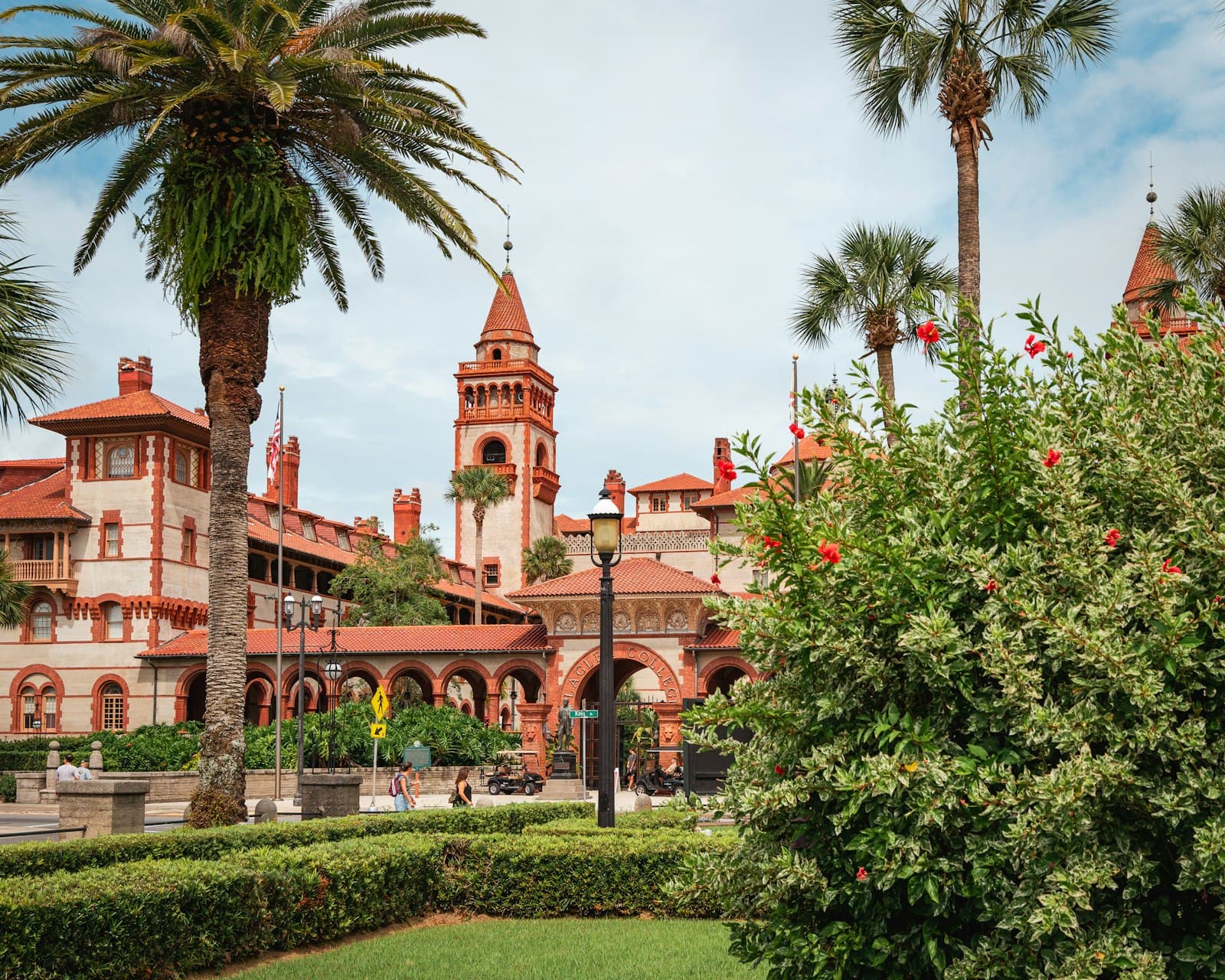
The grand towers of this former luxury hotel, now a college, had a surprising original function beyond mere aesthetics.
Discover every secret of St. Augustine
Every address, every reveal in full — in your ear, right where it happened.
You pick your stops. You walk. The voice reveals what the others miss.


Your self-guided audio tour of St. Augustine is ready — pick your landmarks, choose your language, and start the moment you arrive.
BuyLume has a built-in augmented-reality guide. Hold your phone up and its camera shows the street ahead of you, with a glowing arrow laid over the real view that always points to your next stop — no map to puzzle over, no wrong turns. Like everything in Lume, it works fully offline.
St. Augustine, Florida, stands as the oldest continuously inhabited European-established settlement in the continental United States. Founded in 1565 by Spanish admiral Pedro Menéndez de Avilés, the city predates Jamestown by 42 years and the Pilgrims' arrival at Plymouth Rock by 55 years. Its enduring legacy is woven into the very fabric of its streets, offering a tangible connection to over 450 years of human endeavor.
Exploring St. Augustine is like peeling back layers of time. The city's distinct blend of Spanish colonial architecture, narrow lanes, and historic landmarks creates an atmosphere unlike any other American city. From the imposing walls of its fort to the elegant Gilded Age structures, St. Augustine invites visitors to step back into different eras, revealing stories of conquistadors, pirates, and pioneers.
## Spanish Founding and Colonial Era (1565–1763) St. Augustine's story begins on September 8, 1565, when Spanish admiral Pedro Menéndez de Avilés officially founded the settlement. He named it San Agustín because his ships first sighted land on August 28, the feast day of St. Augustine of Hippo. The Spanish Crown dispatched Menéndez to establish a permanent settlement, protect treasure ships along Florida's coast, and counter French Protestant incursions. The site was strategically chosen to assert Spanish dominion over Florida, a territory claimed earlier by Juan Ponce de León in 1513.
Early years were challenging, marked by attacks, fires, and shortages. English pirates and soldiers repeatedly burned the town during the 1600s. To fortify their position, construction of the Castillo de San Marcos began in 1672, using coquina stone from Anastasia Island. This formidable stone fort, completed in the late 1600s, famously withstood British attacks in 1702 and 1740, never falling to enemy forces. St. Augustine also became a significant refuge for enslaved people escaping English colonies, leading to the establishment of Fort Mose, the first legally recognized free Black community in what is now the United States, in 1738.
## British Interlude and Second Spanish Period (1763–1821) In 1763, the Treaty of Paris transferred Florida to Britain after the French and Indian War, making St. Augustine the capital of British East Florida. This period saw an influx of Loyalists and merchants, and the British expanded roads and encouraged agriculture. However, the second Treaty of Paris in 1783 returned Florida to Spain, as Spain had aided the American colonies during the Revolution. When the Spanish returned in 1784, they found a city transformed, with new settlers like the Minorcans. Spain's renewed control faced challenges from limited resources and growing U.S. territorial ambitions. Florida was peacefully ceded to the United States under the Adams-Onís Treaty in 1821.
## American Era and Gilded Age (1821–Present) As part of the United States, St. Augustine adapted to new political systems while retaining its colonial character. The late 19th century brought American industrialist Henry Flagler, who envisioned St. Augustine as a winter resort for the wealthy. He built opulent hotels like the Hotel Ponce de Leon, now Flagler College, transforming the city's landscape and attracting a new wave of tourism. Today, St. Augustine continues to embrace its layered history, with ongoing archaeological discoveries frequently unearthing evidence of its Spanish, British, and indigenous past beneath the modern city.
Begin your exploration at the Castillo de San Marcos, the oldest masonry fort in the continental United States. Walk its coquina walls and imagine centuries of defense against invaders. Nearby, the St. Augustine Pirate & Treasure Museum houses one of only three authentic Jolly Roger flags in the world. Stroll along St. George Street, a pedestrian thoroughfare lined with shops, restaurants, and museums, offering a lively glimpse into the city's past.
Visit the Oldest Wooden Schoolhouse, a charming structure dating back to at least 1716, complete with animatronic students and a teacher, and an old bell in the courtyard. Explore the grandeur of Flagler College, originally the luxurious Hotel Ponce de Leon, with its Spanish Renaissance architecture, intricate stained glass, and hand-painted murals. Discover the Fountain of Youth Archaeological Park, believed to be where Ponce de León landed in 1513, offering interactive exhibits and a chance to drink from the legendary spring.
For a different perspective, climb the 219 steps of the St. Augustine Lighthouse & Maritime Museum for expansive views of the city and coastline. Just south of downtown, the Fort Matanzas National Monument provides insights into colonial defensive strategies, accessible via a scenic boat ride. Beyond the historic core, St. Augustine offers miles of Atlantic beaches, including St. Augustine Beach and Anastasia State Park, perfect for relaxation and outdoor activities.
The best times to visit St. Augustine are during the spring (March to May) and fall (September to November). Temperatures during these seasons are pleasant, ranging from 65°F to 80°F, with clear skies and less humidity, ideal for exploring historical sites and enjoying outdoor activities. Fall also offers relief from summer humidity and fewer crowds before the peak winter season. While summer can be hot and humid, it's popular for beachgoers. Winter is mild, with temperatures in the 60s and 70s, but also marks peak tourist season due to events like the Nights of Lights.
St. Augustine's historic center is quite walkable, making it ideal to explore on foot. Consider parking your car and utilizing the Old Town Trolley, which offers hop-on, hop-off service to many attractions and helps navigate the narrow streets. Accommodations range from historic inns to modern hotels, many within walking distance of key sites. Dining options are diverse, reflecting the city's coastal location and cultural influences, with fresh seafood and Southern comfort dishes. Public beach access points are plentiful along the Atlantic coastline, stretching from Vilano Beach to Crescent Beach. St. Augustine is located on the northeast coast of Florida, about 40 miles south of Jacksonville.
St. Augustine in Korean, in Chinese or in Hebrew — and 29 more languages, every stop narrated by a native voice. The widest language range of any self-guided audio tour.
Available in: