Pokrovsky Convent
This serene convent holds a secret history of forced vows and powerful women.
Full story unlocks in the tour
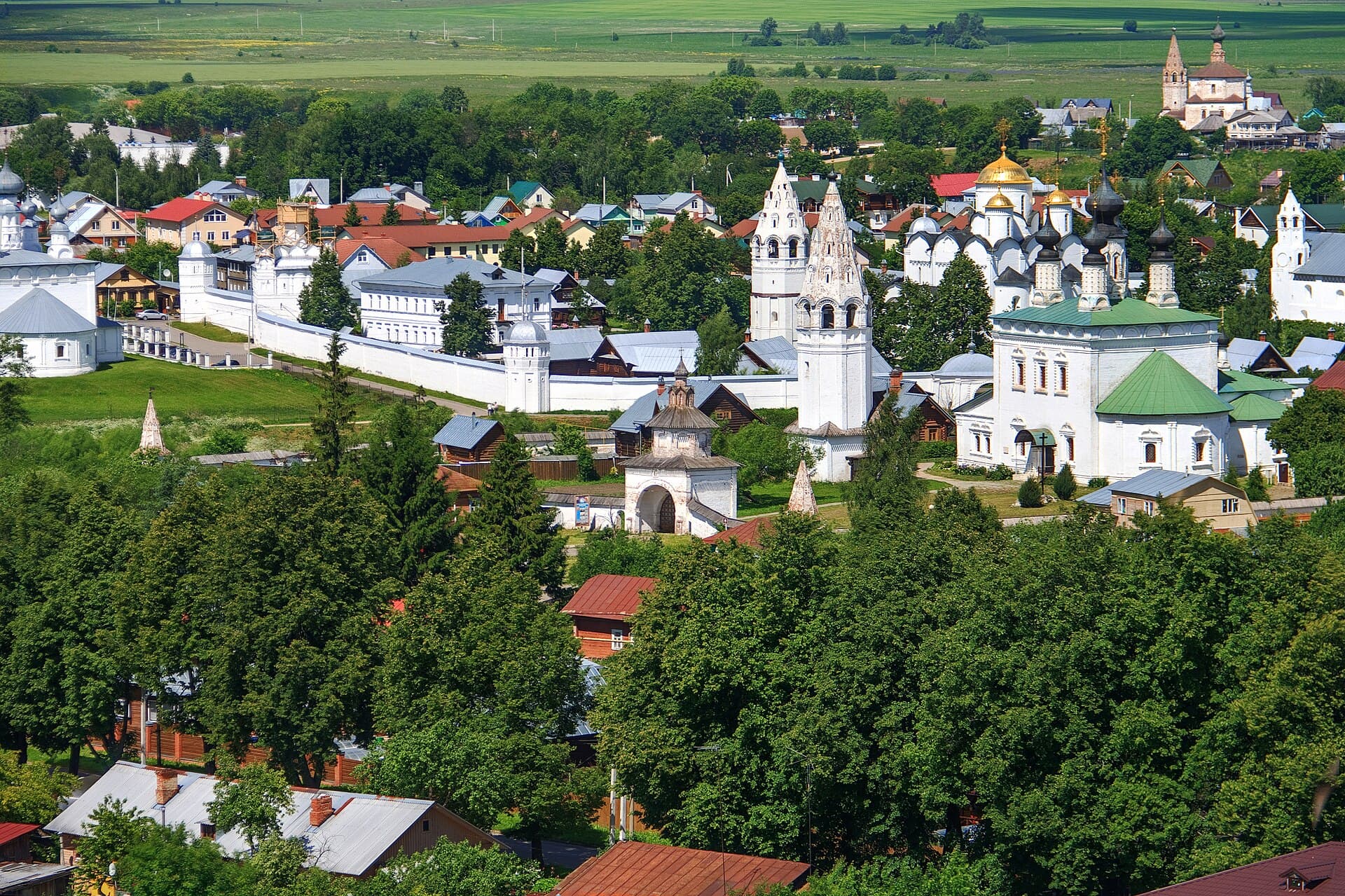 Ludvig14 / CC BY-SA 4.0, via Wikimedia Commons
Self-guided audio walking tour of Suzdal — GPS route, offline playback, story-driven narration in 32 languages.
“Where ancient domes meet quiet meadows, and time slows to a whisper.”
Not the postcards. The stories even locals don't know — whispered in your ear, right where they happened.
This serene convent holds a secret history of forced vows and powerful women.
The absence of a train station in Suzdal isn't an oversight, but a twist of fate that shaped its very soul.
Some of Suzdal's most cherished wooden buildings didn't originate here.
Discover every secret of Suzdal
Every address, every reveal in full — in your ear, right where it happened.
You pick your stops. You walk. The voice reveals what the others miss.


Your self-guided audio tour of Suzdal is ready — pick your landmarks, choose your language, and start the moment you arrive.
BuyLume has a built-in augmented-reality guide. Hold your phone up and its camera shows the street ahead of you, with a glowing arrow laid over the real view that always points to your next stop — no map to puzzle over, no wrong turns. Like everything in Lume, it works fully offline.
Suzdal, a town of fewer than 10,000 people, stands as a living chronicle of Old Russia, a place where the past is not merely preserved but woven into the fabric of daily life. Located 220 kilometers (125 miles) northeast of Moscow, it is a significant stop on Russia's Golden Ring, a route of historic towns recognized for their distinctive architecture.
Often described as an open-air museum, Suzdal's landscape is dotted with onion-domed churches and traditional wooden houses; strict building regulations prevent modern high-rises. The Kamenka River winds gently through the town, and the quiet streets still see horse-drawn carts, creating an atmosphere that feels untouched by the rush of contemporary life. It’s a destination that offers a reflective, slower pace of travel, inviting visitors to experience a romanticized yet tangible reminder of Russia's spiritual and artistic roots.
Suzdal's history stretches back to at least the 11th century, with its first mention in chronicles in 1024. Some historians suggest it may have been founded even earlier, around 982. The town was initially part of Kievan Rus and, in the early 12th century, became the capital of the Rostov-Suzdal principality under Prince Yury Dolgoruky. Dolgoruky, who founded Moscow in 1147, played a significant role in consolidating the town's importance.
Suzdal's political influence waned in the 12th century when Prince Andrey Bogolyubsky moved the capital to Vladimir, forming the Vladimir-Suzdal principality. Despite this, Suzdal continued to prosper as a trading center due to its fertile land. The town faced the devastation of the Mongol-Tatar invasion in 1238, when it was conquered and sacked. Following the invasion, it briefly became the capital of the Principality of Suzdal. By the 13th and 14th centuries, Suzdal was renowned for its monasteries and churches, establishing itself as an important religious center.
In the 16th century, Suzdal experienced a period of significant religious development, with new stone construction for its numerous monasteries and convents, often funded by figures like Vasily III and Ivan the Terrible. At one point, the town, with a population of barely a thousand, had around 40 churches. The 17th and 18th centuries saw wealthy merchants contribute to the construction of many more splendid churches that still stand today. Suzdal's monasteries also served a darker purpose, functioning as prisons for political and religious dissidents, and even for exiled Russian princesses, beginning in the 16th century.
A pivotal moment in Suzdal's preservation occurred in the 19th century when it was bypassed by the Trans-Siberian Railway. This lack of industrialization meant Suzdal retained its provincial charm and traditional way of life, unlike many other Russian towns. In 1967, a plan was adopted to develop Suzdal as an open-air museum, further cementing its status as a preserved historical site. Today, its white-stone monuments, including the Kremlin and Nativity Cathedral, are recognized as a UNESCO World Heritage site.
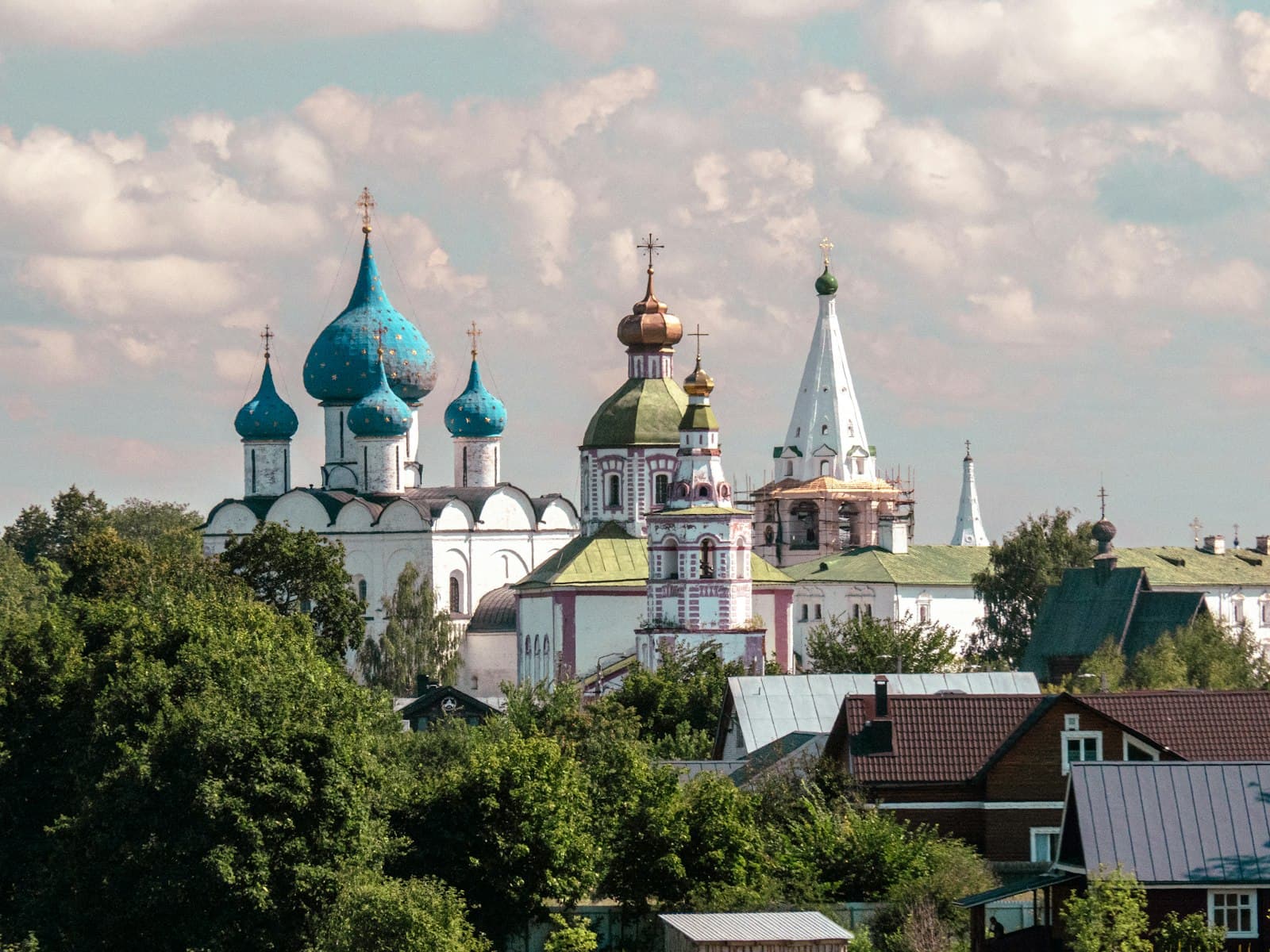
Suzdal offers a concentrated experience of ancient Russian architecture and village life. The Suzdal Kremlin, dating back to the 10th century, stands as the town's historic heart. Within its grounds, you'll find the Cathedral of the Nativity of the Virgin, with its distinctive blue onion domes adorned with golden stars and 13th-century frescoes. The Archbishop's Chambers, an architectural ensemble built over centuries, is also part of the Kremlin complex.
The Spaso-Yevfimiev Monastery (Monastery of Our Savior and St. Euthymius) is a formidable fortress-like complex with 12 towers, founded in 1352. Its main Transfiguration Cathedral features impressive 17th-century frescoes. Do not miss the daily bell concert from the monastery's bell tower. The Pokrovsky Convent (Intercession Convent) is another significant monastic complex, known for its white-stone architecture and its historical role as a place of exile for noblewomen.
For a glimpse into traditional rural life, visit the Museum of Wooden Architecture and Peasant Life. This open-air museum features relocated 18th and 19th-century wooden churches, houses, windmills, and farm buildings, offering insight into the daily lives of peasants. Beyond these major sites, Suzdal's charm lies in its quiet streets lined with brightly painted wooden houses, and the sheer abundance of churches, with over 35 scattered across its small area.
The best time to visit Suzdal for warm-weather activities is from late May to early September, when temperatures are generally pleasant, averaging 15°C to 25°C. This period is ideal for strolling through historic streets, visiting the open-air museum, and taking boat trips on the Kamenka River. Summer also brings festivals like Cucumber Day in July.
Winter, from December to February, offers a charming, snowy landscape, with temperatures dropping below freezing. This season is perfect for sleigh rides and experiencing Christmas markets, though some attractions may have reduced hours.
Suzdal has no railway station, so the most common way to arrive is via Vladimir, located 38 kilometers (24 miles) away. High-speed trains from Moscow's Kursky Railway Station reach Vladimir in about 1 hour 40 minutes. From Vladimir, frequent buses or minibuses connect to Suzdal, taking 30-40 minutes. Direct buses from Moscow's Shchyolkovsky Bus Station to Suzdal are also available, taking approximately 4.5 hours.
Within Suzdal, public transportation is minimal, but the town is small and walkable, with most sights located close to each other, especially along Ulitsa Lenina. Taxis are available, and car rentals offer flexibility for exploring at your own pace. Consider downloading offline maps as mobile internet can be unreliable outside major cities.
Suzdal in Korean, in Chinese or in Hebrew — and 29 more languages, every stop narrated by a native voice. The widest language range of any self-guided audio tour.
Available in: