Storgaten 55
A building on Tønsberg's main thoroughfare once housed a peculiar photographer, whose stories hinted at concealed riches.
Full story unlocks in the tour
 Michal Hope / CC BY-SA 3.0, via Wikimedia Commons
“Where ancient sagas meet the sea's embrace on the Oslofjord.”
Not the postcards. The stories even locals don't know — whispered in your ear, right where they happened.
A building on Tønsberg's main thoroughfare once housed a peculiar photographer, whose stories hinted at concealed riches.
Tønsberg holds an unexpected connection to the Marvel Cinematic Universe, making appearances in several major films.
The prominent Slottsfjell Tower carries a poetic inscription, reflecting Tønsberg's enduring spirit.
Discover every secret of Tønsberg
Every address, every reveal in full — in your ear, right where it happened.
You pick your stops. You walk. The voice reveals what the others miss.
No tours available yet. Check back soon — we're preparing them.
Tønsberg, widely recognized as Norway's oldest city, presents a compelling fusion of Viking heritage, medieval history, and contemporary coastal living. Positioned on the sun-drenched side of the Oslofjord, roughly an hour's train journey south of the capital, it has served as a significant nexus for over a millennium.
From its beginnings as a Viking Age settlement, Tønsberg developed into an important trading center and a royal seat during the Middle Ages. The city's strategic placement on the western coast of the Oslofjord, near its mouth onto the Skagerrak, has consistently shaped its narrative, facilitating maritime trade and fostering a lively waterfront culture that thrives to this day.
Visitors to Tønsberg can wander among ancient ruins, immerse themselves in Viking lore, and savor the spirited atmosphere of its harbor. The city functions as the administrative center for Vestfold county and acts as a gateway to the beautiful Færder archipelago, celebrated for its beaches and skerries.
## From Viking Settlement to Medieval Powerhouse Tønsberg's history extends back to the Viking Age, with archaeological discoveries suggesting a farm settlement existed by the close of the 8th century, likely evolving into a town in the early 9th century. Snorri Sturluson, in his sagas, recounts Tønsberg's existence before the Battle of Hafrsfjord, traditionally dated to 872 AD, solidifying its claim as Norway's oldest city. Harald Fairhair established it in the 9th century, and it served as an ancient capital of Norway.
## The Rise of Tunsberghus Fortress During the 12th-century civil war era, Slottsfjellet (Castle Mountain), a naturally fortified hill north of the city center, became a strategic stronghold. King Haakon Haakonsson considerably expanded the Tunsberghus fortress in the 13th century, transforming it into Norway's largest castle and a symbol of royal authority. This period saw the city become a de facto regional capital, stimulating large-scale stone construction and urban development around the castle. The fortress withstood a Danish assault in 1253, but was ultimately consumed by fire in 1503 and never reconstructed.
## A Maritime and Whaling Legacy After its medieval prominence, Tønsberg was largely destroyed by fire in 1536. However, it re-emerged in the 18th and 19th centuries as a major port and a significant center for shipping and whaling. Tønsberg was even called "the cradle of modern whaling," with local pioneer Svend Foyn revolutionizing the industry in the 1860s by inventing and fitting the explosive harpoon to steam-powered whale catchers. While Tønsberg's leadership in whaling eventually moved to neighboring Sandefjord by the early 20th century, its maritime heritage remains a defining characteristic.
## Modern Tønsberg Today, Tønsberg continues as an industrial and shipping center, recognized for its diverse industries and particularly for its silverware. The city has grown considerably, merging with rural Sem Municipality in 1988 and Re Municipality in 2020, extending its reach south onto the island of Nøtterøy.
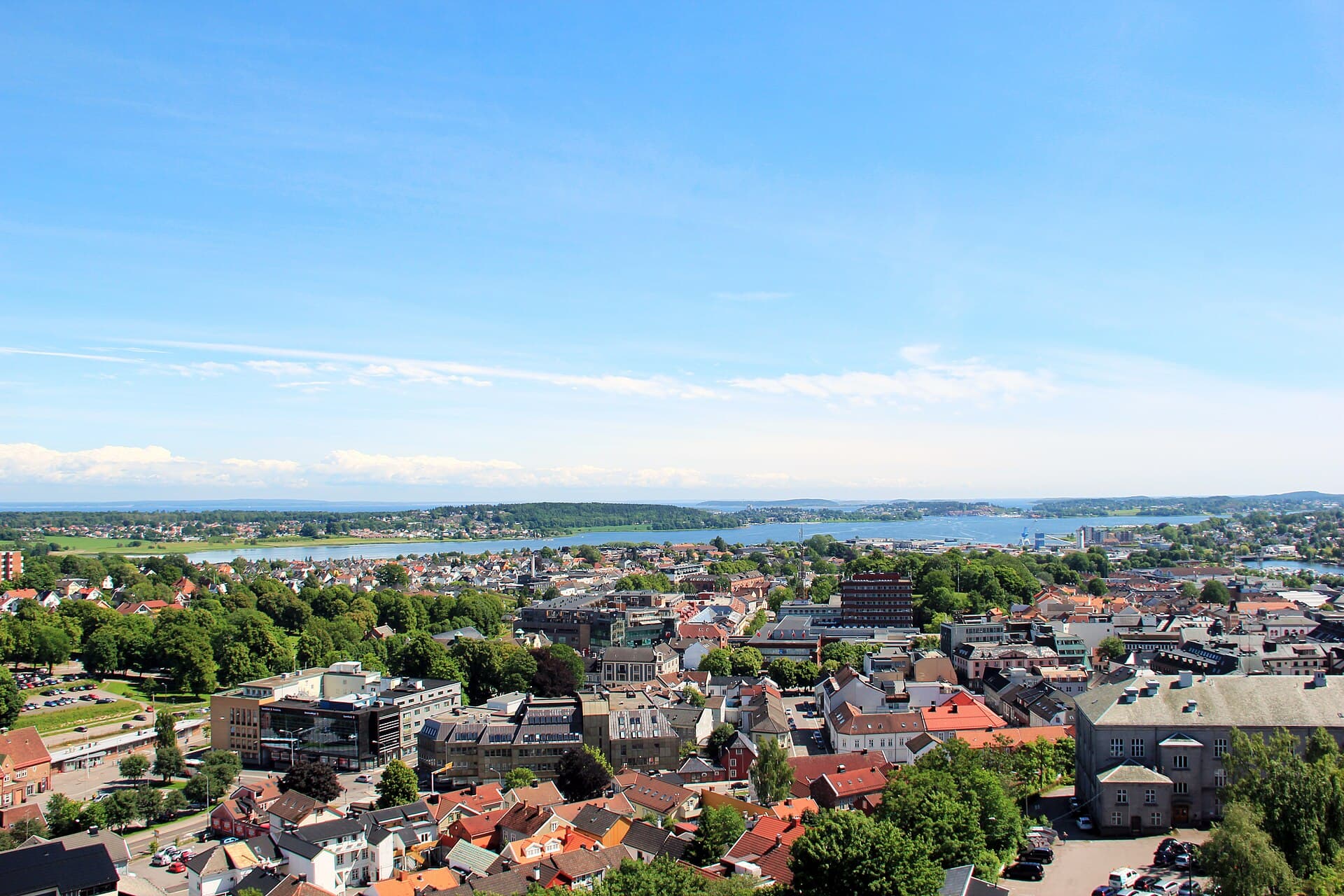
Begin your exploration at Slottsfjellet, or Castle Mountain, where the remnants of Tunsberghus Fortress, once Scandinavia's largest medieval stronghold, offer expansive views of the city and fjord. Ascend the Slottsfjell Tower, constructed in 1888, for even broader vistas.
At the harbor, Vikingodden allows you to journey back in time with a full-size reconstruction of the legendary Oseberg Viking Ship. You can even try your hand at rowing a replica longship. Nearby, the Slottsfjell Museum (also known as Tønsberg Museum) delves into the city's Viking and medieval past, displaying impressive whale skeletons.
Stroll along Tønsberg Brygge, the animated waterfront promenade, lined with converted 19th-century warehouses now housing restaurants, cafés, and bars. For those who appreciate art, the Haugar Vestfold Art Museum exhibits contemporary works. Do not overlook Tønsberg Cathedral, a brick Lutheran church built in the mid-1800s over an older church, notable for its Gothic design.
Consider a boat excursion to the beautiful islands of the Færder archipelago, including Nøtterøy, Tjøme, and Hvasser, where you can discover scenic locations like "The World's End" (Verdens Ende) with its distinctive lighthouse.
The ideal time to visit Tønsberg for warm-weather pursuits is from mid-July to mid-August, when average daily temperatures hover around 16-17°C, often reaching 20°C. The summer months, from June to August, offer extended daylight hours and a lively atmosphere, perfect for coastal exploration and outdoor activities. Spring (April to June) and fall (September to October) are also excellent, with mild weather, blooming nature, and fewer visitors. While winters are mild for the latitude, with average temperatures slightly below freezing, they present a different charm for those seeking a colder, crisp experience.
Tønsberg is readily accessible, situated approximately 102 kilometers (63 miles) south-southwest of Oslo. The most straightforward way to reach the city is by train from Oslo Central Station, with direct trains departing hourly and a journey time of about 1 hour and 30 minutes. Driving from Oslo takes around 1 hour and 20 minutes via the E18 highway.
Once in Tønsberg, the city is compact and very walkable, with most major sights like the waterfront, Slottsfjellet, and the old town within easy reach on foot. For exploring areas slightly beyond the center or nearby coastal spots, renting a bike is a good option, especially during the summer. A local bus network connects the town with surrounding areas, and taxis are available. Paid parking zones and garages are available in the city center for those driving.
Local currency is the Norwegian Krone (NOK). Norwegian and English are widely spoken.