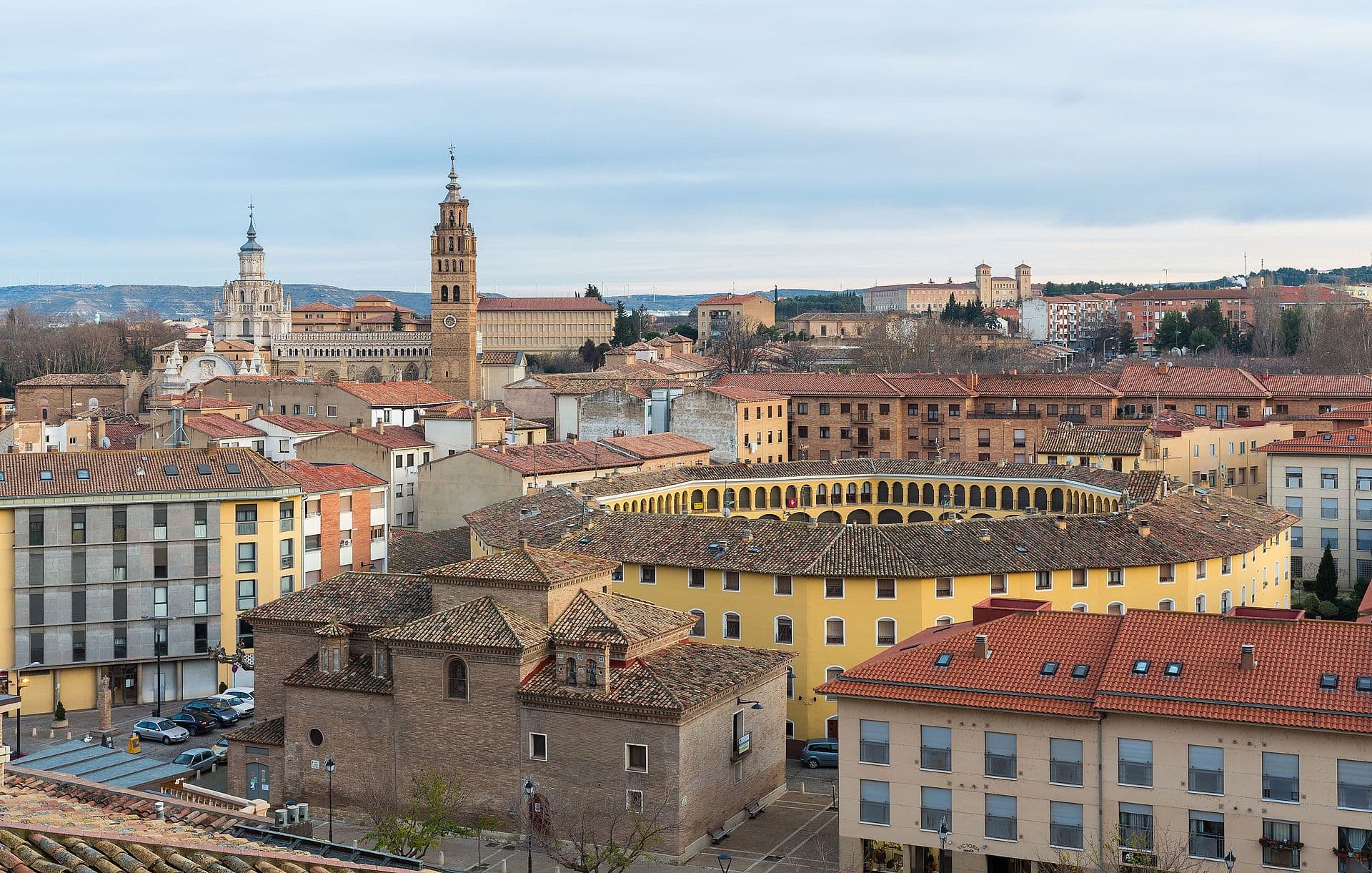
Tarazona, SpainDiego Delso / CC BY-SA 4.0, via Wikimedia Commons
ES

Tarazona

Where Aragonese Mudejar meets Renaissance grandeur, and ancient streets tell their stories.

The secrets of Tarazona

Tarazona, as no one tells it.

Not the postcards. The stories even locals don't know — whispered in your ear, right where they happened.

3 secrets below. Many more wait inside the tour.
Tarazona Cathedral

The Cathedral of Santa María de la Huerta is often called the 'Sistine Chapel of the Spanish Renaissance,' yet its dome safeguards a secret, a fusion of humanist philosophy and an unexpected artistic method.

Full story unlocks in the tour
Old Bullring (Plaza de Toros Vieja)

Tarazona holds an impressive octagonal bullring, but its true distinction lies not just in its shape, but in the lives that unfold within its walls today.

Full story unlocks in the tour
Trasmoz, a nearby village

A short journey from Tarazona leads to a village officially declared cursed by the Catholic Church for centuries, a decree only a Pope can revoke.

Full story unlocks in the tour
The full tour

Discover every secret of Tarazona

Every address, every reveal in full — in your ear, right where it happened.

Get the key to Tarazona

You pick your stops. You walk. The voice reveals what the others miss.

Choose your time

How long do you have in Tarazona?

No tours available yet. Check back soon — we're preparing them.

About Tarazona

The story of Tarazona

Tarazona, a city in the province of Zaragoza, Aragón, invites a compelling journey through time, where layers of Roman, Muslim, Jewish, and Christian cultures have sculpted its distinct character. Set at the base of the Moncayo mountain and bisected by the Queiles River, the city's urban landscape offers an engaging blend of architectural styles and narrow, winding pathways.

Referred to as the 'Sistine Chapel of the Spanish Renaissance' for its magnificent cathedral, Tarazona is a place where history is not merely preserved but actively lived. From its ancient Roman origins as Turiaso to its significant role as a crossroads connecting Aragón, Navarre, Castile, and La Rioja, Tarazona extends a profound legacy for the curious traveler.

History

From Roman Turiaso to a Confluence of Cultures

Tarazona's origins stretch back to Celtiberian times, evolving into an important city that even minted its own currency. Under Roman governance, it thrived as Turiaso, its residents granted full Roman citizenship around 30 BC. The city's strategic placement on the Queiles River, a tributary of the Ebro, proved vital to its early growth.

Following the Roman Empire's decline, Tarazona came under Visigothic rule, then identified as Tirasona. The 8th century marked the onset of Islamic dominion, a period that continued until 1119 when Alfonso I of Aragón, 'the Battler,' reclaimed the city. During centuries of Muslim rule, Tarazona was a space of coexistence, with Christians, Jews, and Muslims living side-by-side, leaving an enduring imprint on its architecture and culture.

The city's Jewish community held particular significance within the Kingdom of Aragón, experiencing periods of prosperity and expansion. Tarazona contained two Jewish quarters, an old and a new, each with its own synagogue. The old quarter, now known as La Rúa, is marked by narrow, intimate alleys and houses that extend over the medieval wall. The expulsion of the Jews from Spain in 1492 led many of Tarazona's Jewish residents to seek refuge in nearby Navarre.

The War of the Two Peters in the 14th century saw Tarazona occupied by Castilian troops for nine years, during which the cathedral sustained damage. Despite this, the city continued to evolve, with the cathedral undergoing substantial Mudejar and Renaissance reconstruction in the 15th and 16th centuries. This merging of styles stands as a testament to the region's singular cultural synthesis, with Aragonese Mudejar architecture recognized as a UNESCO World Heritage Site.

What to see

Begin your exploration at the Tarazona Cathedral (Catedral de Nuestra Señora de la Huerta), a remarkable illustration of Gothic, Mudejar, and Renaissance architecture. Its Mudejar tower, dome, and cloister are especially notable, with the dome's unique grisaille paintings earning it the designation 'Sistine Chapel of the Spanish Renaissance.' The cathedral is generally accessible Tuesday through Sunday.

Cross the Queiles River to Plaza de España to admire the 16th-century Town Hall (Ayuntamiento), originally a market and public granary. Its façade features reliefs depicting Emperor Charles V's triumphant procession and murals of Hercules' heroic deeds. Nearby, the Episcopal Palace, constructed upon an ancient Muslim fortress (Zuda), served as a temporary residence for Aragonese kings and now houses the Cathedral Museum, displaying art from the 13th to 20th centuries.

Wander through the Old Jewish Quarter (Judería Vieja), also known as La Rúa, a maze of narrow, stone-paved pathways and intimate passages. Observe the distinctive 'hanging houses' whose rear facades extend over the medieval wall. The Church of Santa María Magdalena, the oldest preserved temple in Tarazona, displays a prominent Mudejar tower that commands the skyline and offers sweeping views from its mirador.

Be sure to visit the singular Old Bullring (Plaza de Toros Vieja), an octagonal edifice from 1792 where people still reside in the surrounding homes. For a deeper understanding of the city's cultural initiatives, explore the Translator's House, a unique center in Spain that welcomes literary translators from around the world.

When to visit

The most agreeable times to visit Tarazona are April, May, June, September, and October, when temperatures remain comfortable, ranging from 18°C to 27°C (64°F to 81°F). These months offer a favorable balance of sunny and rainy days, with moderate precipitation. July can be quite warm, with average highs around 31°C (88°F), while January is the coldest, with average highs around 11°C (52°F). For those interested in local celebrations, the festival of San Atilano on August 27th features the distinct tradition of the 'Cipotegato,' a character pelted with tomatoes.

Practical

Tarazona is situated in the western part of the province of Zaragoza, approximately 90 kilometers from the city of Zaragoza. It is reachable by car via the N-122 road, connecting it to Soria and Zaragoza, and the N-121C from Tudela. Bus services are also available. The city's compact old town is best explored on foot, with many historical sites within comfortable walking distance.

Accommodation options span from hotels to apartments. The local cuisine reflects Aragón's agricultural heritage, with traditional dishes featuring vegetables like borage and Swiss chard, roasted meats such as ternasco (lamb), and game. Seek out artisanal honey and wines from the D.O. Campo de Borja. The cost of living in Tarazona is generally moderate compared to larger Spanish cities. For medical needs, the Hospital de Tarazona provides local care, with larger hospitals accessible in Zaragoza.

Good to know
What is Tarazona known for?
Tarazona is celebrated for its profound historical and artistic legacy, particularly its unique blend of Gothic, Mudejar, and Renaissance architecture, exemplified by its Cathedral of Santa María de la Huerta and its octagonal bullring.
What is Mudejar architecture?
Mudejar architecture is a style developed by Muslim artisans within Christian kingdoms of Spain, merging Islamic and Christian artistic traditions. Aragón's Mudejar architecture is recognized as a UNESCO World Heritage Site.
Are there any festivals in Tarazona?
Yes, Tarazona commemorates the festival of San Atilano on August 27th, which includes the 'Cipotegato,' a character traditionally pelted with tomatoes.
Is Tarazona a good destination for history enthusiasts?
Absolutely. Tarazona offers a deep exploration of history with its Roman past, well-preserved Jewish and Moorish quarters, and numerous medieval buildings, palaces, and churches.
What kind of food can I expect in Tarazona?
Tarazona's cuisine is rooted in Aragón's agricultural traditions, featuring local vegetables like borage, roasted meats such as lamb, game, and regional specialties like *migas a la pastora*.
How far is Tarazona from Zaragoza?
Tarazona is approximately 90 kilometers (about 56 miles) from Zaragoza.
Tarazona
From€9.00
No booking · activate anytime · 12h to walk it
Get the key to Tarazona