Tbilisi's Sulfur Baths (Abanotubani)
The city's very name, Tbilisi, hints at its steamy origins. The tale behind its founding involves a royal hunt and a surprising culinary discovery.
Full story unlocks in the tour
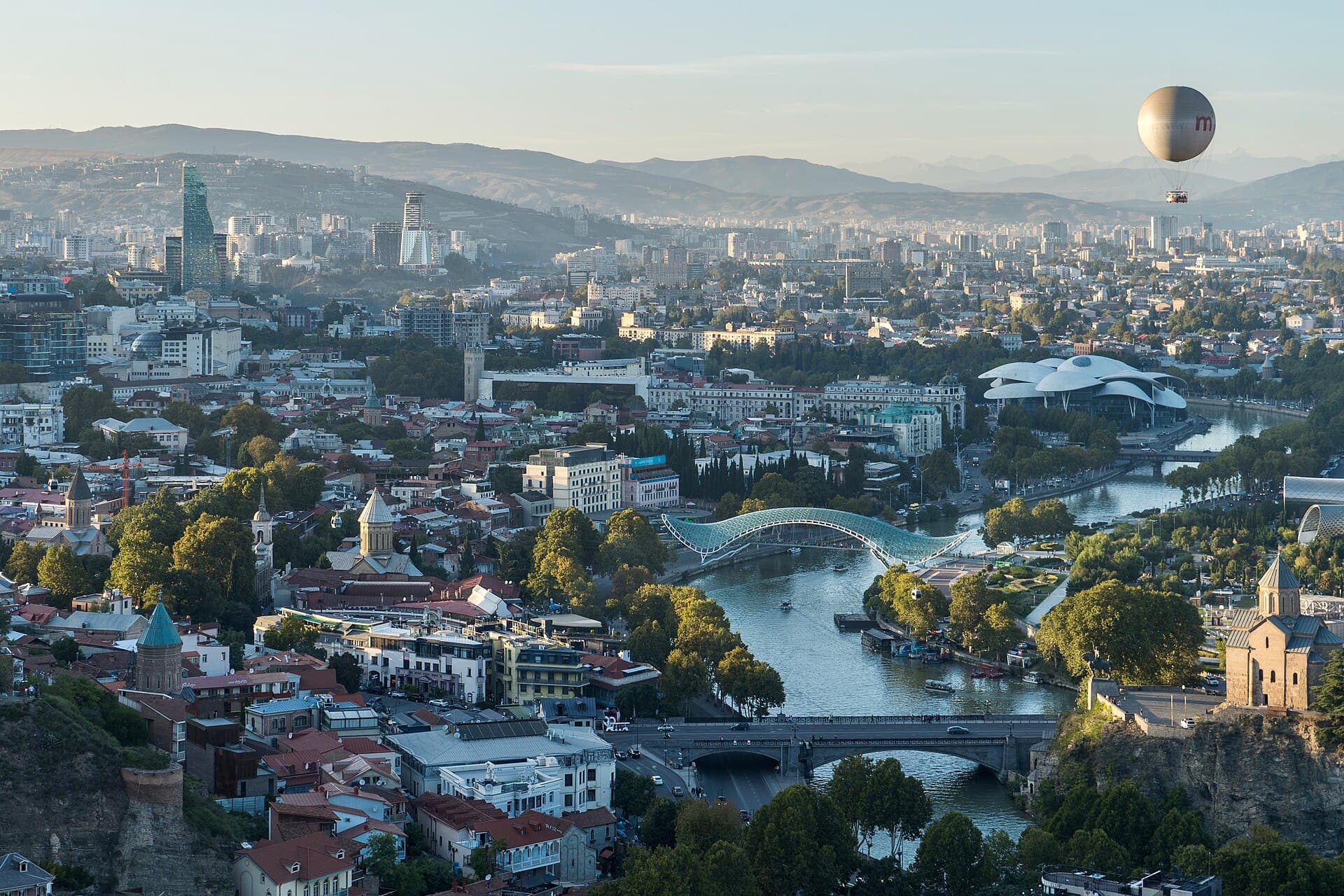 Alexey Komarov / CC BY-SA 4.0, via Wikimedia Commons
“Where ancient legends meet an unfolding present.”
Not the postcards. The stories even locals don't know — whispered in your ear, right where they happened.
The city's very name, Tbilisi, hints at its steamy origins. The tale behind its founding involves a royal hunt and a surprising culinary discovery.
When the Tbilisi Funicular first opened in 1905, residents were hesitant to ride it, despite its innovative design.
Tbilisi's metro system holds a distinction among former Soviet cities, having begun construction before reaching a common demographic benchmark.
Discover every secret of Tbilissi
Every address, every reveal in full — in your ear, right where it happened.
You pick your stops. You walk. The voice reveals what the others miss.
No tours available yet. Check back soon — we're preparing them.
Tbilisi, the capital of Georgia, is a city where ancient narratives and modern dynamism intertwine. Situated on the Mtkvari River, its diverse architecture recounts stories of Persian, Ottoman, and Russian influences, alongside striking contemporary designs. From the pastel-colored, balconied houses of the Old Town to the imposing Soviet-era structures and futuristic glass bridges, Tbilisi offers a visual journey through time.
The city's singular character arises from its embrace of both its long past and its forward-looking spirit. Wander through labyrinthine passageways, discover intimate courtyards, and absorb the atmosphere of a place that has been continuously rebuilt and reimagined over centuries. Tbilisi is a destination that engages all the senses, inviting exploration and promising unexpected discoveries around every corner.
At its core, Tbilisi is defined by its warm, sulfuric springs, which, according to legend, led to its very foundation. These natural thermal waters continue to be a central part of the city's identity, offering a unique tradition of relaxation and social gathering in the historic Abanotubani district.
Tbilisi's origins are deeply rooted in the natural hot springs that still bubble beneath the city. Legend credits King Vakhtang I Gorgasali of Iberia with founding the city in the 5th century, after his hunting falcon allegedly discovered the warm waters. The city's name, 'Tbilisi,' itself derives from the Georgian word for 'warm,' a direct reference to these thermal springs. Prior to this, archaeological evidence suggests human settlement in the area as early as the 4th millennium BC, with written accounts of a fortress dating to the late 4th century AD.
By the 6th century, Tbilisi officially became the capital of the Georgian kingdom, a strategic move that recognized its pivotal location. Positioned at the crossroads between Europe and Asia, and along the lucrative Silk Road, Tbilisi's location made it a coveted prize for various global powers. Over its 1,500-year history, the city has endured numerous invasions and occupations, including by Persians, Byzantines, Arabs, and Mongols. Each conqueror left an indelible mark on the city's architecture, culture, and spirit.
During the Arab rule in the 7th century, Tbilisi became the center of an emirate, and Arabic dirhams were minted there with both Arabic and Georgian inscriptions. The city experienced a period of prosperity before falling under Mongol domination in 1236. In 1795, a devastating invasion by the Persian ruler Agha Mohammad Khan led to the city being burned to the ground, a catastrophe that prompted Georgia to seek protection from the Russian Empire. Much of the "Old Town" visible today was rebuilt in the 19th century, showcasing the city's remarkable resilience.
From 1801 to 1917, Tbilisi, then known as Tiflis, served as the seat of the Caucasus Viceroyalty under Russian rule, governing both the northern and southern Caucasus regions. Following the Russian Revolution in 1917, Tbilisi briefly became the capital of the independent Transcaucasian Federation. After the Soviet occupation in 1921, it functioned first as the capital of the Transcaucasian SFSR and then, until 1991, as the capital of the Georgian Soviet Socialist Republic. During the Soviet era, Tbilisi's population and industrialization grew significantly, cementing its role as a major political, social, and cultural hub within the Soviet Union. Today, Tbilisi stands as the spirited capital of an independent Georgia, a testament to its enduring character and complex history.
Begin your exploration in Old Town (Dzveli Tbilisi), a compact area of winding streets, traditional wooden balconies, and historic churches. Here, you'll find the distinctive dome-shaped roofs of the Abanotubani sulfur baths, an essential Tbilisi experience. Nearby, the Narikala Fortress, with walls dating back to the 4th century, offers expansive city views, accessible by a scenic aerial tramway.
Cross the modern Bridge of Peace, a striking glass and steel pedestrian bridge, to Rike Park. From there, a cable car can take you up to the Mother of Georgia statue, a towering aluminum figure symbolizing the Georgian national character. Do not miss the whimsical Rezo Gabriadze Marionette Theatre and its leaning clock tower, a charming architectural anomaly.
For a grander scale, visit the colossal Sameba Cathedral (Holy Trinity Cathedral of Tbilisi), one of the largest Orthodox cathedrals in the world. Stroll along Rustaveli Avenue, the city's main thoroughfare, lined with significant buildings like the Georgian National Opera Theater and the Parliament of Georgia. For a unique cultural experience, explore Fabrika, a former Soviet sewing factory transformed into a lively hub of hostels, cafes, bars, and boutiques. Consider a day trip to Mtskheta, an ancient capital and UNESCO World Heritage site, home to the Jvari Monastery and Svetitskhoveli Cathedral.
The most agreeable times to visit Tbilisi are spring (April-May) and autumn (September-October). During these months, temperatures are mild and pleasant, making it ideal for exploring the city on foot. Spring brings blooming flowers and cultural events, while autumn offers a festive atmosphere with the grape harvest in nearby Kakheti and various festivals. Summers (June-August) can be warm, with temperatures often exceeding 32°C (90°F), and winters (December-February) are moderately cool and dry, with occasional snow.
The local currency is the Georgian Lari (GEL), with banknotes in denominations of 5, 10, 20, 50, 100, and 200 Lari, and coins in 1 and 2 Lari, as well as smaller tetri. While ATMs are widely available in Tbilisi, some may charge fees, so it's advisable to check. Credit cards are accepted in most hotels, restaurants, and shops in urban centers, but cash is essential for smaller purchases, markets, and some guesthouses.
Tipping in Georgia is not mandatory, but it is appreciated, especially in tourist areas. Many restaurants, particularly upscale ones, may include a 10% service charge, which often does not go directly to the staff; an additional cash tip for good service is a kind gesture. For taxis, it's recommended to use ride-hailing apps like Bolt to ensure fair pricing and avoid complications.
Getting from Tbilisi International Airport (TBS) to the city center is straightforward. Public bus number 337 operates from 7 AM to 11 PM, offering an affordable option at 1 GEL. Taxis booked via the Bolt app are available 24/7 and typically cost around 35 GEL. Private transfers are also an option. The Tbilisi Metro is an efficient way to navigate the city, operating from 6 AM to midnight with a flat fare of 1 Lari per journey.