Pyramid of the Sun
The Pyramid of the Sun might not be dedicated to the sun at all.
Full story unlocks in the tour
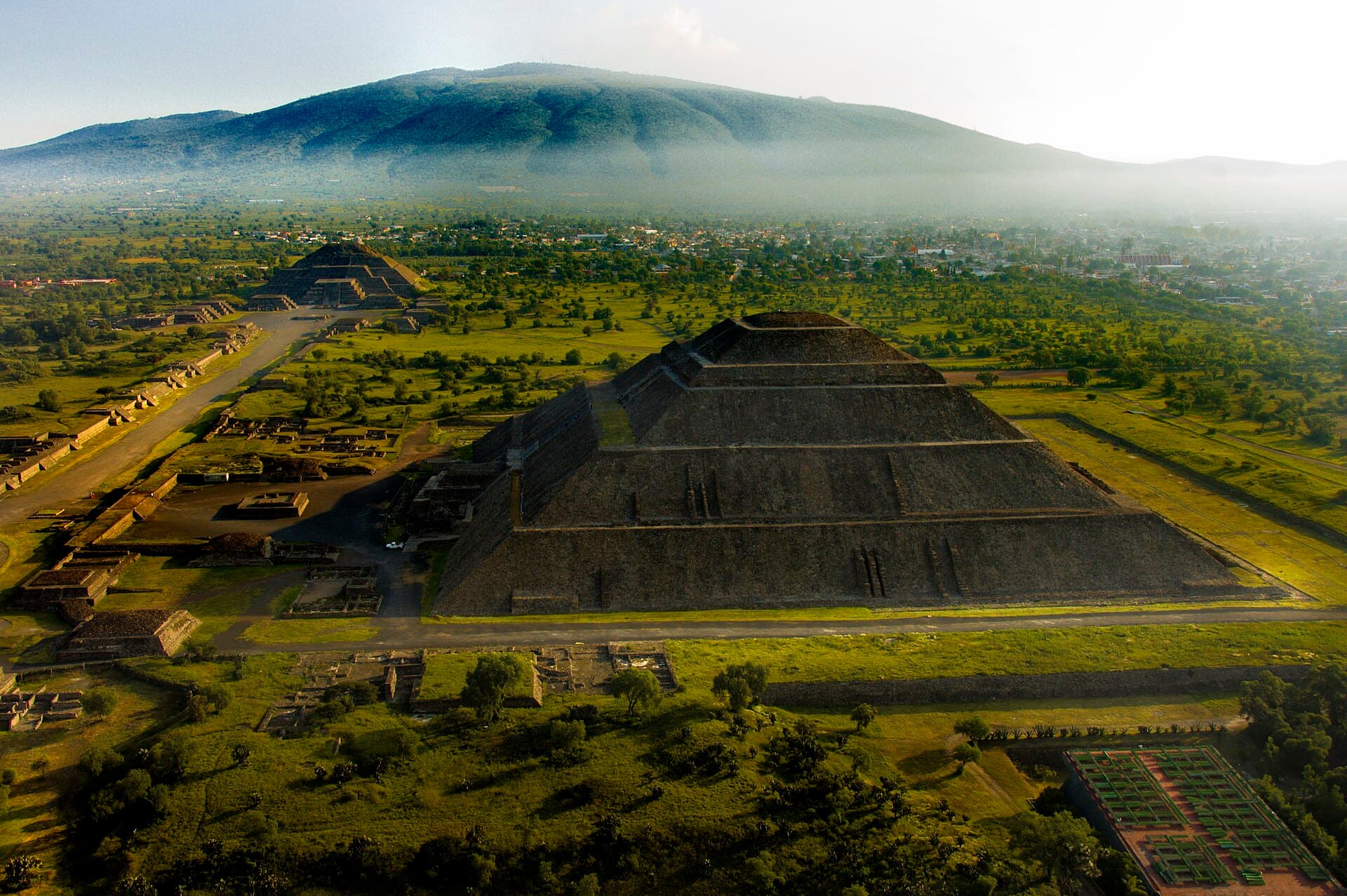 Hdlrosa / CC BY-SA 4.0, via Wikimedia Commons
Self-guided audio walking tour of Teotihuacan — GPS route, offline playback, story-driven narration in 32 languages.
“Walk the ancient avenues where gods were born, and a civilization vanished.”
Not the postcards. The stories even locals don't know — whispered in your ear, right where they happened.
The Pyramid of the Sun might not be dedicated to the sun at all.
Beneath this pyramid, a sealed tunnel held secrets for nearly 2,000 years.
Clap your hands at the base of the Pyramid of the Sun and listen closely.
Discover every secret of Teotihuacan
Every address, every reveal in full — in your ear, right where it happened.
You pick your stops. You walk. The voice reveals what the others miss.


Lume has a built-in augmented-reality guide. Hold your phone up and its camera shows the street ahead of you, with a glowing arrow laid over the real view that always points to your next stop — no map to puzzle over, no wrong turns. Like everything in Lume, it works fully offline.
Teotihuacan, often called the “City of the Gods,” is an ancient Mesoamerican metropolis located about 40 kilometers (25 miles) northeast of modern-day Mexico City. This UNESCO World Heritage site is recognized for its monumental pyramids and its meticulously planned urban layout. Long before the Aztecs arrived in the Valley of Mexico, Teotihuacan flourished, becoming one of the largest and most influential cities in the pre-Columbian Americas.
The city's origins remain a subject of mystery, with scholars still debating the identity of its founders and the language they spoke. At its zenith, around 500 CE, Teotihuacan's population was estimated to be between 100,000 and 200,000 inhabitants, making it one of the largest cities in the ancient world. Its influence extended throughout Mesoamerica, impacting city planning, urban development, and cultural practices in distant regions.
Exploring Teotihuacan today offers a profound glimpse into a sophisticated ancient civilization. The site's wide avenues, grand pyramids, and intricate murals speak to a complex society with advanced understanding of engineering, astronomy, and urban organization. Despite its eventual decline and abandonment around the 7th century CE, Teotihuacan's legacy continues to inspire awe and curiosity, with ongoing archaeological efforts slowly unraveling its many enduring secrets.
The first human settlements in the Teotihuacan Valley date back to 600 BCE, initially consisting of scattered small villages. By 100 BCE, the area began its transformation into a distinct urban center, with major monuments under continuous construction until around 250 CE. The city's growth is sometimes attributed to refugees from a volcanic eruption or possibly the Totonacs from the east, though the true identity of its builders remains unknown.
Teotihuacan's peak, known as Period III, spanned from 350 to 650 CE. During this classical period, the city reached the height of its influence across Mesoamerica, with an estimated population of approximately 100,000 inhabitants. It was a multi-ethnic society, drawing migrants from various groups across ancient Mexico, including those from the Valley of Mexico, Oaxaca, Michoacán, and Veracruz. This cosmopolitan hub was unique in Mesoamerica for its multi-ethnic composition and its sophisticated urban planning.
Teotihuacan was meticulously planned on a precise grid system, a feature unparalleled in Mesoamerica. The city's main thoroughfare, the Avenue of the Dead, aligns with celestial movements, demonstrating an advanced understanding of astronomy. Beyond its architectural prowess, Teotihuacan was a significant economic center, largely controlling the trade of obsidian, a volcanic glass used for tools and weapons. Artisans in the city produced high-quality obsidian blades that were traded widely across Mesoamerica, contributing significantly to the city's wealth and power.
Around 550 CE, the core monuments of Teotihuacan were burned by unidentified persons, and the city's population began to decline significantly after 600 CE. By 750 CE, the city was abandoned. The exact reasons for its collapse are debated, with theories ranging from extreme weather events to civil war or large-scale migration. When the Aztecs discovered the city in ruins centuries later, they named it Teotihuacan, meaning “the place where the gods were created” or “birthplace of the gods,” believing it to be a sacred site where deities sacrificed themselves to create the world.
Begin your exploration along the Avenue of the Dead, the central thoroughfare that stretches for approximately 2.5 kilometers (1.5 miles) and connects the site's major structures. This wide path offers impressive views of the surrounding pyramids and platforms.
The Pyramid of the Sun is the largest structure at Teotihuacan and one of the tallest pyramids in the world. While climbing to the summit is no longer permitted, its sheer scale is captivating from its base. Nearby, the Pyramid of the Moon is the second largest pyramid and offers a commanding view of the Avenue of the Dead. You can climb its stairs for panoramic vistas of the entire complex.
Further south, the Temple of the Feathered Serpent (also known as the Temple of Quetzalcoatl) within the Ciudadela courtyard is notable for its intricate stone carvings. This pyramid features detailed representations of the feathered serpent god. Do not overlook the Palace of Quetzalpapálotl, located behind the Pyramid of the Moon, which displays well-preserved murals and ornate stonework. For a deeper understanding of the artifacts and history, visit the Teotihuacan Archaeological Museum on site.
The best time to visit Teotihuacan is during Mexico's dry season, which runs from October to May. During these months, the weather is generally pleasant with cooler temperatures and clear skies, ideal for outdoor exploration. To avoid the largest crowds and the midday heat, plan to arrive early in the morning, ideally by 8:00 AM when the site opens. Weekdays are typically less crowded than weekends, as Mexican citizens receive free entry on Sundays.
Teotihuacan is open daily, year-round, from 8:00 AM to 5:00 PM. General admission costs MXN 90 (approximately $5 USD), with free entry for children under 13. Mexican nationals and foreign residents with valid documentation can enter for free on Sundays. While not mandatory, purchasing skip-the-line tickets online in advance is recommended, especially for weekend visits or during peak season, to bypass potentially long queues.
Expect to walk several kilometers across the expansive site, so wear comfortable shoes, a hat, sunscreen, and sunglasses, as there is little shade. Bring your own water and snacks, as vendors inside the archaeological zone often charge higher prices. Restaurants, including the unique La Gruta cave restaurant, are located near the entry gates. The site is easily accessible from Mexico City as a day trip, taking under 70 minutes by bus from the North Bus Terminal.
Teotihuacan in Korean, in Chinese or in Hebrew — and 29 more languages, every stop narrated by a native voice. The widest language range of any self-guided audio tour.
Available in: