Thun Castle turrets
The striking turrets of Thun Castle, now offering expansive views, once served a far less glamorous purpose.
Full story unlocks in the tour
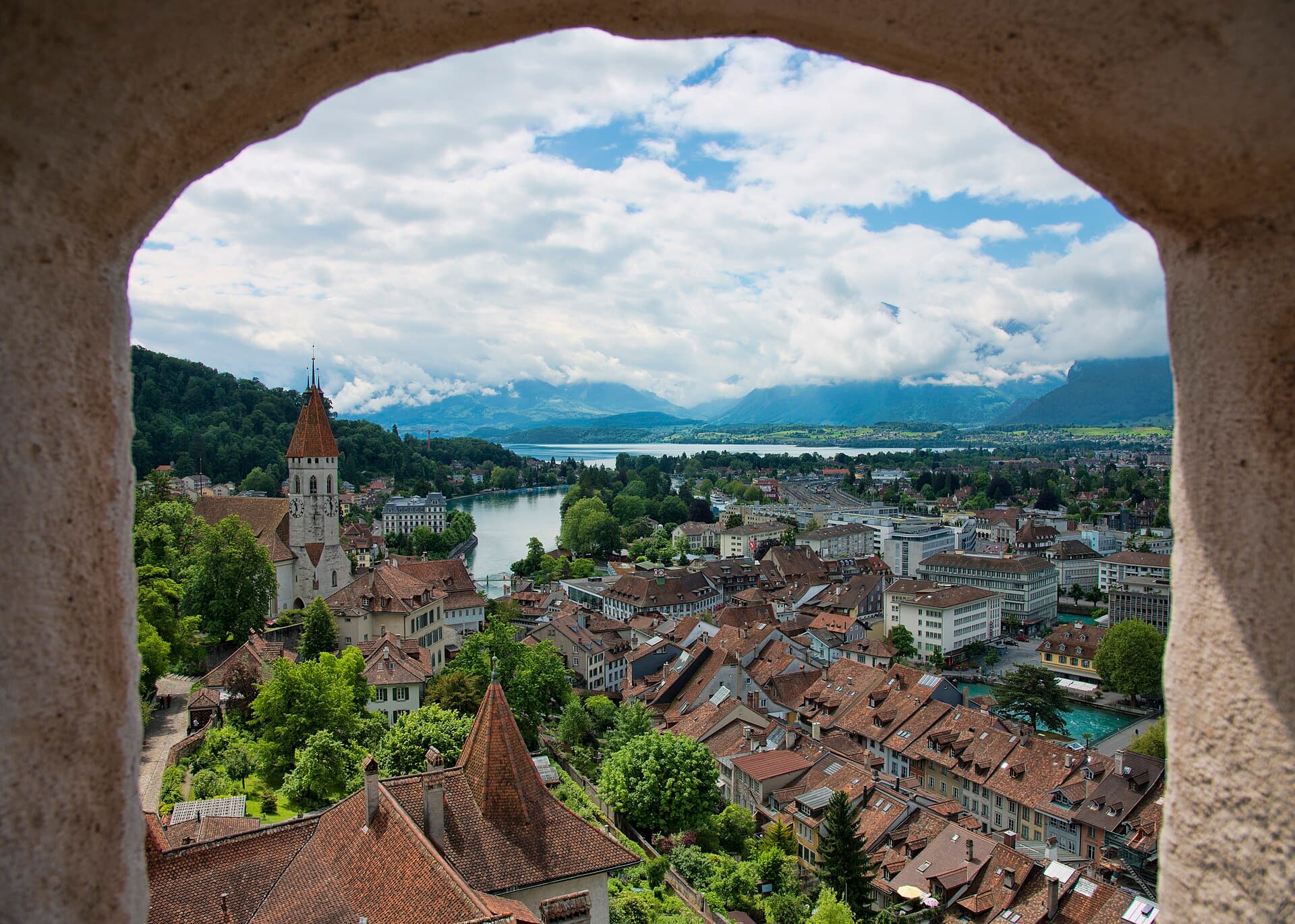 chensiyuan / CC BY-SA 4.0, via Wikimedia Commons
Self-guided audio walking tour of Thun — GPS route, offline playback, story-driven narration in 32 languages.
“Where alpine grandeur meets medieval charm on the Aare's turquoise flow.”
Not the postcards. The stories even locals don't know — whispered in your ear, right where they happened.
The striking turrets of Thun Castle, now offering expansive views, once served a far less glamorous purpose.
Thun's main street, Obere Hauptgasse, features a unique architectural quirk that is more than merely aesthetic.
Beneath the tranquil surface of Lake Thun lies a surprising legacy from a bygone era.
Discover every secret of Thun
Every address, every reveal in full — in your ear, right where it happened.
You pick your stops. You walk. The voice reveals what the others miss.


Your self-guided audio tour of Thun is ready — pick your landmarks, choose your language, and start the moment you arrive.
BuyLume has a built-in augmented-reality guide. Hold your phone up and its camera shows the street ahead of you, with a glowing arrow laid over the real view that always points to your next stop — no map to puzzle over, no wrong turns. Like everything in Lume, it works fully offline.
Thun, a captivating city in Switzerland's Bernese Oberland, is where the turquoise Aare River flows out of Lake Thun, creating a landscape that feels both historic and alive. Often considered a less-trodden alternative to more bustling Swiss destinations, Thun offers a blend of natural beauty, medieval architecture, and a lively local atmosphere. Its position at the gateway to the Bernese Alps makes it an ideal starting point for exploring the surrounding mountains and lakes, while the city itself invites leisurely strolls through its appealing Old Town.
The city's most iconic landmark, Thun Castle, stands grandly on a hill overlooking the town, its four white towers a distinctive feature of the skyline. Beyond the castle, Thun's Old Town unfolds with arcaded sidewalks, historic squares, and wooden bridges that span the Aare. Whether you are drawn to its enduring history, the allure of the lake, or the promise of alpine adventures, Thun provides a memorable Swiss experience with a refined character all its own.
The area around what is now Thun has a remarkably long history of human habitation, dating back to the Neolithic age in the mid-3rd millennium BC. Archaeological discoveries, such as a local chief's grave at Renzenbühl, have revealed some of Europe's most extensive collections of early Bronze Age artifacts, including the Thun-Renzenbühl axe from 1800 BC, an early example of damascening.
The town's name itself, 'Thun,' originates from the Celtic word 'Dunum,' meaning 'fortified town.' It fell under Roman control in 58 BC, becoming a significant administrative center in the region until the Burgundians drove the Romans out around 400 AD. The Aare River then served as a frontier between the Christian Burgundians and the pagan, German-speaking Alemanni to the north.
Thun is first mentioned as 'Tuno' in 1133. The region became part of the Holy Roman Empire in 1033. Around 1190, Duke Berthold V of Zähringen played a pivotal role in shaping the city, constructing Thun Castle and expanding the town. After the Zähringen line ended in 1218, Thun passed to the House of Kyburg, receiving town rights in 1264. In 1384, the canton of Bern purchased the town, and the castle became the seat of local administration. A significant addition during the Bernese period was the massive roof of the castle, constructed between 1430 and 1436.
Thun served as the capital of the Canton of Oberland during the Helvetic Republic from 1798 to 1803. In 1819, a military school was established in Thun, which eventually grew into Switzerland's primary military academy. The town was connected to Switzerland's railway network in 1859, and telephone access became available in 1888. Today, Thun continues its legacy as a military center, with a training base nearby.
Beyond its military importance, Thun developed into a significant trading hub in the Middle Ages, fostering crafts and trade. The distinctive elevated pavements of the Old Town, with arcaded shops, began to take shape during this period of prosperity under Bernese rule. The city's economic activities today include machine and precision instrument engineering, food industry, armaments, and publishing, alongside its flourishing tourism sector.
Begin your exploration at Thun Castle, a striking 12th-century fortress with four distinctive white towers that offers expansive views of the city, Lake Thun, and the surrounding Bernese Alps. Inside, a museum showcases 800 years of regional history, including a well-preserved Knights' Hall.
Descend into the Old Town, where the unique Obere Hauptgasse awaits. This main street features split-level sidewalks with arcaded shops on an elevated pavement, creating a distinctive medieval atmosphere. Explore the Rathausplatz (Town Hall Square), the historic heart of Thun since the 16th century, surrounded by old buildings and often hosting markets.
Walk across Thun's appealing covered wooden bridges, the Obere Schleuse Brücke and Untere Schleuse Brücke, which date back to the 1720s and play a role in regulating the Aare River's water levels. You might even spot surfers riding the river's standing waves near these bridges.
For a change of pace, visit Schadau Park, an English-style garden that is home to Schadau Castle and the Thun-Panorama. The Thun-Panorama is the world's oldest preserved circular painting, offering a 360-degree view of early 19th-century Thun. Consider a Lake Thun cruise to fully appreciate the region's scenery, with options for day passes and themed cruises.
The best time to visit Thun for warm-weather activities and sightseeing is from late June to late August. During these months, average daytime temperatures range from 20°C to 22.4°C, providing comfortable conditions for exploring the city and enjoying lake excursions. While precipitation is frequent throughout the year, May and June tend to have the most wet days. For those interested in winter landscapes and activities, December to March is recommended, with December being a high season for winter tourism.
Thun is easily accessible by train, with regular connections from Bern, which is less than 30 minutes away. The city's train station is well-connected, and a Swiss Rail Pass can cover train and boat fares if you plan multiple trips. The Old Town is very walkable, making it easy to explore on foot.
While German is the official language, a local variant of Alemannic Swiss German is commonly spoken. Thun offers a variety of shops, restaurants, and cafes, particularly along the Obere Hauptgasse and Mühleplatz. The Panorama Card Lake Thun, available with overnight stays, provides free travel on local buses and discounts on boat tickets, cable cars, and attractions.
Parking is available, with options like Parkhaus City Ost Schlossberg providing convenient access to the castle.
Thun in Korean, in Chinese or in Hebrew — and 29 more languages, every stop narrated by a native voice. The widest language range of any self-guided audio tour.
Available in: