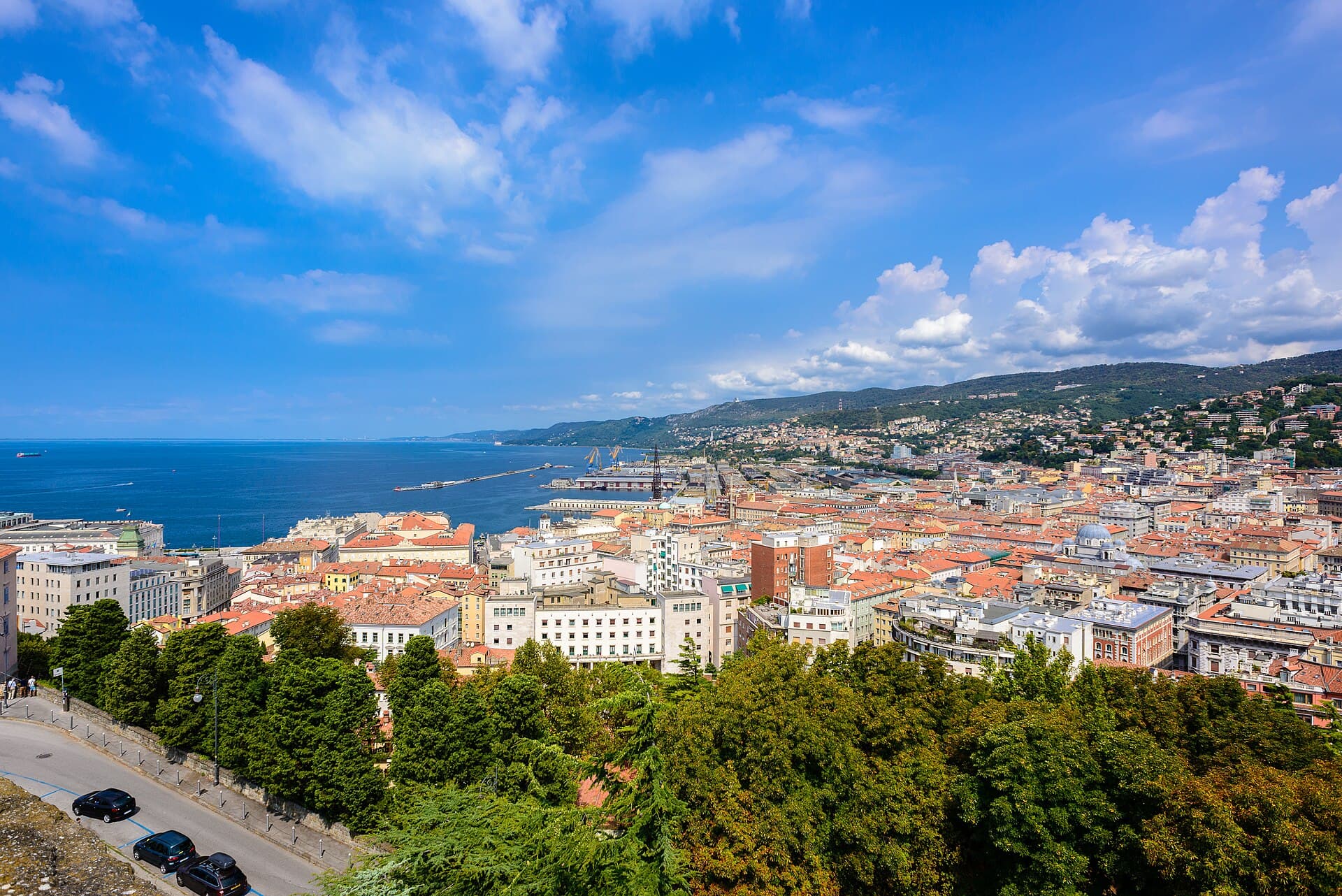
Trieste, ItalyNick Savchenko from Kiev, Ukraine / CC BY-SA 2.0, via Wikimedia Commons
IT

Trieste

Where Central European grandeur meets Adriatic breezes and literary ghosts.

The secrets of Trieste

Trieste, as no one tells it.

Not the postcards. The stories even locals don't know — whispered in your ear, right where they happened.

3 secrets below. Many more wait inside the tour.
Piazza Unità d'Italia

The grandest square in Trieste, Piazza Unità d'Italia, has witnessed some of the 20th century's most pivotal moments, yet one of its most striking features is a subtle nod to a past that lies beneath your feet.

Full story unlocks in the tour
Roman Theatre

Trieste's Roman Theatre, a testament to ancient Roman life, was once considered lost to time, swallowed by the city's growth.

Full story unlocks in the tour
The Bora Wind

The fierce Bora wind is synonymous with Trieste, shaping its character and even its residents, but its name carries an ancient, mythological echo.

Full story unlocks in the tour
The full tour

Discover every secret of Trieste

Every address, every reveal in full — in your ear, right where it happened.

Get the key to Trieste

You pick your stops. You walk. The voice reveals what the others miss.

Choose your time

How long do you have in Trieste?

No tours available yet. Check back soon — we're preparing them.

About Trieste

The story of Trieste

Trieste, a captivating port city on Italy's northeastern coast, offers a unique blend of Italian, Central European, and Slavic influences. It sits where the Adriatic Sea meets the Karst Plateau, creating a distinctive landscape and cultural tapestry. Often considered one of Italy's most literary cities, Trieste has been a haven for writers and intellectuals, including renowned figures like James Joyce, Italo Svevo, and Umberto Saba.

The city's grand architecture, particularly the impressive Piazza Unità d'Italia, reflects its prosperous past as a vital seaport under the Austrian Empire. Beyond its historical significance, Trieste is a city that invites exploration, from its ancient Roman ruins to its bustling coffeehouses, which have long served as intellectual hubs. Its position at a cultural crossroads makes it a fascinating destination for those seeking a different side of Italy.

History

From Roman Port to Habsburg Center

Trieste's history stretches back to pre-Roman times, evolving into a city after Roman conquest in the 2nd century BC, then known as Tergeste. Remains of its Roman heritage, such as the Arco di Riccardo and a Roman theater, are still visible today. The strategic location on the Adriatic meant Trieste changed hands multiple times throughout the centuries, eventually becoming a free city before joining the House of Habsburg in 1382.

Under Austrian rule, particularly in the 18th and 19th centuries, Trieste experienced a golden age. Empress Maria Theresa's investments transformed it into the Habsburg Empire's primary seaport, briefly overshadowing Venice. This period saw significant development, with grand Austro-Hungarian buildings shaping the city's elegant appearance, especially around Piazza Unità d'Italia. Trieste became a leading Italian and European cultural center, all while maintaining Italian as its primary language.

A Literary Crossroads and Post-War Identity

The late 19th and early 20th centuries solidified Trieste's reputation as a literary hub. Writers like James Joyce, who lived in the city from 1904 to 1920 and wrote parts of Ulysses and A Portrait of the Artist as a Young Man here, found inspiration in its cosmopolitan atmosphere. Local literary giants Italo Svevo and Umberto Saba also called Trieste home, their works deeply intertwined with the city's unique identity. Statues of these authors can be found throughout the city, serving as reminders of its intellectual past.

The 20th century brought significant upheaval. After the collapse of the Austro-Hungarian Empire, Trieste was annexed by Italy in 1918. Following World War II, it became the capital of the Free Territory of Trieste before finally being fully integrated into Italy in 1954. This complex history, marked by shifting allegiances and cultural influences, has left Trieste with a distinctive character that continues to fascinate visitors.
What to see

Begin your exploration at Piazza Unità d'Italia, often referred to as Europe's largest square located next to the sea. This expansive square is framed by impressive Austro-Hungarian buildings and offers views of the Adriatic. A short stroll leads to the Canal Grande, a picturesque waterway lined with cafes, perfect for experiencing Trieste's famous coffee culture.

Ascend to the San Giusto Hill to discover the Castle of San Giusto and the Trieste Cathedral. The castle, with its origins in a prehistoric fortified settlement and later a Roman urban center, offers panoramic views of the city and the Gulf. Within its walls, you can explore the Castle Museum and the Lapidario Tergestino, which houses Roman stone finds. At the foot of the hill lies the Roman Theatre, a 1st-century AD structure that once accommodated thousands of spectators and is still occasionally used for summer performances.

For literary enthusiasts, Trieste offers several points of interest. Visit the Museo LETS (Letterature Trieste), which includes the James Joyce Museum and Italo Svevo Museum, celebrating the city's literary history. Statues of these writers, along with Umberto Saba, are also found throughout the city. Consider a visit to Miramare Castle, an enchanting 19th-century castle set on a promontory overlooking the sea, surrounded by beautiful sculpture gardens.

When to visit

The best times to visit Trieste are during the spring (April to June) and fall (September to October). During these months, the weather is mild and pleasant, ideal for walking and outdoor activities. While July and August offer warm sea temperatures and long daylight hours, they can also be hot and more crowded. The famous Bora wind is more frequent and intense in winter, typically between October and March.

Practical

Trieste is a very walkable city, especially the city center. For longer distances or to navigate its hilly areas, an extensive bus network operated by Trieste Trasporti is available. Tickets can be purchased at tobacconists, newsagents, and some bars, or via the Tpl FVG App. Google Maps is generally accurate for bus schedules and route planning. Trieste is considered a very safe city, with low crime rates. While petty theft can occur in busy tourist areas, violent incidents are rare. The city is well-connected by train, with Trieste Centrale offering regional and intercity services to cities like Venice, Udine, and Rome. Trieste Airport (Ronchi dei Legionari) is about 40km northwest of the city, with train connections to the city center.

Good to know
Is Trieste a safe city for tourists?
Yes, Trieste is considered a very safe city with low crime rates, even for solo female travelers. While petty theft can occur in crowded areas, violent incidents are rare.
What is the best way to get around Trieste?
Trieste's city center is very walkable. For longer distances or to reach areas outside the center, an extensive public bus system is available. Tickets can be bought at tobacconists or via the Tpl FVG App.
What is the local currency and language in Trieste?
The local currency is the Euro (€). The official language is Italian, though due to its history, you may encounter German and Slovene influences.
Are there any famous literary figures associated with Trieste?
Yes, Trieste has a rich literary heritage. James Joyce lived and wrote in Trieste for many years, and it was also home to Italian authors Italo Svevo and Umberto Saba.
What is the 'Bora' wind in Trieste?
The Bora is a strong, cold, north-northeasterly katabatic wind that blows from the mountains into the Gulf of Trieste. It is a defining characteristic of the city, especially in winter, and can reach very high speeds.
How many days are recommended to visit Trieste?
It is recommended to dedicate at least 2 to 3 days to explore Trieste's main highlights, including its iconic attractions, historic center, and local cuisine. An extended stay allows for deeper cultural exploration and day trips.
Trieste
From€9.00
No booking · activate anytime · 12h to walk it
Get the key to Trieste