Archaeologist Heinrich Schliemann, the man credited with unearthing Troy, claimed to have found a dazzling hoard of gold and jewels belonging to King Priam.
CherryX / CC BY-SA 3.0, via Wikimedia CommonsTroy
Self-guided audio walking tour of Troy — GPS route, offline playback, story-driven narration in 32 languages.
“Where ancient myth breathes in stone and wind.”
Troy, as no one tells it.
Not the postcards. The stories even locals don't know — whispered in your ear, right where they happened.
Homer's Iliad describes Troy's downfall as a fiery siege, but archaeological evidence suggests a different, equally devastating end for one of its most prominent layers.
Visitors to Troy are often eager to see the iconic Trojan Horse, and there are actually two notable replicas in the region.
Discover every secret of Troy
Every address, every reveal in full — in your ear, right where it happened.
You pick your stops. You walk. The voice reveals what the others miss.

How long do you have in Troy?
Your self-guided audio tour of Troy is ready — pick your landmarks, choose your language, and start the moment you arrive.
BuyThe story of Troy
The legendary city of Troy, or Truva as it's known in Turkish, is more than just an archaeological site; it's a place where myth and history intertwine, brought vividly to life by Homer's epic poem, the Iliad. Situated on the Hisarlık hill in modern-day Çanakkale Province, overlooking the Dardanelles Strait, Troy has captivated imaginations for millennia as the fabled setting of the Trojan War.
For centuries, many believed Troy was merely a myth, a literary invention. However, archaeological excavations in the 19th century began to uncover not one, but multiple layers of a city, proving that a major settlement had existed here for thousands of years. Today, as a UNESCO World Heritage Site, Troy offers a profound journey through time, allowing visitors to walk through the remnants of over 4,000 years of continuous habitation.
## From Myth to Discovery For much of history, Troy was considered a legendary city, its existence confined to the verses of Homer's Iliad, which recounts the ten-year Trojan War. This epic conflict, sparked by the abduction of Helen by Paris, a Trojan prince, culminated in the city's eventual capture by the Greeks through the cunning use of the Trojan Horse.
The site's true identity began to emerge in the 19th century. In 1863, British expatriate Frank Calvert discovered ancient ruins at Hisarlık in western Turkey. Convinced these were the remains of Troy, he began initial excavations. Heinrich Schliemann, a German businessman turned amateur archaeologist, arrived in 1868 and, with Calvert's guidance and funding, took credit for the more extensive excavations that followed, dramatically unearthing multiple layers of settlement.
## Layers of Time Archaeological work at Troy has revealed nine distinct layers, or cities, built atop one another, spanning nearly 4,000 years of human habitation from around 3600 BC until it faded into obscurity after the founding of Constantinople in 324 CE. Each layer tells a story of rise, fall, and rebirth, with archaeologists referring to them using Roman numerals, from Troy I (the earliest) to Troy IX (the latest).
Among the early layers, Troy II is noted for its wealth and imposing architecture. During the Late Bronze Age, the city was known as Wilusa and was a vassal of the Hittite Empire. Troy VI, which existed from around 1750 BC to 1300 BC, featured massive defensive walls. Many archaeologists now consider Troy VIIa, destroyed by fire and violence around 1190–1180 BC, to be the most plausible candidate for the city described in Homer's epic.
## Roman Reverence The city was abandoned around 1000 BC but was reoccupied in the 8th century BC, around the time Homer lived. The final layers, Troy VIII and IX, represent Greek and Roman cities that served as tourist attractions and religious centers due to their connection to the mythical tradition. Roman emperors, including Julius Caesar and Augustus, paid homage here, with the Romans tracing their ancestry back to the Trojan hero Aeneas. This later Roman city, Ilium Novum, featured structures like the Bouleuterion (Council House) and an Odeon (small concert hall), highlighting its continued cultural and political importance.
A visit to the archaeological site of Troy offers a tangible connection to one of the world's most enduring stories. Near the entrance, a large wooden Trojan Horse replica stands, inviting visitors to climb inside for a unique photo opportunity and a tangible link to the legend.
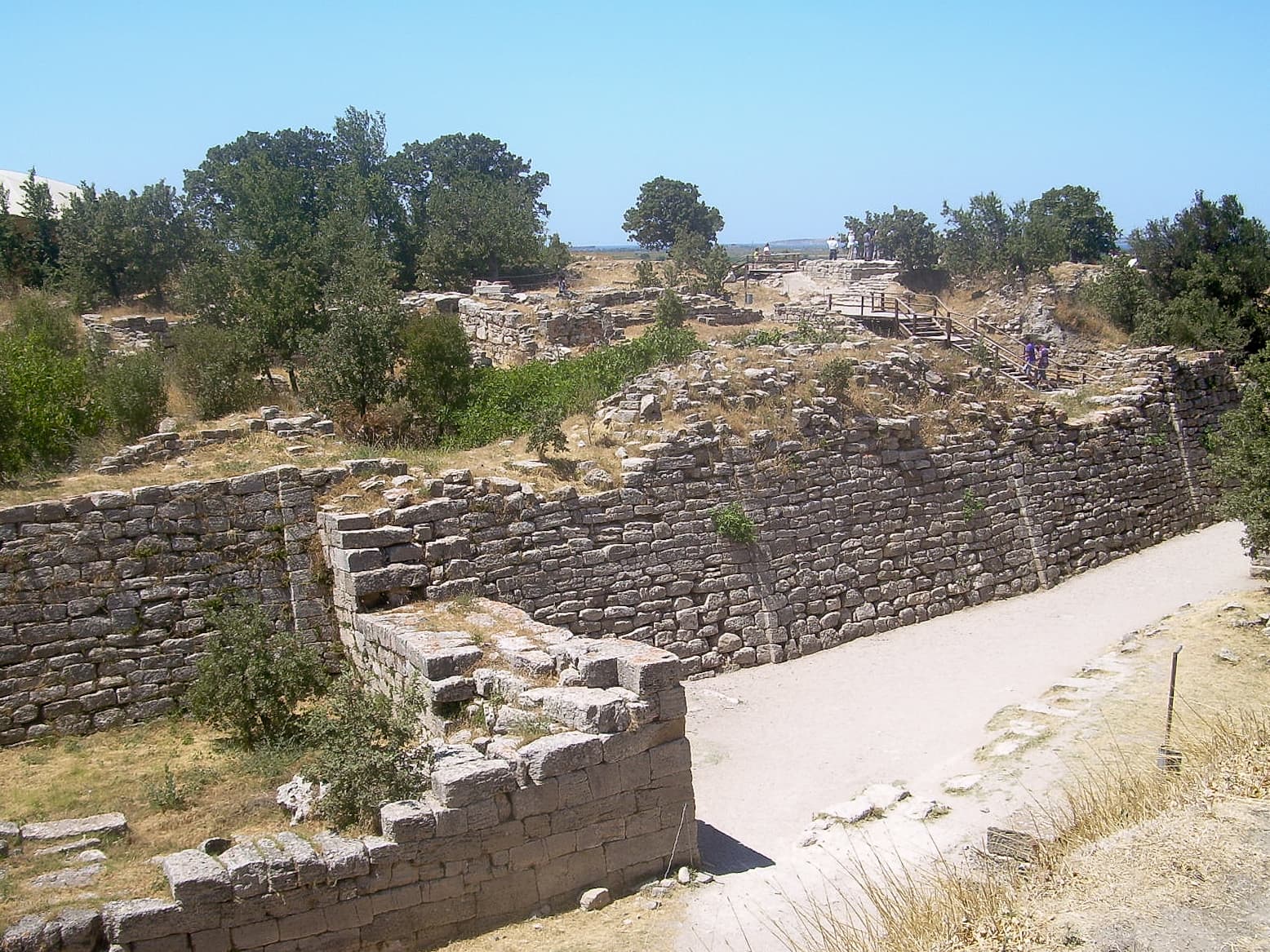
Walk along the remnants of Troy's formidable defensive walls, particularly those from Troy VI and VII, which showcase the city's architectural prowess. You can also observe the deep excavation trench dug by Heinrich Schliemann, which, despite its controversial methods, was pivotal in uncovering Troy's many layers.
Further exploration reveals the foundations of the Temple of Athena, once a central religious site, and Roman-era structures like the Odeon (a small theater) and the Bouleuterion (council chamber), reflecting Troy's later prosperity under Roman rule.
Just outside the archaeological site, the modern Troy Museum houses thousands of artifacts unearthed during excavations, including pottery, jewelry, sculptures, and everyday objects from various periods. Interactive exhibits and detailed displays bring the city's extensive history to life, providing valuable context for the ruins.
The best times to visit Troy are during spring (April to May) and autumn (September to October). During these months, the weather is mild and comfortable, with temperatures ranging from 18-25°C, making it ideal for exploring the outdoor archaeological site. These seasons also see fewer crowds compared to the peak summer months. If visiting in summer, aim for early morning or late afternoon to avoid the heat and large tour groups.
The archaeological site of Troy is located near Tevfikiye village, approximately 30 kilometers (19 miles) from Çanakkale, which serves as a convenient base for visitors. Dolmuş (minibuses) run regularly from Çanakkale's local bus station to Troy, with a journey time of about 45 minutes. Taxis are also an option.
The entrance fee to the Troy Archaeological Site, which includes entry to the Troy Museum, is €27 as of 2026. The site is open daily; generally from 08:30 to 19:00 from April to October, and from 08:00 to 17:00 from November to March. It's always advisable to check the official site for current times as they can shift. Allow 1-2 hours for the ruins and an additional 1-2 hours for the museum. Comfortable walking shoes are essential for navigating the gravel paths and boardwalks.
- Is Troy a real place or just a myth?
- Troy is a real archaeological site in modern-day Turkey, identified as Hisarlık. While the legendary Trojan War is recounted in Homer's epic poems, archaeological excavations have revealed multiple layers of a city that was inhabited for over 4,000 years.
- How many cities of Troy were there?
- Archaeological work has uncovered nine distinct layers of settlement at Troy, with each new city built on the ruins of its predecessor. These layers span nearly 4,000 years of continuous habitation.
- Is the Trojan Horse at the site real?
- The large wooden Trojan Horse at the entrance to the archaeological site is a modern replica, designed for visitors to experience and photograph. The original Trojan Horse from the myth was a clever deception, not a permanent structure.
- Do I need a guide to visit Troy?
- While it's possible to explore Troy independently, many visitors find that a licensed guide greatly enhances the experience. A guide can help you understand the different archaeological layers and bring the stories and historical context of the ruins to life.
- What else is there to see near Troy?
- The nearby city of Çanakkale offers a charming waterfront, the Trojan Horse from the movie "Troy," and the Çimenlik Castle and Naval Museum. The Gallipoli Peninsula Historical National Park, a poignant World War I battlefield, is also a short ferry ride away.
- What kind of local food can I try in the Troy region?
- The Çanakkale region is known for its fresh seafood, particularly sardines, which are often wrapped in vine leaves. Other local delights include bluefish served with buttery Turkish pilav and Ezine white cheese, a specialty of the area.