Truro Cathedral
This impressive Gothic Revival cathedral holds a secret that echoes across the globe every Christmas Eve.
Full story unlocks in the tour
 Ian S / CC BY-SA 2.0, via Wikimedia Commons
Self-guided audio walking tour of Truro — GPS route, offline playback, story-driven narration in 32 languages.
“Where Cornish heritage flows with three rivers and Gothic spires.”
Not the postcards. The stories even locals don't know — whispered in your ear, right where they happened.
This impressive Gothic Revival cathedral holds a secret that echoes across the globe every Christmas Eve.
Before they filled stadiums worldwide, a legendary rock band played their very first gig in Truro.
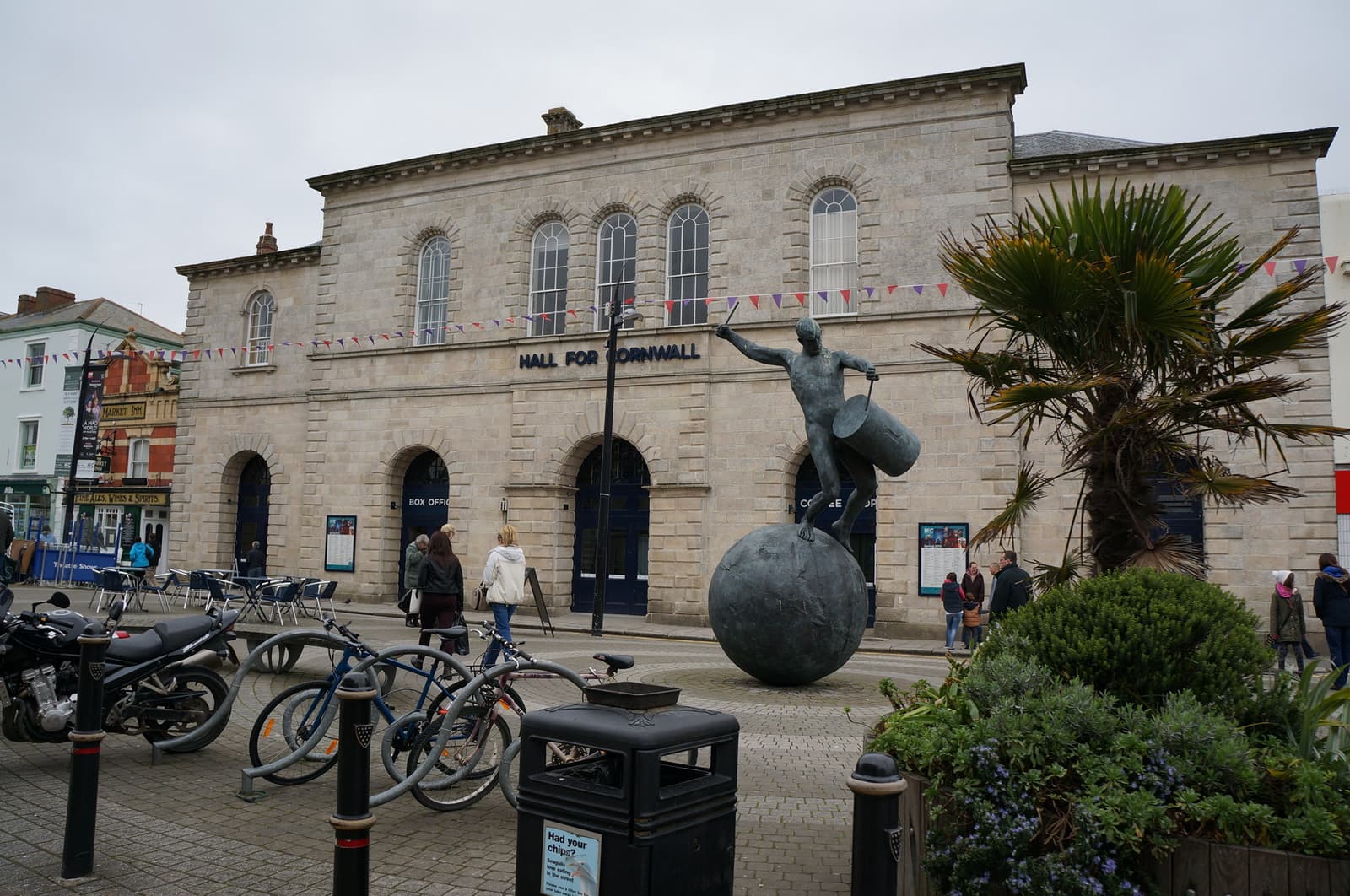
Even the city's traffic islands have a surprising claim to fame.
Discover every secret of Truro
Every address, every reveal in full — in your ear, right where it happened.
You pick your stops. You walk. The voice reveals what the others miss.


Your self-guided audio tour of Truro is ready — pick your landmarks, choose your language, and start the moment you arrive.
BuyLume has a built-in augmented-reality guide. Hold your phone up and its camera shows the street ahead of you, with a glowing arrow laid over the real view that always points to your next stop — no map to puzzle over, no wrong turns. Like everything in Lume, it works fully offline.
Truro, the United Kingdom's southernmost city, serves as Cornwall's administrative and retail heart. Despite its city designation, Truro maintains a relaxed, town-like atmosphere, characterized by its striking Gothic Revival and Georgian architecture. The city's name is believed to derive from the Cornish 'Tri-veru,' meaning 'three rivers,' a nod to the Kenwyn, Allen, and Glasteinan (or sometimes the Truro River itself) waterways that converge within the city before flowing into the Truro River and eventually the River Fal. This unique geography has shaped Truro's story and continues to define its character.
Today, Truro functions as a cultural hub, offering a blend of independent boutiques, high-street stores, and a lively food scene. Visitors can explore its historic streets, delve into Cornish heritage at the Royal Cornwall Museum, or enjoy performances at the Hall for Cornwall. Truro's central location also makes it an excellent base for exploring Cornwall's varied landscapes, from rugged north coast beaches to tranquil riverside villages.
## From Ancient Settlement to Stannary Town Truro's origins stretch back to at least the Bronze Age, with evidence of settlements existing long before it officially became a town in 1327. The city's strategic inland location, away from coastal invaders, and its navigable rivers were crucial to its early growth. Around 1166, Reginald de Dunstanville, Earl of Cornwall, issued one of Truro's earliest known charters, and a castle was likely built by Richard de Lucy between 1139 and 1140, around which the town began to grow. By the early 14th century, Truro had become a significant port and a stannary town, a designated center for assaying and stamping tin and copper from Cornish mines before taxation and trade.
## Prosperity and City Status The Black Death brought a period of recession and population decline in the 14th century, but Truro recovered and prospered in the 18th and 19th centuries. Improved mining methods and higher tin prices attracted wealthy mine owners, who built elegant Georgian and Victorian townhouses, particularly along Lemon Street, often cited as some of the finest Georgian architecture west of Bath. This era saw Truro become a social center, earning it the nickname 'the London of Cornwall.' Its growing importance was officially recognized in 1877 when Queen Victoria granted Truro city status, following the establishment of the Diocese of Truro in 1876.
## Modern Truro The construction of Truro Cathedral, a magnificent Gothic Revival structure designed by John Loughborough Pearson, began in 1880 on the site of the 16th-century St Mary's Church and was completed in 1910. It was the first Anglican cathedral built on a new site in England since Salisbury Cathedral in 1220. Today, Truro remains Cornwall's county town, home to Cornwall Council, the Royal Cornwall Museum, and the Hall for Cornwall, continuing its legacy as a vital administrative, cultural, and commercial hub.
Truro Cathedral stands as the city's most prominent landmark, its three spires reaching 76 meters (249 feet) above the city. Visitors can take free guided tours to learn about its history and intricate design. Part of the original St Mary's Church, consecrated over 600 years prior, was incorporated into the cathedral and now serves as St Mary's Aisle. The Royal Cornwall Museum offers insights into Cornish heritage, alongside an Ancient Egypt exhibition and ceramics from the V&A. For live entertainment, the Hall for Cornwall hosts West End shows, musical concerts, and comedy performances.
The Lemon Street Market is a bustling hub of independent shops, cafés, and an art gallery. On Wednesdays and Saturdays, an outdoor farmer's market provides locally sourced produce and handmade crafts. For a moment of tranquility, Victoria Gardens features exotic trees, shrubs, and summer bandstand performances. You can also explore the picturesque waterside villages of St Clement's and Malpas, which are within walking distance of the city center, offering tranquil views of the Tresillian River.
The best time to visit Truro for warm-weather activities is from late June to early September, when average daily temperatures range from 19°C to 20°C, occasionally reaching 25°C. July is typically the clearest month, with less cloud cover. While rain is possible year-round, with 9 to 15 days of precipitation per month, summer generally sees a slight decrease in rainy days. Spring (May) and autumn (September) offer milder weather and fewer crowds. Truro also hosts notable events, such as a food festival in September and spectacular Christmas markets in November and December.
Truro is easily accessible by road via the A30. Truro train station is on the mainline to London Paddington, with direct journeys taking approximately five hours. Local rail services connect to nearby Falmouth. The central bus station, located next to Lemon Quay, offers transport throughout Cornwall. The Truro Park & Ride service operates from two sites, Langarth and Tregurra, providing a convenient way to access the city center. Day tickets for the Park & Ride can be purchased from the driver, terminals, or via the Transport for Cornwall app, with family and group options available.
For parking within the city, Truro has several car parks, including Moorfield, Garras Wharf, Edward Street, and Moresk. Some car parks offer free parking for the first few hours, but a ticket must still be displayed. Payment can often be made via the JustPark app. Truro is a compact city, making it easy to explore on foot.
Truro in Korean, in Chinese or in Hebrew — and 29 more languages, every stop narrated by a native voice. The widest language range of any self-guided audio tour.
Available in: