Saint Sophia Cathedral
The dove atop the central dome of Saint Sophia Cathedral isn't just a decorative element; local legend says its fate is tied to the city's.
Full story unlocks in the tour
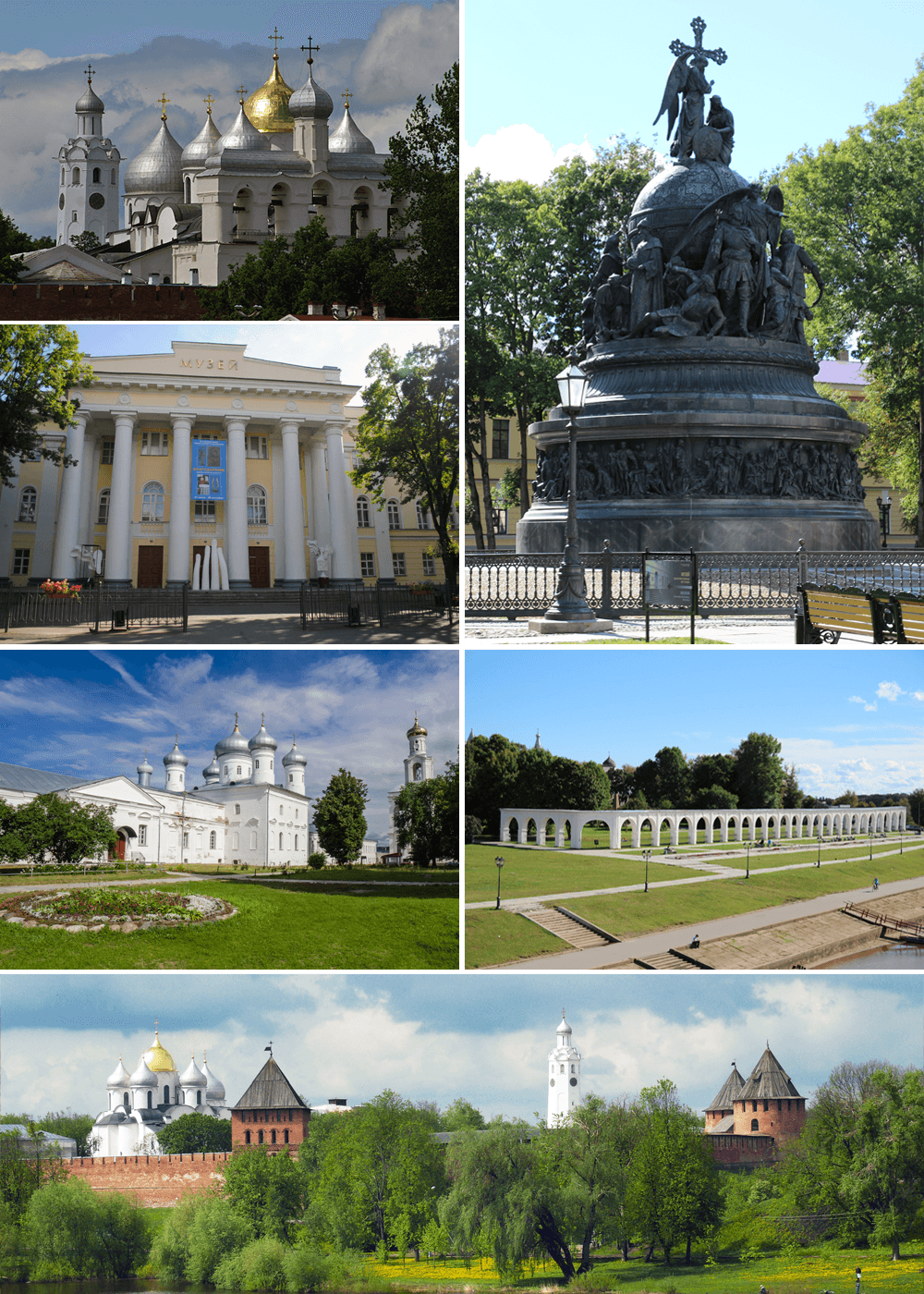 Insider, Dio-fine-art, Нелли, Belliy, Konstantin hramov / CC BY-SA 4.0, via Wikimedia Commons
“Where Russia's story began, in stone and parchment.”
Not the postcards. The stories even locals don't know — whispered in your ear, right where they happened.
The dove atop the central dome of Saint Sophia Cathedral isn't just a decorative element; local legend says its fate is tied to the city's.
This massive bronze monument, celebrating a thousand years of Russian statehood, has a curious omission among its 129 figures.
Beneath the ancient walls of the Novgorod Kremlin, there's a treasure that even the Germans couldn't unearth during World War II.
Discover every secret of Veliki Novgorod
Every address, every reveal in full — in your ear, right where it happened.
You pick your stops. You walk. The voice reveals what the others miss.
No tours available yet. Check back soon — we're preparing them.
Veliky Novgorod, often called the 'birthplace of Russia,' is a city where history breathes through ancient stones and river currents. Situated on the Volkhov River, just below its outflow from Lake Ilmen, this city dates back to 859 AD and is one of Russia's oldest settlements. Unlike the grand imperial facades of St. Petersburg or the Soviet-era monumentalism of Moscow, Veliky Novgorod offers a glimpse into medieval Rus, a period of unique political and cultural development.
Designated a UNESCO World Heritage site, Veliky Novgorod preserves an extraordinary collection of architectural monuments from the 11th to 17th centuries, including ancient frescoes, manuscripts, and icons. It was a vital commercial hub, connecting the Baltic with Byzantium and Central Asia, and for centuries, it operated as a republic governed by an assembly of citizens, known as the veche. This distinct history makes Veliky Novgorod a compelling destination for those seeking to understand the foundational layers of Russian identity.
Veliky Novgorod's story begins in the mid-9th century, emerging as a political center for Slavic and Finno-Ugric tribes. According to tradition, Prince Rurik settled here in 862, giving rise to the first Russian state and the Rurik dynasty, which ruled for over 700 years. This foundational event is commemorated by the Millennium of Russia Monument within the Kremlin, erected in 1862.
From 1136 to 1478, Veliky Novgorod was the capital of the Novgorod Republic, a unique medieval state that spanned from the Baltic Sea to the Ural Mountains. Unlike other Russian cities where princes held supreme authority, Novgorod was governed by an assembly of citizens, the veche, and an oligarchy of trading families. This early form of democratic tradition allowed the city to flourish as a major trading center, with extensive links to the Hanseatic League and river routes connecting northern Europe with Asia. Its prosperity was largely built on the trade of furs and beeswax from the vast northern forests under its control.
Novgorod's independence, however, eventually succumbed to the rising power of Moscow. In 1478, Ivan III absorbed it into the Muscovite state, marking the end of the Novgorod Republic. Despite this, the city's unique economic and cultural characteristics endured. The city suffered significant damage during World War II, being on the front line for over two years, but its historic buildings have since been meticulously restored, allowing visitors to experience its ancient grandeur.
The heart of Veliky Novgorod is its Kremlin, also known as the Detinets, the oldest surviving Kremlin in Russia. Entry to the grounds is free, allowing ample time to explore. Within its red-brick walls stands the majestic Saint Sophia Cathedral, built between 1045 and 1050, the oldest stone building in Russia. Look for its famous bronze doors and the central golden dome, crowned by the symbolic dove. Also within the Kremlin is the Millennium of Russia Monument, a grand bronze sculpture depicting key figures from Russian history.
Across the Volkhov River, connected by a pedestrian bridge, lies Yaroslav's Court and the old market. This area, once a bustling medieval marketplace, features several ancient churches, including St. Nicholas Cathedral. A short drive or taxi ride south of the city leads to the Yuriev Monastery, founded in 1030 and one of Russia's oldest monasteries, with its impressive St. George's Cathedral. Nearby, the Vitoslavlitsy Museum of Wooden Architecture is an open-air museum showcasing traditional wooden churches, houses, and izbas from the 16th to 20th centuries.
The best time to visit Veliky Novgorod for comfortable outdoor activities is from late June to mid-August. During these summer months, temperatures are pleasant, averaging between 22°C and 24°C (72-75°F), ideal for walking along the river and exploring the city's historical sites. While winters are very cold, the snow-covered city offers a photogenic landscape and fewer tourists, providing a different, serene experience. Autumn, particularly September to November, can also be a good time for fewer crowds and picturesque landscapes, though temperatures will be cooler.
Veliky Novgorod is easily accessible by train from both St. Petersburg and Moscow. The fast Lastochka train from St. Petersburg takes about three hours, while an overnight train from Moscow is also an option. The train station in Novgorod is conveniently located within a 10-15 minute walk of the city center. The city center is compact and walkable, making it easy to explore the main attractions on foot. For visits further afield, like to Yuriev Monastery and Vitoslavlitsy, taxis are readily available. While English may not be widely spoken, especially outside of major tourist areas, a smattering of Russian or a translation app can be helpful. The local currency is the Russian Ruble (RUB). Don't leave without trying Novgorod gingerbread (pryanik) or local honey, and consider birch bark crafts as unique souvenirs.