Ponte delle Tette
This bridge's unusual name hints at a surprising historical practice that once aimed to boost a specific Venetian industry.
Full story unlocks in the tour
 kallerna / CC BY-SA 4.0, via Wikimedia Commons
“Where every ripple tells a story and every alley holds a secret.”
Not the postcards. The stories even locals don't know — whispered in your ear, right where they happened.
This bridge's unusual name hints at a surprising historical practice that once aimed to boost a specific Venetian industry.
There's a street in Venice so narrow, you might have to breathe in to pass through.
Venetians still avoid walking between two prominent columns in St. Mark's Square, a tradition rooted in centuries of grim public spectacle.
Discover every secret of Venice
Every address, every reveal in full — in your ear, right where it happened.
You pick your stops. You walk. The voice reveals what the others miss.
No tours available yet. Check back soon — we're preparing them.
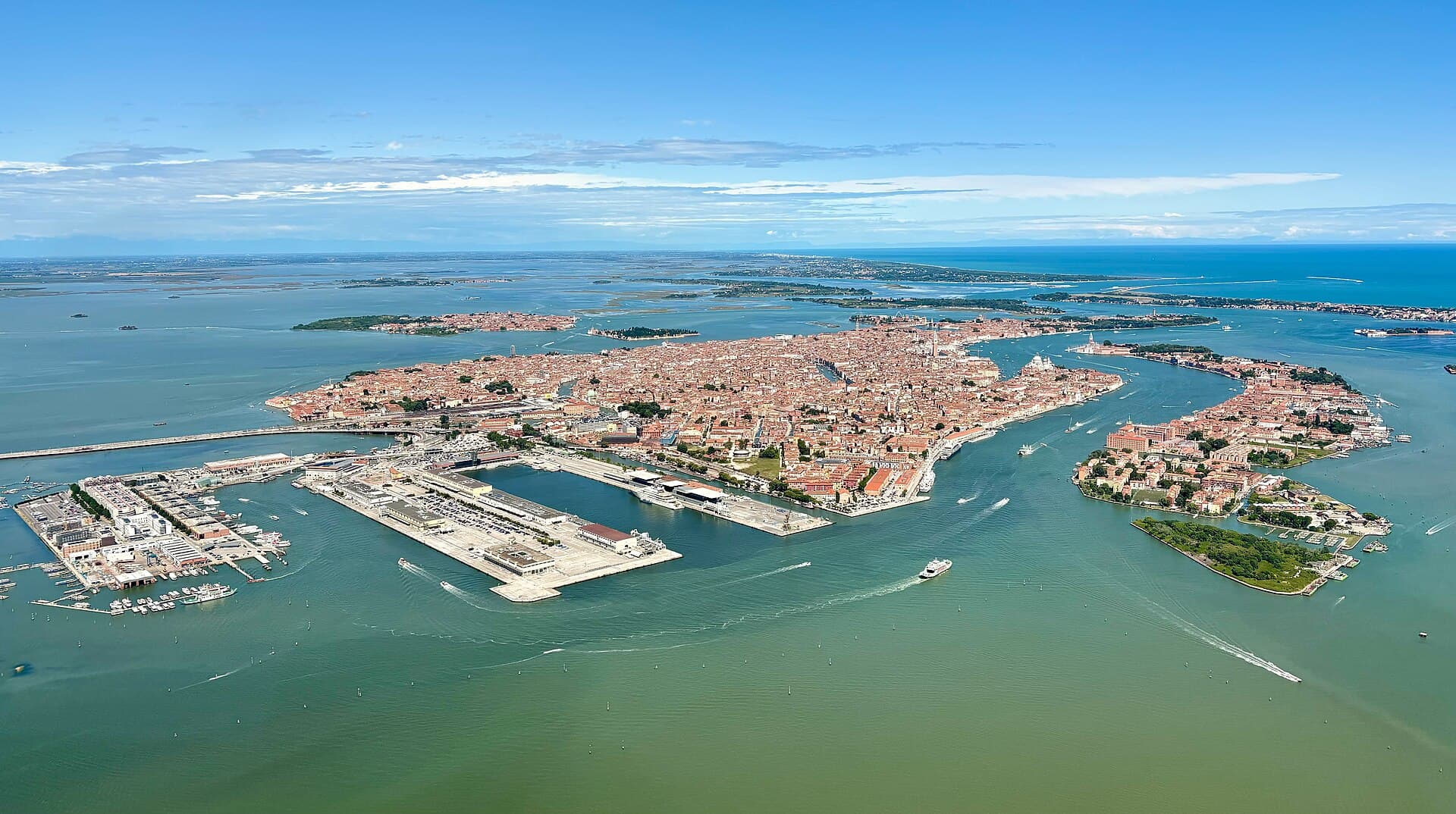
Venice, or Venezia as it is known in Italian, is a city unlike any other, constructed upon 118 small islands connected by over 400 bridges. This singular urban landscape, where waterways replace roads and boats are the primary mode of transport, has earned it monikers like 'City of Water' and 'The Floating City'. Its distinctive environment, architecture, and history have established it as a major seaport and a significant cultural center, consistently ranked among the most beautiful cities globally.
Stepping into Venice feels like entering a different world, one free of cars, where the rhythmic lapping of water against ancient stone structures sets the pace. While its iconic sights like Piazza San Marco and the Rialto Bridge draw visitors, the true enchantment of Venice often reveals itself in its quieter corners—the intricate alleyways, charming residential areas, and the unexpected beauty found when simply allowing yourself to wander. It is a city that rewards slow exploration and an open mind, offering a delicate balance between enjoying its renowned attractions and discovering its authentic, living pulse.
The origins of Venice trace back to the 5th century AD, when inhabitants from the mainland, primarily the Veneti tribe, sought refuge in the shallow Venetian Lagoon from invading barbarian tribes like the Huns, Goths, and Lombards. Early settlements on islets and sandbanks, such as Torcello and Malamocco, gradually grew, with the present urban structure taking shape in the early 7th century. Rivo Alto, later corrupted to Rialto, became the central hub, linking 118 separate islands and establishing the rule of an elected doge.
Venice quickly developed into a prosperous city-state, leveraging its strategic position at the head of the Adriatic Sea to control trade routes between Europe and the Middle East and Asia. By the 9th century, it had emerged as a major maritime power, benefiting from trading rights granted by the Byzantine Empire and gradually asserting its independence. The city became a crucial center for commerce in silk, grain, and spices, and its shipbuilding prowess was legendary. The Venetian Arsenal, established around 1104, is considered by many historians to be the first factory in history, capable of producing a warship a day and forming the backbone of Venice's naval might for centuries.
By the 13th century, Venice was one of the most prosperous cities in Europe, dominating Mediterranean shipping. Its influence extended to art and music, playing a significant role in the Italian Renaissance and being the birthplace of Baroque composers like Antonio Vivaldi. The Republic of Venice, known as 'La Serenissima' (The Most Serene), maintained its independence for nearly a millennium, from 810 to 1797. However, challenges such as the Black Death, conflicts with neighboring powers, and the discovery of new trade routes gradually diminished its economic importance.
Venice's sovereignty ultimately ended in 1797 when Napoleon Bonaparte conquered the city during the War of the First Coalition. After a period under Austrian rule and then as part of Napoleon's Kingdom of Italy, Venice finally became part of the newly created Kingdom of Italy in 1866 following the Third Italian War of Independence. Despite losing its political power, Venice has preserved its cultural heritage and remains a globally recognized symbol of beauty and history.
Begin your exploration in Piazza San Marco, the city's main public square, home to the magnificent St. Mark's Basilica with its Byzantine mosaics, and the Doge's Palace, a masterpiece of Venetian Gothic architecture. Consider an evening visit to these major sights for a more serene experience away from midday crowds. Cross the Rialto Bridge, one of the oldest bridges spanning the Grand Canal, offering expansive views of the bustling waterway.
Beyond the main attractions, allow yourself to wander. Take a vaporetto (water bus) ride along the Grand Canal for a scenic perspective of the city's palaces. For a more intimate experience, consider a gondola ride through the smaller canals. Explore the Cannaregio district, home to the historic Venetian Ghetto, the oldest ghetto in history, offering a glimpse into Jewish Venetian culture. Visit the quirky Libreria Acqua Alta, a bookshop where books are stored in bathtubs and gondolas to protect them from high water.
Consider a day trip to the colorful island of Burano, renowned for its brightly painted houses and lace-making tradition. For art enthusiasts, the Gallerie dell'Accademia houses an exceptional collection of Venetian art, and the Peggy Guggenheim Collection offers modern art in a beautiful setting. Do not miss the opportunity to simply get lost in the residential areas, where you can find tranquil moments and observe local life.
The most pleasant times to visit Venice are during the spring (April to June) and fall (September to early October) shoulder seasons. During these months, the weather is mild and agreeable, and while there are still visitors, the crowds are generally smaller than during the peak summer months. Summer (July and August) brings hot, humid weather and the largest crowds, though it is also a time for lively cultural events and festivals. Winter (outside of Carnival) offers the fewest crowds and a quieter, often foggy, atmosphere, but also colder temperatures and a higher chance of acqua alta (flooding).
Venice is a pedestrian city; no cars, bikes, or scooters are allowed in the historic center. The primary ways to get around are walking or by boat. The vaporetto (public water bus) is an efficient way to navigate the canals, and multi-day passes are more cost-effective if you plan to use it frequently. Private water taxis are available but significantly more expensive.
Comfortable footwear is essential, as you will be doing a lot of walking over bridges and uneven paving stones. When visiting churches, remember to cover your shoulders and knees. Be aware that Venice can be crowded, especially around major sights, so consider starting your sightseeing early or late in the day to avoid the busiest times. While generally safe, be mindful of pickpockets in crowded tourist areas. It is also advisable to book accommodation and tours in advance, especially during peak seasons.