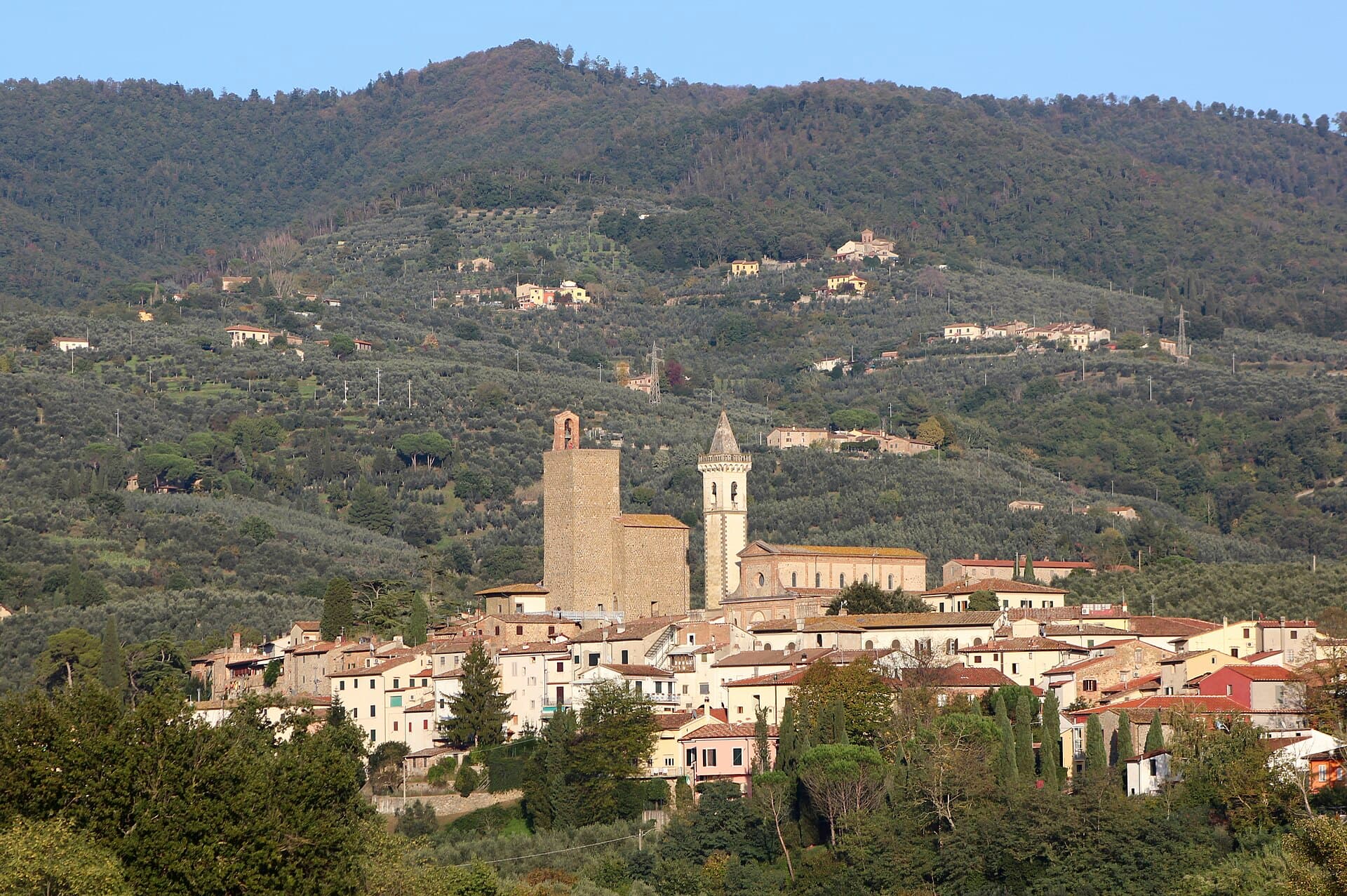
The medieval castle overlooking Vinci's skyline holds a secret about its unusual silhouette.
LigaDue / CC BY-SA 4.0, via Wikimedia CommonsVinci
“Walk the same Tuscan streets that shaped a Renaissance master.”
Vinci, as no one tells it.
Not the postcards. The stories even locals don't know — whispered in your ear, right where they happened.
Beyond the statues and museums, a local story endures about Leonardo's family in the town's central square.
Each July, Vinci re-enacts a dramatic medieval narrative involving betrayal, a desperate leap, and a surprising escape.
Discover every secret of Vinci
Every address, every reveal in full — in your ear, right where it happened.
You pick your stops. You walk. The voice reveals what the others miss.
How long do you have in Vinci?
No tours available yet. Check back soon — we're preparing them.
The story of Vinci
Vinci, a compact medieval town set in the Florentine hills of Tuscany, is globally recognized as the birthplace of Leonardo da Vinci. This engaging settlement, surrounded by gentle hills, olive groves, and vineyards, offers a passage into the life and inspirations of the Renaissance polymath.
The town's identity is deeply intertwined with its most celebrated son, with many attractions dedicated to his ingenuity. From reconstructed machines based on his designs to the very farmhouse where he was born, Vinci provides a tangible link to Leonardo's early life and the landscape that shaped his observations and creations.
Beyond its Leonardian focus, Vinci retains the character of a well-preserved medieval Tuscan town, inviting visitors to wander its ancient pathways and enjoy the serene countryside. It serves as an ideal destination for those seeking a blend of cultural immersion, historical exploration, and the tranquil splendor of the Tuscan landscape.
From Ancient Roots to Renaissance Genius
Vinci’s origins stretch back to antiquity, its strategic hilltop position establishing it as an important settlement. The town lies on the slopes of Montalbano, a hilly expanse characterized by terraced vineyards and olive groves. Its name is thought to derive from 'vinco' or 'vincastro,' referring to the willow tree, whose flexible twigs were used to tie vine shoots.
The medieval period saw the construction of key landmarks, including the Castle of the Guidi Counts, built around the year 1000, and the Church of Santa Croce, documented by the 12th century. Over the centuries, Vinci was a contested territory, eventually becoming a municipality in 1372, with the Guidi fortress serving as the residence of the Podestà, or chief magistrate. The Podestà’s Hall within the castle still displays the coats of arms of past magistrates.
Vinci gained worldwide renown on April 15, 1452, with the birth of Leonardo da Vinci in the nearby hamlet of Anchiano. Born an illegitimate son to Florentine notary Ser Piero and a peasant woman named Caterina, Leonardo was baptized in the Church of Santa Croce. His early years were spent in this rural setting, surrounded by the landscapes that would later inspire elements in his celebrated paintings, such as the bluish misty horizons seen in many of his works. While he moved to Florence as a child, Leonardo maintained a connection to Vinci, even returning in 1478 to sign a lease for the Vinci Mill.
The idea of a museum dedicated to Leonardo in his hometown emerged in 1919, the 400th anniversary of his death. The Castle of the Guidi Counts was donated to the municipality for this purpose and, after restoration, the Museo Leonardiano was inaugurated in 1953, showcasing models of his inventions.
A visit to Vinci naturally focuses on Leonardo da Vinci. The Museo Leonardiano, housed within the medieval Castle of the Guidi Counts and the Palazzina Uzielli, is a primary stop. It presents an extensive collection of models built from Leonardo's sketches, illustrating his ingenuity in fields like civil engineering, warfare, and flight, alongside interactive displays.
Just 3 kilometers from the town center, in the hamlet of Anchiano, stands the Casa Natale di Leonardo, the farmhouse where Leonardo was born. This museum offers insights into his early life, featuring reproductions of his drawings and a life-size hologram of Leonardo recounting his story.
In the heart of Vinci, the Church of Santa Croce, dating back to the 13th century, is believed to be where Leonardo was baptized, and it still preserves the original baptismal font. Nearby, Piazza dei Guidi, designed by artist Mimmo Paladino, features geometric patterns inspired by Leonardo's scientific and artistic works. Observe the bronze 'Leonardo's Horse' monument in Piazza della Libertà, inspired by his unrealized equestrian sculptures.
For researchers and enthusiasts, the Biblioteca Leonardiana offers a wealth of documents and replicas of Leonardo's codices.
The most agreeable times to visit Vinci are during the spring (April, May, June) and autumn (September, October) months. During these periods, temperatures are comfortable, ranging from 18°C to 30°C (64°F to 86°F), and the Tuscan landscape is particularly verdant. This allows for pleasant walks through the countryside and comfortable exploration of the town's attractions with fewer crowds. While July and August offer warm weather and longer days, they are also the driest months with average highs around 30°C (86°F) and lows around 18°C (64°F), making them suitable for outdoor activities, though potentially busier. November is the wettest month.
Vinci is located approximately 50 kilometers (31 miles) west of Florence. While you can reach Vinci by car in about 40 minutes from Florence, there is no direct train service to Vinci itself; driving or hiring a personal driver is recommended. Alternatively, you can take a train to a nearby town like Empoli and then a bus. Free parking is available on streets surrounding the village, such as Via Rossi and Via Montalbano, and near Leonardo's Birthplace.
Most visitors find one to two days sufficient to explore Vinci's main sights at a relaxed pace. A single ticket often covers admission to both the Museo Leonardiano and Leonardo's Birthplace. Individual visitors do not typically need to book museum tickets in advance. The Municipality of Vinci applies a tourist tax of €1.50 per person per day for up to six consecutive nights, with children under 14 exempt.
- How far is Vinci from Florence?
- Vinci is approximately 50 kilometers (31 miles) west of Florence, a drive that typically takes about 40 minutes.
- Can I reach Vinci by train?
- There is no direct train station in Vinci. It is recommended to drive, hire a private driver, or take a train to a nearby city like Empoli and then connect via bus.
- Is there an entrance fee for the Leonardo Museum and his birthplace?
- Yes, there is an entrance fee, and a combined ticket often allows access to both the Museo Leonardiano and Leonardo's Birthplace. Individual visitors do not usually need to book in advance.
- How much time should I allocate for visiting Vinci?
- Most visitors find that one to two days are sufficient to explore the main attractions in Vinci at a comfortable pace.
- Are there parking facilities in Vinci?
- Yes, free parking spaces are available on streets surrounding the village, such as Via Rossi and Via Montalbano, and near Leonardo's Birthplace.
- Is there a tourist tax in Vinci?
- Yes, the Municipality of Vinci applies a tourist tax of €1.50 per person per day, for a maximum of six consecutive nights. Children under 14 are exempt.