RU

Volgograd

Volgograd: Where history's echoes meet the Volga's flow.

The secrets of Volgograd

Volgograd, as no one tells it.

Not the postcards. The stories even locals don't know — whispered in your ear, right where they happened.

3 secrets below. Many more wait inside the tour.
Mamayev Kurgan

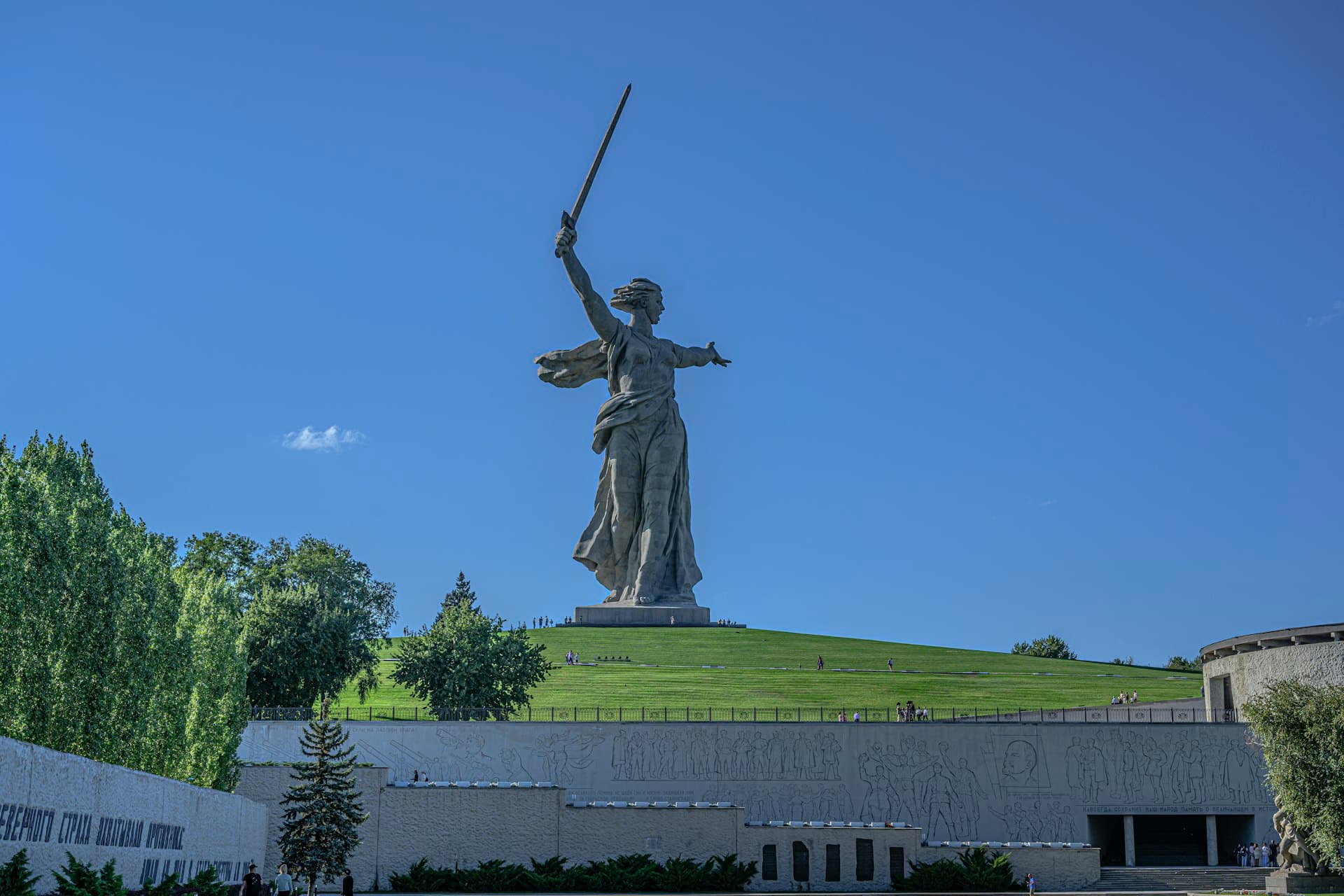
The colossal 'The Motherland Calls' sculpture on Mamayev Kurgan is a powerful symbol, yet its creation posed an unexpected engineering puzzle.

Full story unlocks in the tour
Gerhardt's Mill

This skeletal mill stands as a stark testament to the Battle of Stalingrad, though it once served a purpose far removed from destruction.

Full story unlocks in the tour
Volgograd Metrotram

Volgograd possesses a distinctive public transport system, offering a journey that feels like a blend of two different transit experiences.

Full story unlocks in the tour
The full tour

Discover every secret of Volgograd

Every address, every reveal in full — in your ear, right where it happened.

Get the key to Volgograd

You pick your stops. You walk. The voice reveals what the others miss.

Choose your time

How long do you have in Volgograd?

No tours available yet. Check back soon — we're preparing them.

About Volgograd

The story of Volgograd

Volgograd, a city stretching over 80 kilometers along the western bank of the mighty Volga River, is a place deeply etched into the annals of time. Established in 1589 as the fortress of Tsaritsyn, it later became globally recognized as Stalingrad, the stage for one of World War II's most pivotal and brutal conflicts. Today, Volgograd stands as an enduring monument to human tenacity, having risen from near-total devastation to become a modern industrial and transport nexus.

The city's identity is profoundly linked to its past, with numerous memorials and museums honoring the courage and sacrifice of its defenders. Yet, beyond its deep historical resonance, Volgograd offers a distinctive array of experiences, from its singular Metrotram system to its expansive riverfront. It is a city that invites quiet contemplation and profound discovery, revealing layers of its intricate narrative to those who wander its wide boulevards and tranquil corners.

History

From Tsaritsyn to Volgograd: A City Forged by Conflict

Volgograd's origins trace back to 1589 when it was established as the fortress of Tsaritsyn. Its strategic location at a narrow point of the Volga River, where ancient trade routes converged, rendered it a vital outpost for defending Russian territories against incursions from the south and east. For nearly three centuries, Tsaritsyn functioned as a modest military and trading settlement, frequently repelling assaults from Cossacks, Crimean Tatars, and Kalmyks.

The 19th century brought swift development with the construction of the Volga-Don Railway, transforming Tsaritsyn into an important river port and commercial center. This period of growth saw the emergence of new factories, enhanced infrastructure, and a burgeoning population. However, the city's strategic importance also drew it into the maelstrom of the Russian Civil War. In November 1917, it came under Bolshevik control, briefly falling to the White Army in mid-1919, before returning to Bolshevik hands in January 1920. In 1925, Tsaritsyn was renamed Stalingrad in recognition of Joseph Stalin's role in the city's defense during the Civil War.

The city's most defining period arrived during World War II, when it became the epicenter of the Battle of Stalingrad (August 1942 to February 1943). This brutal and bloody conflict, considered by many historians to be the greatest battle of the entire war, saw the German Sixth Army attempt to seize the industrial city, aiming to sever Soviet transport links and secure a propaganda triumph. The fighting was incredibly fierce, with every structure contested and the city reduced to rubble. The Soviet victory at Stalingrad is widely regarded as the turning point of World War II.

After the war, Stalingrad was extensively rebuilt as a model Soviet city, with contributions from across the Soviet Union aiding its restoration. In 1961, as part of Nikita Khrushchev's de-Stalinization efforts, the city was renamed Volgograd. This alteration, while controversial to some due to Stalingrad's symbolic importance, marked a new chapter for the city. Today, Volgograd continues to embrace its past while looking toward the future, serving as a major industrial center and transport hub on the Volga River.

What to see

Volgograd's most prominent landmark is the Mamayev Kurgan memorial complex, a commanding height overlooking the city that commemorates the Battle of Stalingrad. The centerpiece is the colossal 'The Motherland Calls' sculpture, an 85-meter (279 ft) tall concrete figure depicting a woman with a sword, which was the tallest free-standing sculpture in the world upon its completion in 1967. The memorial also includes the Hall of Military Glory and the Square of Heroes, with its poignant ruined walls.

Adjacent to Mamayev Kurgan is the Panorama Museum of the Battle of Stalingrad, which houses artifacts from World War II, including a rifle belonging to the renowned sniper Vasily Zaytsev, and features a panoramic painting of the battlefield. Nearby, the skeletal remains of Gerhardt's Mill stand as a preserved testament to the intense urban combat, intentionally left in its war-torn state. Another significant site is Pavlov's House, a strategic apartment building defended by a small group of Soviet soldiers for two months.

For a different perspective, explore the Volga River embankment, offering views of the river and illuminated landmarks at night. The city's distinctive Metrotram provides an intriguing way to navigate, with sections running underground like a metro. The Alley of Heroes, a pedestrian boulevard connecting the central waterfront to the main square, is lined with steles commemorating Soviet Union heroes.

When to visit

The most pleasant times to experience Volgograd are during late spring (May to early June) and early autumn (September to early October). During these months, temperatures are mild and comfortable, typically ranging from 18-25°C (64-77°F), making outdoor exploration enjoyable. Rainfall is also less frequent during these periods. Summers, particularly July and August, can be very hot, with temperatures often exceeding 35°C (95°F). Winters, from December to February, are cold and snowy, with temperatures dropping to -10°C (14°F) or lower.

Practical

Volgograd International Airport (VOG) is the primary gateway, situated approximately 15 km northwest of the city center, offering direct flights from Moscow and St. Petersburg. Train travel presents another option, with journeys from Moscow lasting around 20-24 hours. Once within the city, the Volgograd Metrotram is an efficient way to navigate, particularly for longer distances across the city's elongated layout. Ride-hailing applications are also widely used and economical.

The local currency is the Russian Ruble (RUB). While card payments are common in larger establishments, carrying cash is advisable for smaller shops, museums, and public transport, as international card acceptance can vary. Volgograd experiences a phenomenon of biting midges, known as 'moshka,' especially in June, so prepare with repellent if visiting during this time. Allow at least 2-3 days to thoroughly explore the city's historical sites and attractions.

Good to know
What was Volgograd called before?
Volgograd was originally established as Tsaritsyn in 1589. It was renamed Stalingrad in 1925 and subsequently Volgograd in 1961 as part of de-Stalinization efforts.
What is 'The Motherland Calls' sculpture?
'The Motherland Calls' is a colossal 85-meter (279 ft) high sculpture on Mamayev Kurgan, commemorating the Battle of Stalingrad. It depicts a female personification of Russia with a sword, symbolizing strength and resolve.
What is the Volgograd Metrotram?
The Volgograd Metrotram is a distinctive public transport system that combines elements of both a surface tram and an underground metro, connecting various parts of the city's extensive length.
What is the significance of Mamayev Kurgan?
Mamayev Kurgan is a commanding hill that was a crucial strategic point during the Battle of Stalingrad, witnessing some of the most intense fighting. Today, it hosts a vast memorial complex, including 'The Motherland Calls' sculpture, honoring the battle's heroes.
What is Gerhardt's Mill?
Gerhardt's Mill is the preserved, ruined shell of an early 20th-century industrial mill that served as a fortified defensive position during the Battle of Stalingrad. It was intentionally left unrestored as a memorial.
What is the best way to get around Volgograd?
The Volgograd Metrotram is an efficient way to travel, especially considering the city's elongated layout. Ride-hailing applications are also widely available and economical for direct convenience.
Volgograd
From€9.00
No booking · activate anytime · 12h to walk it
Get the key to Volgograd