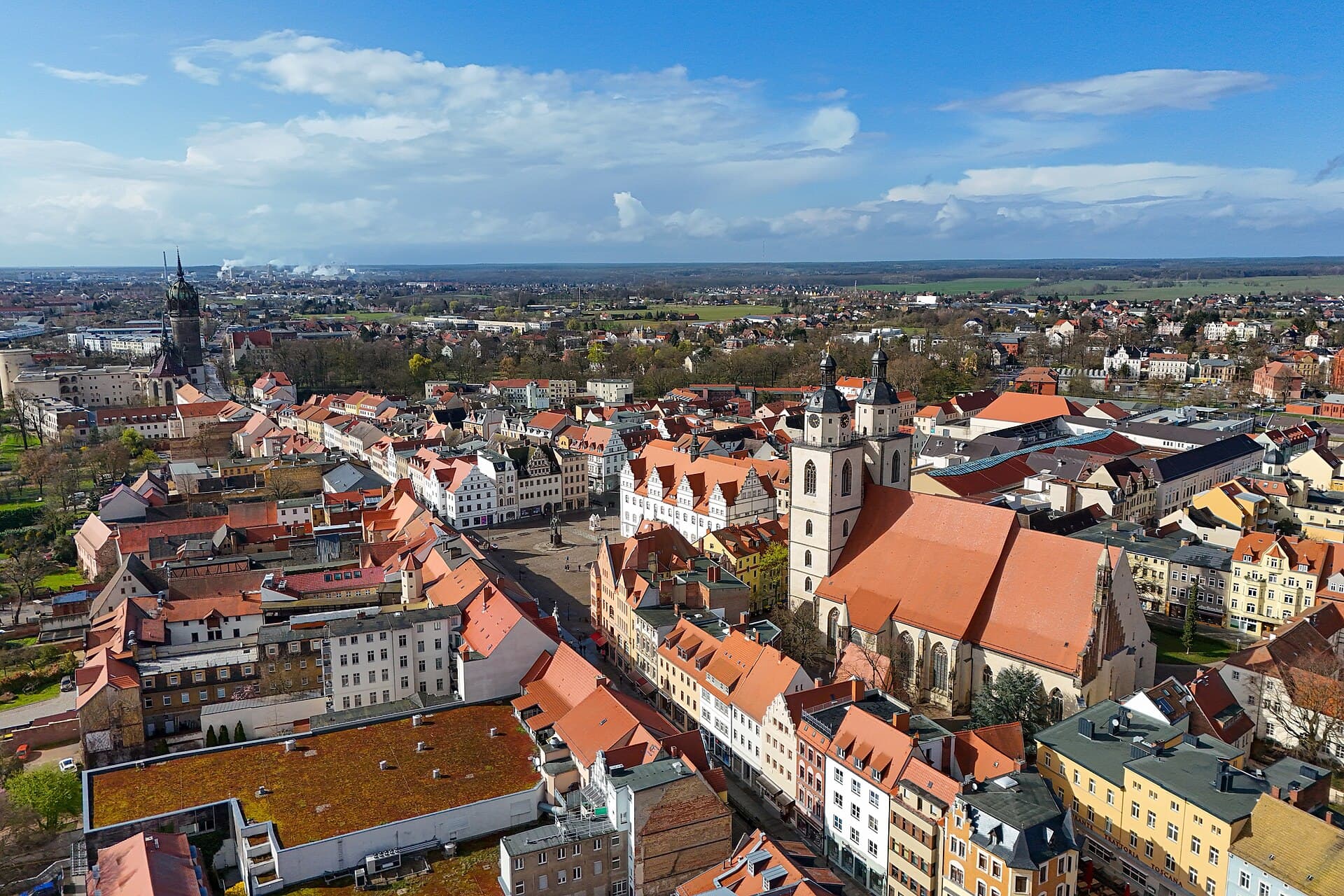
Wittenberg, GermanyToniklemm / CC BY-SA 4.0, via Wikimedia Commons
DE

Wittenberg

Where a monk's hammer struck the spark that reshaped a continent.

The secrets of Wittenberg

Wittenberg, as no one tells it.

Not the postcards. The stories even locals don't know — whispered in your ear, right where they happened.

3 secrets below. Many more wait inside the tour.
Lutherhaus

Martin Luther's former home, now the world's largest Reformation museum, holds a secret about its closure during a recent visit.

Full story unlocks in the tour
Wittenberg Castle Church

The iconic bronze doors of the Castle Church, etched with Luther's 95 Theses, aren't the originals.

Full story unlocks in the tour
Wittenberg Market Square

The statues of Luther and Melanchthon standing prominently in the market square weren't always there.

Full story unlocks in the tour
The full tour

Discover every secret of Wittenberg

Every address, every reveal in full — in your ear, right where it happened.

Get the key to Wittenberg

You pick your stops. You walk. The voice reveals what the others miss.

Choose your time

How long do you have in Wittenberg?

No tours available yet. Check back soon — we're preparing them.

About Wittenberg

The story of Wittenberg

Wittenberg, officially known as Lutherstadt Wittenberg, is a town along the Elbe River in Saxony-Anhalt, Germany. It is known as the "cradle of the Reformation," a pivotal 16th-century religious movement that profoundly reshaped European history and led to the birth of Protestantism. The town's enduring legacy is its deep connection to Martin Luther, who lived, taught, and preached here for much of his life.

Today, Wittenberg is a well-preserved town, offering a tangible link to this transformative period. Its historic center, a UNESCO World Heritage Site, features late-Gothic and Renaissance architecture and a peaceful atmosphere. Despite its immense historical importance, Wittenberg maintains a compact and uncrowded feel, making it an ideal destination for those interested in religious history, German culture, or a tranquil escape.

History

From Medieval Settlement to Reformation Epicenter

Wittenberg first appears in historical records in 1180 as a small village established by Flemish colonists. By 1260, it became the residence of the dukes of Saxe-Wittenberg, and in 1293, it was granted its town charter. Over the following centuries, Wittenberg grew into an important trading hub due to its central location. In 1422, the House of Wettin assumed control, and by the late 1400s, under Elector Frederick III "the Wise," Wittenberg transformed into a major political and cultural center.

Frederick the Wise founded the University of Wittenberg (Leucorea) in 1502, attracting scholars like Martin Luther and Philip Melanchthon, who would become central figures in the Reformation. It was here, on October 31, 1517, that Martin Luther allegedly nailed his Ninety-five Theses to the door of the Castle Church, an act widely considered the catalyst for the Protestant Reformation. Luther's ideas, disseminated from Wittenberg, challenged established Christian beliefs and led to the division of Western Christendom.

Wars, Rebuilding, and Enduring Legacy

Wittenberg's significance continued through the religious wars that followed the Reformation. In 1547, the Capitulation of Wittenberg resulted in a shift of power within Saxony. The town suffered damage during the Seven Years' War in 1760, when Austrian forces bombarded it, destroying a significant portion of the Castle Church, including its original wooden doors. French forces occupied Wittenberg in 1806, and Napoleon ordered its fortifications strengthened in 1813. However, the Prussian Army stormed the city in 1814, and it became part of the Kingdom of Prussia in 1815.

Despite these conflicts, Wittenberg was largely spared destruction during World War II due to its religious history. The town underwent significant restoration in the late 1800s, with the Castle Church being rebuilt between 1885 and 1892. Today, Wittenberg's well-preserved historic center and its sites associated with Luther and Melanchthon are recognized as a UNESCO World Heritage site, drawing visitors from around the globe to explore its profound historical and cultural impact.

What to see

Wittenberg's historic core, a UNESCO World Heritage site, offers a concentrated experience of Reformation history. Begin at the Market Square (Marktplatz), the town's central hub, featuring statues of Martin Luther and Philip Melanchthon and framed by the impressive 16th-century Renaissance Town Hall. The Stadtkirche St. Marien (Town and Parish Church of St. Mary's), the oldest building in Wittenberg, is where Luther regularly preached and where the first Mass in German was held. Inside, admire the Cranach Altarpiece, a masterpiece by Lucas Cranach the Elder and his son.

The Castle Church (Schlosskirche) is an imposing landmark, famous as the site where Luther allegedly posted his 95 Theses. Climb its tower for expansive views of the town. Luther and Melanchthon are buried inside. The Lutherhaus, Luther's former residence in a converted Augustinian monastery, is now the world's largest museum of Reformation history. Explore the Melanchthonhaus, the beautiful Renaissance-style home of Luther's close associate Philip Melanchthon, offering insights into their lives and work. Find the Cranach Courts (Cranach-Höfe), where Lucas Cranach the Elder lived and worked, now housing galleries and studios. For a different perspective, visit the Old Latin School, built in 1564 as a city school for boys, which played a role in Western education.

When to visit

Wittenberg experiences a temperate climate with four distinct seasons. The most comfortable time for warm-weather activities and sightseeing is from mid-June to early September, when average daily highs are above 69°F (20°C) and often reach 76°F (25°C). Spring (April to June) and autumn (September to early October) offer mild weather and fewer crowds. While winter is quieter, it can be cold and damp, with average lows around 28°F (-2°C) in January. The town hosts medieval fairs, including "Luther's Wedding" in June and the Reformation Festival around October 31st.

Practical

Wittenberg is easily accessible. It's approximately an hour by train from Berlin and Leipzig, and about 100 kilometers southwest of Berlin. The train station is a 10-15 minute walk from the old town. The town center is compact and largely pedestrianized, making it highly walkable. Comfortable shoes are recommended for exploring the streets. Consider spending at least one night to fully experience the sights without rushing, though highlights can be seen in a day. While ticket fees for attractions are moderate, food can be on the higher end of the budget. Most shops in Germany, including Wittenberg, are closed on Sundays, with some exceptions for souvenir shops and cafes in tourist areas.

Good to know
What is Wittenberg most famous for?
Wittenberg is most famous as the birthplace of the Protestant Reformation, where Martin Luther allegedly nailed his 95 Theses to the door of the Castle Church in 1517.
Is Wittenberg a UNESCO World Heritage site?
Yes, several sites in Wittenberg associated with Martin Luther and Philip Melanchthon, including the Castle Church, Stadtkirche St. Marien, Lutherhaus, and Melanchthonhaus, were designated a UNESCO World Heritage site in 1996.
How far is Wittenberg from Berlin?
Wittenberg is about 62 miles (100 km) southwest of Berlin and can be reached by train in approximately one hour.
What are the main attractions in Wittenberg?
Key attractions include the Castle Church, Stadtkirche St. Marien, Lutherhaus (Luther's home and museum), Melanchthonhaus, the Cranach Courts, and the historic Market Square.
Are there any festivals in Wittenberg?
Yes, Wittenberg hosts several festivals, including "Luther's Wedding" in June, a medieval fair that recreates the marriage of Martin Luther and Katharina von Bora, and the Reformation Festival around October 31st.
Is Wittenberg walkable?
Yes, Wittenberg is a small and compact town, and its historic center is largely pedestrianized, making it very easy to explore on foot.
Wittenberg
From€9.00
No booking · activate anytime · 12h to walk it
Get the key to Wittenberg