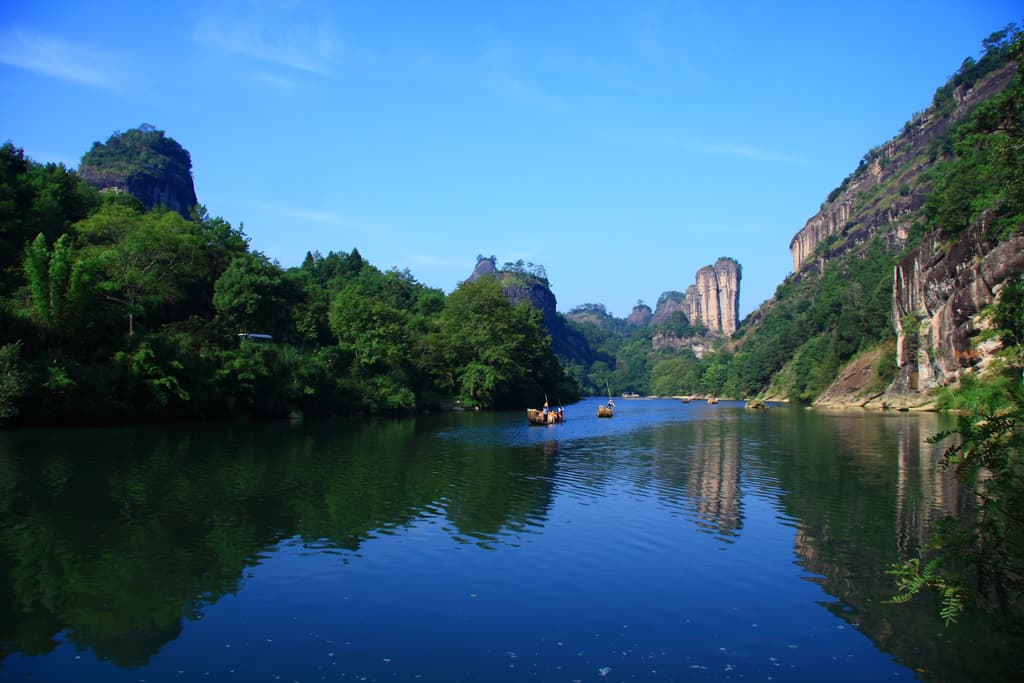
Jiuqu Stream (Nine-Bend Stream)
The tranquil bamboo raft journey down the Jiuqu Stream offers more than just scenic beauty.
Full story unlocks in the tour
 老过 / CC BY 2.5 cn, via Wikimedia Commons
Self-guided audio walking tour of Wuyishan — GPS route, offline playback, story-driven narration in 32 languages.
“Where ancient peaks meet enduring tea traditions and the wisdom of Neo-Confucianism.”
Not the postcards. The stories even locals don't know — whispered in your ear, right where they happened.
The tranquil bamboo raft journey down the Jiuqu Stream offers more than just scenic beauty.
The most expensive tea in the world comes from just a few ancient bushes clinging to a cliffside in Wuyishan.
High on the cliffs of Wuyishan, mysterious wooden boat-shaped coffins defy easy explanation.
Discover every secret of Wuyishan
Every address, every reveal in full — in your ear, right where it happened.
You pick your stops. You walk. The voice reveals what the others miss.

Your self-guided audio tour of Wuyishan is ready — pick your landmarks, choose your language, and start the moment you arrive.
BuyLume has a built-in augmented-reality guide. Hold your phone up and its camera shows the street ahead of you, with a glowing arrow laid over the real view that always points to your next stop — no map to puzzle over, no wrong turns. Like everything in Lume, it works fully offline.
Wuyishan, a UNESCO World Heritage site in China's Fujian province, presents a landscape where dramatic red sandstone cliffs meet the clear waters of the Nine-Bend Stream. This region is celebrated for its unique Danxia landforms, which feature towering monoliths and domed cliffs carved by water and wind over millions of years. Beyond its natural grandeur, Wuyishan holds profound cultural significance, recognized for its exceptional biodiversity and its deep connections to ancient civilizations, tea culture, and Neo-Confucianism.
The area offers a harmonious blend of scenic beauty and historical depth, making it a compelling destination for those seeking both natural wonder and cultural enlightenment. From tranquil bamboo raft journeys along the winding river to exploring ancient temples and tea plantations, Wuyishan invites a contemplative pace, revealing a new perspective at every turn and a distinct flavor in every cup of its renowned tea.
Wuyishan is not merely a collection of picturesque views; it is a living testament to the interplay between nature and human endeavor, a place where legends are woven into the very fabric of the landscape. It is one of the few places globally to hold dual UNESCO World Heritage status for both its natural and cultural values.
The history of Wuyishan stretches back over 4,000 years, with archaeological evidence indicating human habitation during the Neolithic era. The region was once home to the Minyue kingdom, which flourished between 334 and 110 BC, leaving behind unique cultural artifacts, including the enigmatic 'hanging coffins'. The strategic importance of the area was recognized early, with a large administrative capital built nearby by the Han Dynasty in the 1st century BC.
The mountains themselves are said to have been named after two legendary brothers, Wu and Yi, who, according to folklore, tamed the river floods in ancient times. An administrative entity, Chong'an County, was established in 994 during the Song Empire, a precursor to the modern Wuyishan City, which gained its current status in 1989.
Wuyishan transformed into a significant intellectual and spiritual center during the Song Dynasty, particularly with the rise of Neo-Confucianism. The influential philosopher Zhu Xi spent over 40 years in Wuyishan in the 12th century, where he taught, wrote extensively, and founded a renowned academy in 1183. His work cemented Wuyishan's reputation as the 'Cradle of Neo-Confucianism,' profoundly influencing East Asian cultures for centuries.
Wuyishan's enduring story is also inextricably linked to tea. The region is one of the oldest and most historically significant tea-growing areas globally, with references to tribute teas for emperors dating back to the Northern and Southern dynasties (386–589 AD). It is widely recognized as the birthplace of black tea, with Lapsang Souchong being the first red tea produced here around the beginning of the Qing Dynasty (1636-1912). Farmers in Wuyishan also developed the methods for making oolong tea around 1650, a style known as 'Yan Cha' or 'Rock Tea' due to the unique mineral-rich soil of the volcanic mountains.
In the 13th and 14th centuries, during the Yuan Dynasty, imperial tea gardens were established in Wuyishan to produce tea for the imperial court, solidifying its reputation for elite tea. By the 17th century, Wuyishan became the starting point of the Great Tea Road, an overland trade route that supplied tea, including famous red teas, to Europe, contributing significantly to the region's economic prosperity and global renown.
Wuyishan offers a range of experiences, from serene river journeys to invigorating mountain hikes and immersive tea culture. A highlight is the Nine-Bend Stream (Jiuquxi), where traditional bamboo rafts drift through a landscape of red sandstone cliffs and lush greenery. The 9.5-kilometer journey, with its eighteen winding turns, provides unique scenic vistas at each bend. Consider tipping your rafter for detailed explanations of the surrounding peaks and their folklore.
For expansive views, Heavenly Tour Peak (Tianyoufeng) is a popular ascent, offering panoramas of the meandering Nine-Bend Stream and surrounding tea farms. The climb involves approximately 800 stone steps, with rest stops and viewing pavilions along the way. Many say a visit to Wuyishan is incomplete without climbing this peak.
Explore the Da Hong Pao Scenic Area, home to the legendary 'mother trees' of Da Hong Pao oolong tea, clinging to a cliffside. Walking through the terraced tea gardens here provides insight into the origins of Wuyi rock tea. Nearby, the Water Curtain Cave (Shuilian Dong) is the largest rock cavern in Wuyishan.
Do not overlook the Wuyi Palace, a historical site dating back to the 7th century, originally built for emperors to conduct sacrificial activities. Adjacent to the palace is Song Street, a modern area with cafes, restaurants, and souvenir shops, ideal for a break after exploring.
For a unique cultural experience, consider the Impression Da Hong Pao show, an outdoor performance with a rotating 360-degree stage, set against the backdrop of Great King Peak, themed on the legend of Da Hong Pao tea.
The most pleasant times to visit Wuyishan are during spring (March to May) and autumn (September to November). During these shoulder seasons, temperatures are mild, ranging from 15°C to 25°C (59°F to 77°F), making conditions ideal for outdoor activities like hiking and bamboo rafting. Spring offers blooming flowers and the tea-picking season, while autumn brings clear skies and lively foliage. Summers (June-August) can be hot and humid, with temperatures often exceeding 30°C (86°F) and more frequent rainfall, though the lush greenery and refreshing rivers are appealing. Winters (December-February) are cooler and quieter, with fewer tourists and the chance of misty mountain views.
Wuyishan has its own airport (WUS) with direct flights from major Chinese cities like Beijing, Shanghai, and Xiamen. The airport is conveniently located, about 15 kilometers from Wuyi Mountain, with taxis and free local buses (routes 6 or 7) available to the scenic area and city center. High-speed rail is another excellent option, with Wuyishan North Station connecting to cities such as Fuzhou, Xiamen, and Shanghai. Taxis from Wuyishan North to the resort zone typically cost 25-30 CNY.
Within the Wuyishan National Park, private vehicles are not permitted. Shuttle buses connect the main scenic areas, and their cost is usually included in the park entry ticket. For the Nine-Bend River rafting, a separate shuttle or taxi may be needed to reach the starting point at Xingcun. It's advisable to wear comfortable, non-slip shoes for hiking, especially on stone steps which can be slippery due to humidity. Bringing a reusable water bottle, sun protection, and insect repellent is also recommended. While English interfaces are available for ride-hailing apps like DiDi, learning a few basic Mandarin phrases can enhance interactions with locals.
Wuyishan in Korean, in Chinese or in Hebrew — and 29 more languages, every stop narrated by a native voice. The widest language range of any self-guided audio tour.
Available in: