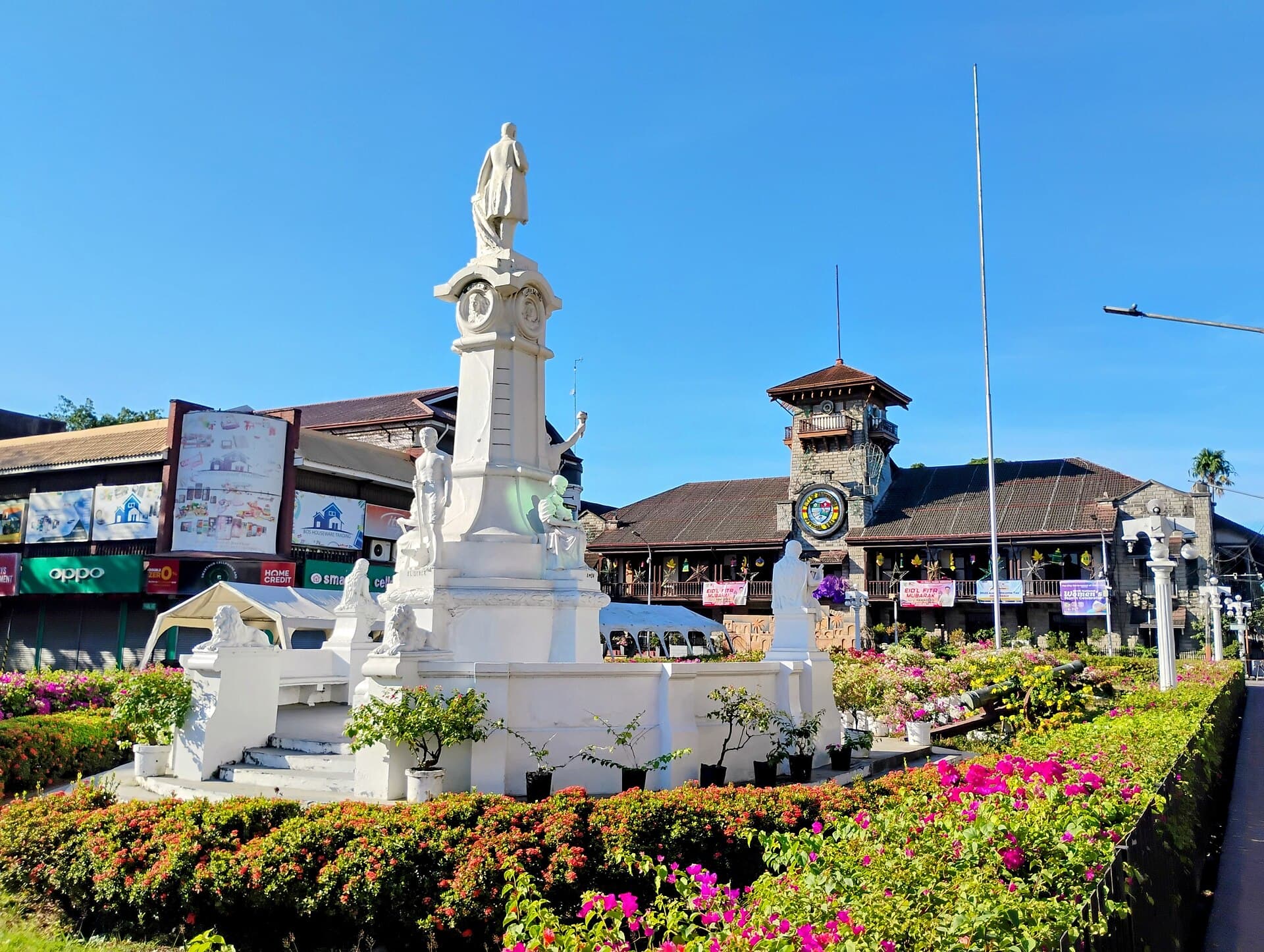
The stately Zamboanga City Hall, with its Antillean architecture, carries a subtle detail on its roof that alludes to a significant period in the city's past.
Ralff Nestor Nacor / CC BY-SA 4.0, via Wikimedia CommonsZamboanga
“Where Spanish echoes in a tropical breeze, and pink sands meet graceful vintas.”
Zamboanga, as no one tells it.
Not the postcards. The stories even locals don't know — whispered in your ear, right where they happened.
A coastal barangay in Zamboanga City, known for shipbuilding and repair, bears a name that diverges from its original, more descriptive Spanish designation.
Among Zamboanga's many islands, a particular cluster, known as 'Once Islas,' offers a distinct island-hopping experience with a surprising limitation.
Discover every secret of Zamboanga
Every address, every reveal in full — in your ear, right where it happened.
You pick your stops. You walk. The voice reveals what the others miss.
How long do you have in Zamboanga?
No tours available yet. Check back soon — we're preparing them.
The story of Zamboanga
Zamboanga City, often called the "City of Flowers," is a compelling urban center at Mindanao, Philippines' southwestern tip. Here, diverse cultures—from indigenous Subanen people to Muslim communities and Spanish settlers—have woven together, creating a singular blend of traditions and a distinct identity. This highly urbanized city stands as the third-largest in the Philippines by land area and the sixth-most populous in the archipelago, serving as the commercial and industrial heart of the Zamboanga Peninsula Region.
What truly distinguishes Zamboanga is its lively atmosphere and the enduring legacy of its past. The city is celebrated for Chavacano, a Spanish-based creole language spoken by a significant portion of its population, earning it the designation "Asia's Latin City." Beyond its linguistic charm, Zamboanga presents a dynamic array of historical landmarks, active markets, and natural marvels, including the renowned pink sand beach of Great Santa Cruz Island.
A Spanish Stronghold and Cultural Crossroads
The story of Zamboanga City is deeply rooted in its strategic location and its role as a significant Spanish settlement in Mindanao. The area was initially settled by the Subanen people, who arrived between 2,000 to 6,000 years ago. Later, in the 13th and 14th centuries, it became a hub for barter trading among Chinese, Malays, and various indigenous groups like the Tausugs, Samals, Subanons, and Badjaos.
Spanish presence began in 1569 with a small Catholic mission at La Caldera, now known as Recodo. However, the official establishment of the city by the Spanish occurred on June 23, 1635, when construction began on Fort San José, later to be known as Fort Pilar. This fort was vital for protecting Christian settlers against Moro pirates and served as a main headquarters for Spanish colonial efforts in the southern Philippines. The city's name itself is a Hispanicized spelling of the Sinama term "samboangan," meaning "mooring place," though it is also linked to the Malay word "jambangan," meaning "place of flowers."
After over 300 years of Spanish rule, Zamboanga experienced a brief period as the Republic of Zamboanga in 1899, following the defeat of the Spanish by revolutionary forces. The United States then established authority, converting Zamboanga into a city in the Commission Form, making it the first province of Mindanao to become a city during the American military government's existence. Zamboanga was officially inaugurated as a chartered city on February 26, 1937, under Commonwealth Act No. 39. It was designated a highly urbanized city on November 22, 1983. This rich array of influences has shaped Zamboanga into a city where Spanish-style architecture, a unique creole language, and diverse cultural practices continue to flourish.
Begin your exploration at Fort Pilar, a 17th-century Spanish military defense fortress that now houses a branch of the National Museum. Within its walls, you will discover artifacts illustrating the region's varied cultures and traditions. Just beyond the fort stands the Shrine of Our Lady of the Pillar, an open-air Marian shrine.
Take a relaxed walk along Paseo del Mar, a lively waterfront park ideal for observing sunsets, sampling local food, and finding souvenirs. From this point, you can arrange a boat trip to Great Santa Cruz Island, celebrated for its distinctive pink sand beach, a result of crushed red organ-pipe coral mixing with white sand. The island is a protected marine sanctuary, perfect for swimming, snorkeling, and lagoon tours where you can even row a traditional vinta.
For a deeper cultural experience, visit the Yakan Weaving Village to observe traditional weaving techniques and acquire intricate textiles directly from local artisans. Explore Pasonanca Park, which offers public swimming pools, an aviary, a flower garden, and the notable Zamboanga Tree House. Do not overlook the historic Taluksangay Mosque, considered the oldest in Western Mindanao and a significant site for Islam in the region.
Zamboanga City enjoys a tropical climate, remaining warm throughout the year with average temperatures around 26–27°C (79–81°F). The driest period, generally considered the most favorable for visitors, is from January to May, when the likelihood of rain is lowest. While a rainy season occurs from June to October, with May and November as transitional months, Zamboanga experiences relatively low rainfall compared to other Philippine regions and is not typically affected by typhoons. The Zamboanga Hermosa Festival, a lively cultural celebration, occurs every October.
Zamboanga International Airport (ZAM) serves as the primary entry point, with daily flights from major Philippine cities such as Manila, Cebu, and Davao. The airport is conveniently situated near the city center, facilitating easy transfers. Within the city, jeepneys and tricycles are the most common forms of transportation. Taxis are also available. While Chavacano is widely spoken, many locals also comprehend Cebuano, Tagalog, and English. The local currency is the Philippine Peso (PHP). When visiting Great Santa Cruz Island, remember to book your trip through the local tourism office in advance and note that plastic bags are not permitted on the island. For extended stays, hotels are concentrated in the city center and near the airport, both areas providing dining and shopping choices.
- What is Zamboanga City known for?
- Zamboanga City is widely recognized as the "City of Flowers" and "Asia's Latin City" due to its abundant floral displays and the prevalent use of Chavacano, a distinctive Spanish-based creole language. It is also celebrated for its pink sand beach on Great Santa Cruz Island and as the "Sardines Capital of the Philippines."
- What is Chavacano?
- Chavacano, also spelled Chabacano, is a Spanish-based creole language primarily spoken in Zamboanga City. It is the sole Spanish-based creole in Asia and possesses a grammar structure significantly influenced by Tagalog, with a substantial portion of its vocabulary derived from Mexican Spanish.
- How do I get to Great Santa Cruz Island?
- To reach Great Santa Cruz Island, you can hire a tricycle from the city center to the Santa Cruz Island Ferry Terminal in Paseo del Mar. The boat journey to the island takes approximately 20 minutes. It is advisable to book your trip through the local tourism office in advance.
- What local dishes should I try in Zamboanga?
- Do not depart Zamboanga without savoring *curacha*, a local spanner crab delicacy often presented with a rich, spicy sauce. Another favored local dish is *satti*, which consists of grilled meat skewers (beef, chicken, or chicken liver) served with *puso* (rice cooked in woven coconut leaves) and a thick, chili-spiked sauce.
- Are there cultural festivals in Zamboanga City?
- Yes, Zamboanga City hosts several festivals throughout the year, with the most prominent being the Zamboanga Hermosa Festival. Celebrated every October in honor of the city's patron saint, Our Lady of the Pillar, it features colorful parades, street dancing, and traditional *vinta* boat races.
- What are the common modes of transportation within Zamboanga City?
- The most common forms of transportation within Zamboanga City are jeepneys, tricycles, and taxis. Jeepneys cover major roads and commercial districts, while tricycles are suitable for shorter, direct routes. Taxis are also readily available.