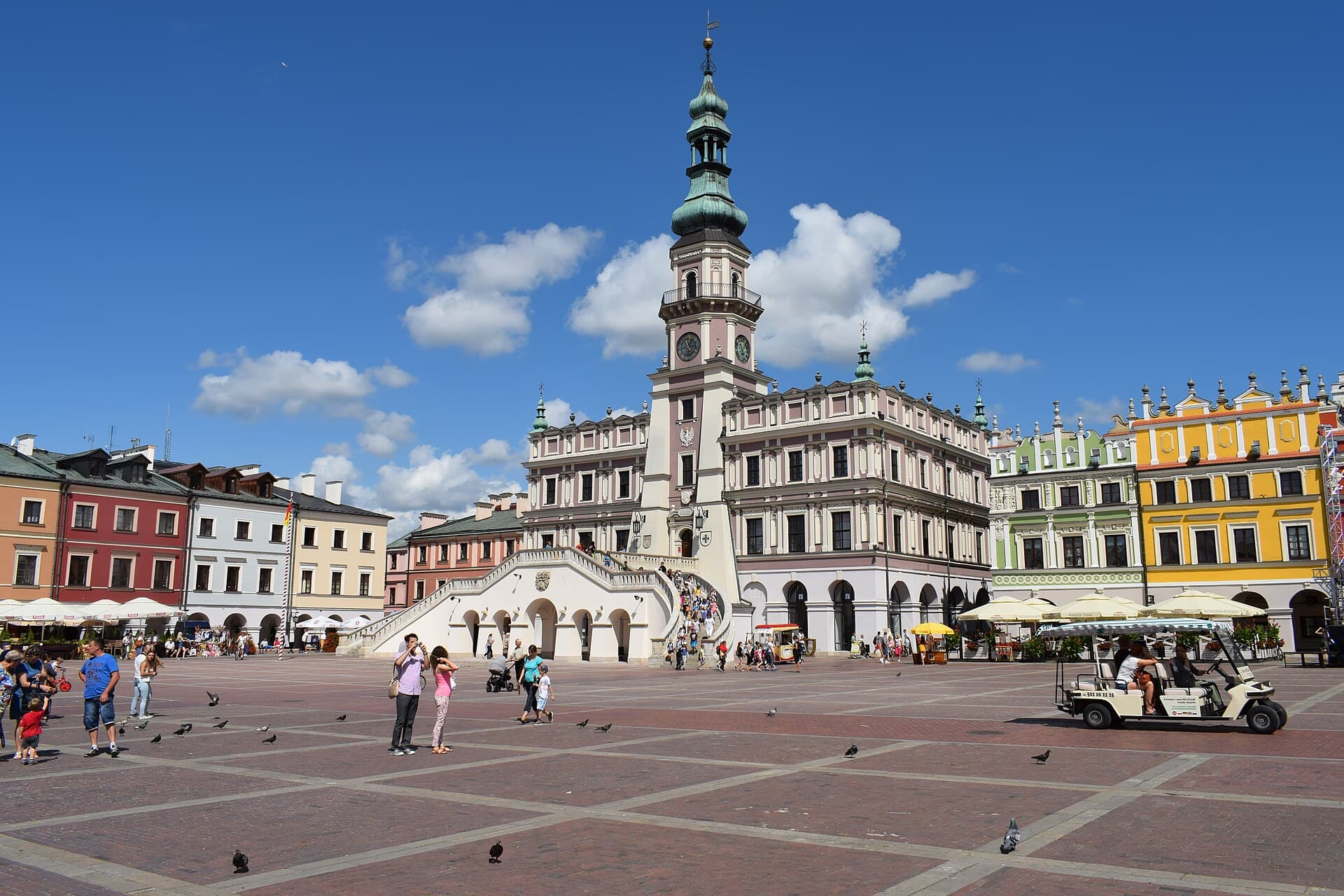
Die Fassade des Rathauses
Das prächtige Rathaus am Großen Marktplatz weist eine seltsame Asymmetrie auf.
Die ganze Geschichte wird in der Tour freigeschaltet
 Sylwpak / CC BY-SA 4.0, via Wikimedia Commons
Selbstgeführte Audio-Walking-Tour durch Zamość — GPS-Route, Offline-Wiedergabe, erzählerische Narration in 32 Sprachen.
“Zamość: Wo Renaissanceträume in Polen Wurzeln schlugen, eine akribisch gestaltete 'Idealstadt'.”
Nicht die Postkarten. Die Geschichten, die selbst Einheimische nicht kennen – dir ins Ohr geflüstert, genau dort, wo sie geschahen.
Das prächtige Rathaus am Großen Marktplatz weist eine seltsame Asymmetrie auf.
Die bunten armenischen Kaufmannshäuser rund um den Großen Marktplatz bargen einst Geschichten in ihren Mauern.
Zamość wurde konzipiert, um die menschliche Form widerzuspiegeln.
Entdecke jedes Geheimnis von Zamość
Jede Adresse, jede Enthüllung vollständig – in deinem Ohr, genau dort, wo es geschah.
Du wählst deine Stationen. Du gehst. Die Stimme enthüllt, was andere übersehen.


Deine selbstgeführte Audio-Tour durch Zamość ist bereit – wähle deine Sehenswürdigkeiten, deine Sprache und starte, sobald du ankommst.
KaufenLume enthält einen integrierten Augmented-Reality-Guide. Halten Sie Ihr Handy hoch: Die Kamera zeigt die Straße vor Ihnen, mit einem leuchtenden Pfeil über dem echten Bild, der immer auf Ihren nächsten Stopp zeigt — keine Karte zum Rätseln, keine falschen Abzweigungen. Wie alles bei Lume funktioniert es komplett offline.
Zamość, manchmal als „Venedig des Nordens“ bezeichnet, ist eine sorgfältig erhaltene Stadt im Südosten Polens, etwa 90 km südöstlich von Lublin. Gegründet 1580 von Jan Zamoyski, dem Großkanzler Polens, und entworfen vom italienischen Architekten Bernardo Morando, ist sie ein bemerkenswertes Beispiel einer „idealen Stadt“ aus dem späten 16. Jahrhundert.
1992 als UNESCO-Weltkulturerbe anerkannt, bewahrt Zamość seinen ursprünglichen rechtwinkligen Straßenplan, seine Verteidigungsanlagen und eine harmonische Mischung aus italienischen und mitteleuropäischen Architekturtraditionen. Der Große Marktplatz der Stadt, umgeben von Arkadenhäusern der Kaufleute, und das imposante Rathaus rufen das Gefühl einer Reise in die Vergangenheit hervor. Über seine architektonische Pracht hinaus bietet Zamość einen Einblick in eine reiche, vielfältige Vergangenheit, die Gemeinschaften wie Armenier, Griechen und sephardische Juden anzog, die zu seinem Handels- und Kulturcharakter beitrugen.
Heute vereint Zamość seinen historischen Reiz mit einer zeitgenössischen Atmosphäre, modernen Geschäften, Cafés und einer Universität. Es fungiert als Kulturzentrum für die malerische Region Roztocze und bietet Möglichkeiten für aktive Erholung wie Kajakfahren, Wandern und Radfahren in nahegelegenen Nationalparks.
Zamość wurde 1580 von Jan Zamoyski, einem mächtigen polnischen Adligen und Großkanzler der Krone, gegründet, der eine neue Stadt als Zentrum für Handel, Kultur und Wissenschaft plante. Er beauftragte den italienischen Architekten Bernardo Morando aus Padua, die Stadt von Grund auf zu entwerfen, basierend auf den italienischen Renaissance-Theorien der „idealen Stadt“. Die strategische Lage der Stadt an der Handelsroute, die West- und Nordeuropa mit dem Schwarzen Meer verband, war für Zamoyskis Plan eines blühenden Handelszentrums unerlässlich.
Morandos Entwurf, der zwischen 1582 und 1591 umgesetzt wurde, führte zu einer symmetrischen, geordneten und befestigten Stadt. Der Plan teilte die Stadt in zwei Bereiche: Adelssitze im Westen und die eigentliche Stadt im Osten, organisiert um drei Plätze: den Großen Marktplatz, den Salzmarkt und den Wasserplatz. Der Architekturstil, oft als „Zamość Renaissance“ bezeichnet, kombiniert italienisches Cinquecento mit mitteleuropäischen Traditionen, was sich in den Arkadengängen und dekorativen Attiken zeigt.
Von Anfang an war Zamość als multinationale Stadt mit einem hohen Maß an religiöser Toleranz gedacht, eine Politik, die Siedler aus verschiedenen Hintergründen anzog. Armenier, Griechen und sephardische Juden gehörten zu den ersten, die Privilegien erhielten, und trugen zum kosmopolitischen Charakter der Stadt bei. 1594 festigte Jan Zamoyski weiter den kulturellen Rang Zamośćs durch die Gründung der Zamoyski-Akademie, der dritten Akademie im polnisch-litauischen Bund, die zu einem bedeutenden wissenschaftlichen und kulturellen Zentrum der Region wurde.
Zamość wurde als „Festungsstadt“ mit beeindruckenden Verteidigungsmauern und sieben Bastionen konzipiert, um seine Bewohner zu schützen und Handelsrouten zu sichern. Im Laufe seiner Geschichte sah sich die Stadt zahlreichen Invasionen gegenüber, darunter Belagerungen durch Kosaken im Jahr 1648 und Schweden im Jahr 1656, aber ihre Verteidigungsanlagen erwiesen sich als widerstandsfähig und sie wurde während dieser Angriffe nie erobert. Sie wurde jedoch im frühen 18. Jahrhundert während des Großen Nordischen Krieges von schwedischen und sächsischen Truppen besetzt.
Bei der Ersten Teilung Polens 1772 wurde Zamość von der Habsburgermonarchie annektiert und wurde 1815 Teil des russisch kontrollierten Königreichs Polen. Während des Zweiten Weltkriegs wurde Zamość von den Deutschen besetzt, die in der Zamośćer Rotunde ein Vernichtungslager errichteten, in dem schätzungsweise 8.000 Menschen getötet wurden. Trotz dieser Gräueltaten des Krieges blieb die Altstadt weitgehend unzerstört und behielt ihr Aussehen aus dem 16. Jahrhundert. 1992 wurde das historische Zentrum von Zamość in die Liste des UNESCO-Weltkulturerbes aufgenommen und als „herausragendes Beispiel einer geplanten Renaissance-Stadt des späten 16. Jahrhunderts“ anerkannt.
Das Herzstück von Zamość ist der Große Marktplatz (Rynek Wielki), eine perfekt proportionierte 100x100-Meter-Fläche. Hier zieht das markante Rathaus, ein Barockbau mit einer charakteristischen Mitteltreppe und einem hohen Uhrenturm, den Blick auf sich. Den Platz umgeben bunte armenische Häuser, die für ihre Arkaden und kunstvollen Fassaden bekannt sind und einst einflussreichen armenischen Kaufleuten gehörten. Drei dieser Häuser beherbergen heute das Zamośćer Museum, das Einblicke in die Geschichte, Ethnographie und Archäologie der Stadt bietet.
Nur einen kurzen Spaziergang vom Platz entfernt befindet sich die Kathedrale der Auferstehung und des Heiligen Thomas des Apostels, ebenfalls von Morando entworfen. Fertiggestellt im Jahr 1637, ist ihr Inneres besonders beeindruckend mit seinen Stuckarbeiten der „Lubliner Renaissance“ und den Gräbern der Familie Zamoyski. Die Zamośćer Synagoge, ein bedeutendes Beispiel spätrenaissancistischer jüdischer Architektur, weist zarte florale Stuckarbeiten und Inschriften auf. Heute beherbergt sie ein Museum, das der Geschichte der Juden aus Zamość und Umgebung gewidmet ist.
Erkunden Sie die Festung Zamość, die ursprünglich als „Festungsstadt“ konzipiert wurde. Sie können entlang der Bastion VII-Wälle spazieren, um die Stadtplanung zu überblicken, und die unterirdische Touristenroute besuchen, die durch Korridore, Schießscharten und Kasematten führt. Das Arsenalmuseum bietet weitere Einblicke in die Verteidigungsgeschichte der Stadt. Für eine ernüchternde Besinnung dient die Zamośćer Rotunde, ursprünglich eine Verteidigungsanlage, die während des Zweiten Weltkriegs als Gestapo-Gefängnis und Hinrichtungsstätte diente und heute als Gedenkstätte fungiert.
Die angenehmsten Zeiten für einen Besuch in Zamość sind das späte Frühjahr (Mai und Juni) und der Frühherbst (September und Oktober). In diesen Monaten ist das Wetter angenehm und die Besucherzahl ist generell geringer. Der Sommer (Juni bis August) ist ebenfalls eine beliebte Zeit mit angenehmen Temperaturen, markiert jedoch die geschäftigste Touristensaison. Die Stadt beherbergt im Frühling und Sommer verschiedene Kultur-, Sport- und Handelsveranstaltungen, von denen viele auf dem Großen Marktplatz stattfinden. Obwohl die Winter kalt und schneereich sind, hat Zamość zur Weihnachtszeit mit festlichen Dekorationen und Führungen seinen eigenen Reiz.
Zamość liegt in der Woiwodschaft Lublin, etwa 90 km südöstlich von Lublin und 247 km von Warschau entfernt. Mit dem Auto dauert die Fahrt von Lublin etwa 1,5 Stunden. Regelmäßige Busse und Züge verbinden Lublin und Zamość, es ist jedoch ratsam, die Fahrpläne im Voraus zu überprüfen, insbesondere an Wochenenden oder Feiertagen. Direkte InterCity-Züge von Warschau nach Zamość dauern etwas mehr als vier Stunden, von Krakau etwa die Hälfte dieser Zeit. Der Bahnhof in Zamość liegt günstig in der Nähe der Altstadt, etwa 10 Gehminuten von der Festung entfernt.
Die Altstadt ist fußgängerfreundlich, die meisten Sehenswürdigkeiten sind bequem zu Fuß erreichbar. Das Touristische und Historische Informationszentrum Zamość, am Rynek Wielki 13 (ein Nebeneingang im Rathaus), bietet Stadtpläne und Informationen. Sie bieten auch eine mobile Anwendung für selbstgeführte Touren in mehreren Sprachen an. Die Unterkunftsmöglichkeiten reichen von Hotels in der Altstadt bis hin zu bescheideneren Optionen und Hostels.
Zamość — Koreanisch, Chinesisch, Hebräisch und 29 weitere Sprachen, jede Station von einer muttersprachlichen Stimme erzählt. Die größte Sprachauswahl aller selbstgeführten Audiotouren.
Verfügbar auf: