Giant Buddha Temple
Within the hallowed halls of Zhangye’s Giant Buddha Temple, a significant figure in China’s imperial lineage is thought to have begun his life.
Full story unlocks in the tour
 YubYub41 / CC BY-SA 4.0, via Wikimedia Commons
Self-guided audio walking tour of Zhangye — GPS route, offline playback, story-driven narration in 32 languages.
“Where the Silk Road’s ancient echoes meet mountains painted in earth’s own pigments.”
Not the postcards. The stories even locals don't know — whispered in your ear, right where they happened.
Within the hallowed halls of Zhangye’s Giant Buddha Temple, a significant figure in China’s imperial lineage is thought to have begun his life.
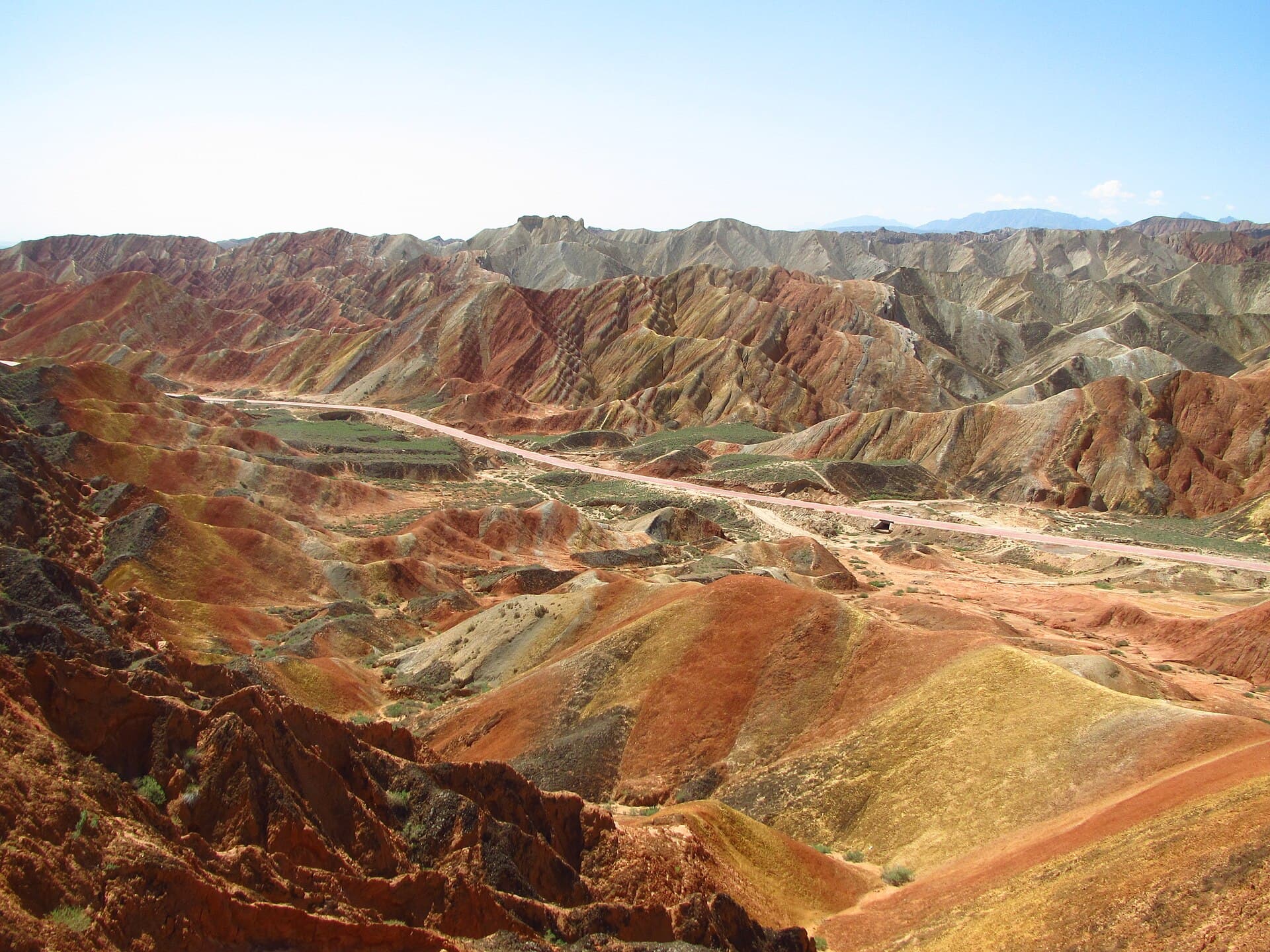
The striking colors of Zhangye’s Rainbow Mountains are not merely an optical illusion, but a grand geological composition crafted over countless millennia.
Zhangye, a city often celebrated for its colorful peaks, held a far more critical strategic position in antiquity than that of a mere scenic interlude.
Discover every secret of Zhangye
Every address, every reveal in full — in your ear, right where it happened.
You pick your stops. You walk. The voice reveals what the others miss.


Your self-guided audio tour of Zhangye is ready — pick your landmarks, choose your language, and start the moment you arrive.
BuyLume has a built-in augmented-reality guide. Hold your phone up and its camera shows the street ahead of you, with a glowing arrow laid over the real view that always points to your next stop — no map to puzzle over, no wrong turns. Like everything in Lume, it works fully offline.
Zhangye, a city in China’s Gansu Province, stands as a place where ancient narratives and dramatic natural splendor converge. Positioned within the Hexi Corridor, a crucial artery of the ancient Silk Road, Zhangye has been a pivotal point for commerce and cultural exchange for over two millennia. While its historical weight as a military outpost and commercial center remains fundamental to its identity, contemporary travelers are increasingly drawn to its extraordinary landscapes, particularly the Zhangye Danxia National Geological Park.
Often called the 'Rainbow Mountains,' the Danxia landforms present a surreal tableau of striped hills that appear as if painted onto the earth’s canvas. Beyond these geological marvels, Zhangye offers a window into China’s profound Buddhist heritage through sites like the Giant Buddha Temple, which houses one of the country’s largest reclining Buddha statues. The city’s singular blend of cultural relics and diverse natural scenery, from snow-capped peaks to grasslands and desert expanses, renders it a compelling destination for photographers, history enthusiasts, and adventurers alike.
## A Silk Road Stronghold Zhangye’s history stretches back over two millennia, its origins deeply interwoven with the ancient Silk Road. Established in 104 BC during the Western Han Dynasty, it was created as a military outpost and administrative center following successful campaigns against nomadic tribes. The city’s name, Zhangye, is an abbreviation of a phrase meaning 'extending the arm of the country to connect with the Western Realm,' signifying China’s aspiration to expand its influence westward.
Throughout its early history, Zhangye, then known as Ganzhou, functioned as a critical commercial crossroads where caravans from East and West converged. It was not merely a marketplace for goods, but also a channel for the exchange of ideas, faiths, and technologies. Buddhism, notably, found its way into central China through Zhangye, prompting the construction of numerous temples. The city’s strategic location in the Hexi Corridor, a narrow passage between the Tibetan Plateau and the Gobi Desert, made it a vital defensive point against northern nomads and granted Han armies access to the Tarim Basin.
## Dynastic Shifts and Cultural Flourishing Before falling under Mongol dominion, Zhangye was controlled by the Western Xia dynasty, and prior to that, by the Uyghurs from at least the early 10th century. The Giant Buddha Temple, constructed around 1100 AD during the Western Xia period, stands as a testament to the region’s spiritual importance during this era. Marco Polo, the renowned Venetian traveler, is said to have spent a year in Ganzhou (Zhangye) during the 13th century, impressed by its magnificent structures and prosperity.
Despite periods of destruction, such as when much of the Giant Buddha Temple was razed by the Ming army in 1372, Zhangye consistently rebuilt and regained its prominence. Reconstruction efforts, like those on the Giant Buddha Temple in the early 15th century, ensured the preservation of its cultural and religious heritage. Today, Zhangye continues to be recognized for its profound past, with over 1,200 cultural sites and more than 30,000 historical relics preserved in local museums and temples.
The primary attraction in Zhangye is undeniably the Zhangye Danxia National Geological Park, often referred to as the 'Rainbow Mountains.' These geological formations are a spectacle of vivid reds, oranges, yellows, and greens, best observed at sunrise or sunset when the shifting light deepens their colors. The park provides several designated viewing platforms, with shuttle buses transporting visitors between them.
Adjacent to the main Danxia area is Binggou Danxia, which offers a distinct, equally compelling landscape of singular rock formations resembling castles, cones, and pillars, frequently described as a 'sculpted' terrain. Many travelers opt to explore both Danxia areas on the same day.
In the city center, the Giant Buddha Temple (Dafo Temple) is an essential visit. Built in 1098 during the Western Xia Dynasty, it houses China’s largest indoor reclining Buddha statue, measuring 34.5 meters long. The temple also contains precious Buddhist scriptures, including some inscribed in gold ink, and ancient frescoes depicting scenes from 'Journey to the West.'
Further afield, approximately 65 kilometers south of Zhangye, lie the Mati Temple Grottoes. These Buddhist cave art sites are carved into cliff faces and offer a combination of historical grottoes, expansive views of the Qilian Mountains, and insights into Yugu minority culture. Some grottoes involve ascending through narrow vertical passages.
The most favorable time to visit Zhangye is during spring and autumn, specifically from April to June and September to October. In these periods, the weather is gentle and pleasant for exploration. Autumn, in particular, offers clear skies and reduced chances of rainfall, which is ideal for photography and capturing the intense hues of the Danxia landforms. While summer (June to September) is also popular due to comfortable temperatures and potential for rain to enhance the colors of the Danxia mountains, it can be the high season, so early booking is advised. Winters are cold, dry, and windy, making them less suitable for sightseeing.
Zhangye is reachable by air and high-speed rail. Zhangye Ganzhou Airport (ZHY) provides domestic flights from major cities such as Beijing, Xi’an, and Lanzhou. The Zhangye West Railway Station is a crucial stop on the Lanzhou-Xinjiang High-Speed Railway, connecting the city to Lanzhou, Xi’an, Jiayuguan, and Dunhuang.
Within Zhangye, taxis are readily available and reasonably priced. For attractions beyond the city center, such as the Danxia National Geological Park, it is advisable to arrange a private car for the day or join a local tour group, as public buses can be infrequent. While larger hotels may accept international credit cards, cash (Renminbi) remains widely used in smaller establishments. Mobile payment applications are also common. Consider packing comfortable walking shoes, sun protection, and layers of clothing, as temperatures can vary considerably between day and night, especially in the desert climate.
Zhangye in Korean, in Chinese or in Hebrew — and 29 more languages, every stop narrated by a native voice. The widest language range of any self-guided audio tour.
Available in: