Zytturm (Clock Tower)
The Zytturm in Zug's Old Town reveals more than just the hour.
Full story unlocks in the tour
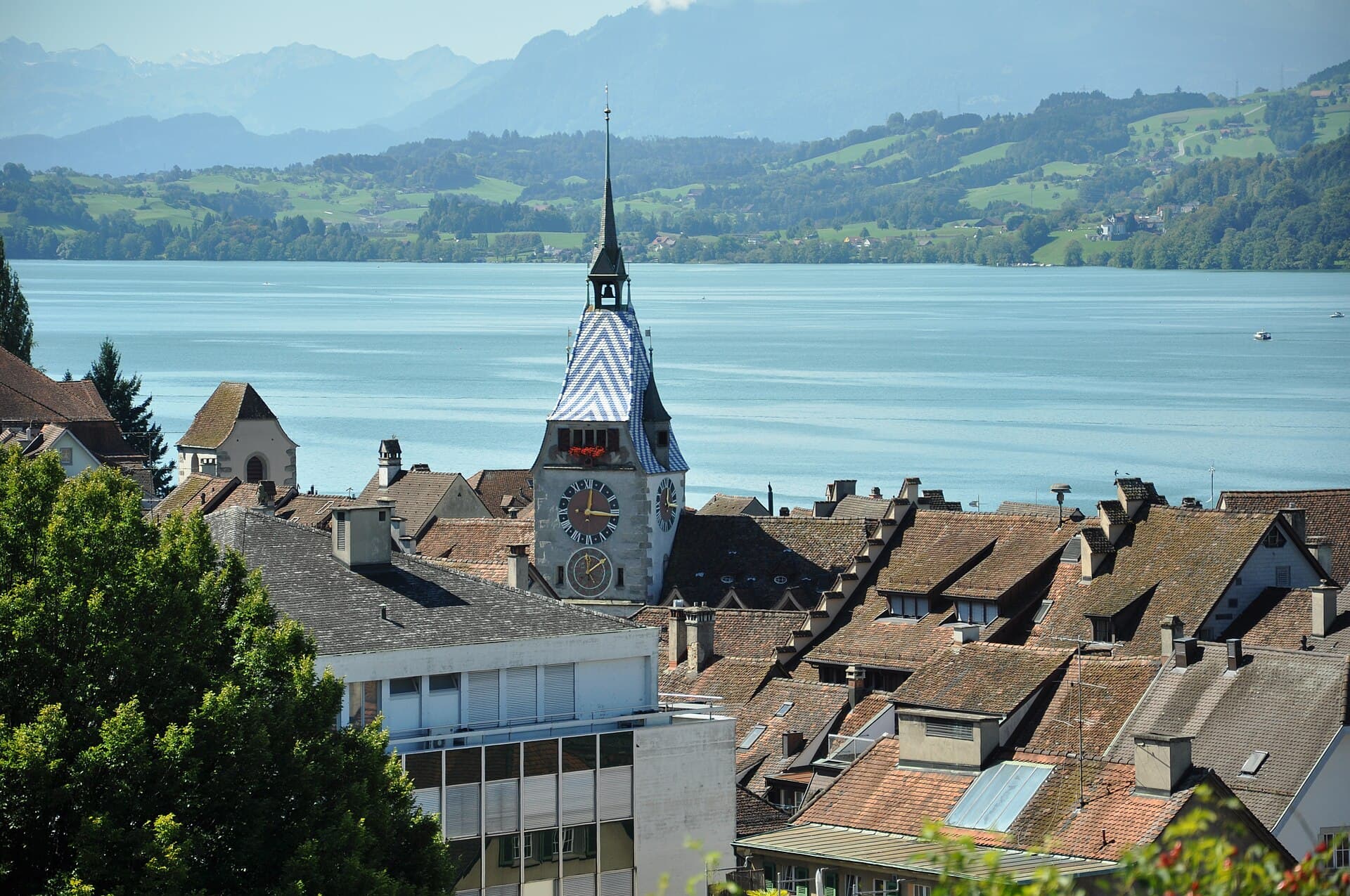 Schulerst / CC BY-SA 3.0, via Wikimedia Commons
“Where ancient foundations meet modern ambition on a reflective lake.”
Not the postcards. The stories even locals don't know — whispered in your ear, right where they happened.
The Zytturm in Zug's Old Town reveals more than just the hour.
Lake Zug is known for its vivid sunsets, and there is a particular reason for their intensity.
Beneath the stone pathways of Zug's Old Town lies evidence of a dramatic event.
Discover every secret of Zoug
Every address, every reveal in full — in your ear, right where it happened.
You pick your stops. You walk. The voice reveals what the others miss.
No tours available yet. Check back soon — we're preparing them.
Zug, a city in central Switzerland, serves as the capital of its namesake canton. Situated on the northeastern shore of Lake Zug and at the foot of the Zugerberg mountain, it offers a blend of enduring character and natural splendor. The city's population was approximately 30,934 as of December 2020. While the official language is the Swiss variety of Standard German, the local Alemannic Swiss German dialect is primarily spoken, and English is also widely used, especially in business.
Recognized for its favorable tax policies, Zug has evolved into a significant center for multinational corporations, investors, and affluent residents. This economic environment has drawn a diverse international community, with foreign nationals making up about one-third of the population. Despite its modern economic prominence, Zug maintains a strong connection to its historical roots, evident in its well-preserved Old Town and medieval structures.
The city provides a high quality of life, characterized by low crime rates, excellent healthcare, and abundant green spaces, making it an appealing destination for both professionals and families. Its location offers easy access to lakeside activities, mountain excursions, and cultural experiences, contributing to its reputation as a dynamic yet peaceful Swiss city.
The origins of Zug can be traced back to the Paleolithic period, with archaeological evidence indicating human presence around 14,000 BCE. Neolithic pile-dwelling settlements, or stilt-houses, have been discovered on the shores of Lake Zug, with artifacts from the Bronze Age displayed at the local Museum for Prehistory. Around 600 AD, Alemannic families settled in the area. The town itself began to take shape after 1200, likely founded by the Counts of Kyburg, who fortified it with walls. Zug was first mentioned in 1240 and referred to as an "oppidum" (fortified town) in 1242.
In 1273, Rudolf of Habsburg (later Rudolf I of Germany) purchased Zug from Anna, the heiress of Kyburg, bringing the town under Habsburg control. During this period, Zug became an important administrative center, a local marketplace, and a crucial stage town for transporting goods like salt and iron over the Hirzel hill towards Lucerne.
Zug joined the Swiss Confederation on June 27, 1352, becoming the seventh canton to do so. However, this affiliation was initially turbulent, with Zug briefly re-acknowledging its former lords and breaking ties with the league before being recovered by Schwyz around 1364. By 1389, the Habsburgs renounced their claims to Zug, solidifying its place within the Confederation.
During the Reformation in the 16th century, Zug remained loyal to the Catholic Church, serving as a religious stronghold and a confessional border town. It became a member of the Golden League in 1586, an alliance of Catholic cantons. This era, up until 1798, was marked by internal political rivalries and turbulence. The invasion of French troops in 1798 brought an end to the old order, and Zug briefly served as the capital of the canton Waldstätten under the Helvetic order.
Zug's industrialization began relatively late, after 1850, aided by the arrival of the railway connecting it to Zurich. A pivotal moment in its modern history occurred in 1946 when the cantonal government decided to implement one of the world's lowest tax regimes. This strategic decision transformed Zug from a quiet market town into a global economic hub, attracting numerous international companies and wealthy residents. By the 1970s, Zug had become a corporate hub, further solidified by figures like Marc Rich, a commodities trader who established his empire there. Today, Zug is also recognized as "Crypto Valley" due to its high concentration of companies involved in cryptocurrency.
Begin your exploration in Zug's Old Town, where narrow alleys lead past well-preserved historical buildings. The Zytturm, or Clock Tower, is a prominent landmark, originally part of the city's fortifications. You can even collect a key from the nearby Wunderbox boutique to ascend the tower. Other remnants of the old city walls include the Capuchin, Powder, and Knöpfli Towers. Take a moment at the Kolin Fountain and seek out the world's oldest goldsmith's house.
For a deeper dive into local history, visit the Museum Burg Zug, housed within the 13th-century Zug Castle. The Museum for Prehistory also offers insights into the region's ancient past. St. Oswald's Church, dating from 1478–1545, showcases elaborate Gothic interiors. Enjoy a stroll along the lakeside promenade of Lake Zug, particularly at dusk, which is known for its intense colors. Boat trips on the lake are also available.
Ascend the Zugerberg mountain via the funicular railway for expansive views, hiking paths, and in winter, cross-country skiing and toboggan runs. The Höllgrotten dripstone caves in the Lorzentobel are a unique natural attraction. For families, the Freiruum Zug offers an indoor playground and trampoline park. Do not depart without trying the local specialty, Zuger Kirschtorte (cherry schnapps cake).
The best time to visit Zug for warm-weather activities is from late June to early September. During these months, average daily temperatures are pleasant, reaching around 23°C in July and August, ideal for sightseeing and lake activities. The period from April to October generally offers agreeable weather, with spring bringing Alpine blooms and autumn (late September to October) showcasing spectacular colors and clear views. Winter, from December to February, is suitable for snow sports and experiencing a festive atmosphere. May and November tend to be the wettest months.
The official currency in Zug, and throughout Switzerland, is the Swiss Franc (CHF). While some places may accept Euros, it is recommended to carry or convert to Francs, and having cash and coins for public transportation is useful. When using an ATM, opt to be charged in Swiss Francs for a fairer exchange rate.
Vehicles in Switzerland drive on the right side of the road. The electrical supply in Zug operates at 230V / 50Hz, using Type J sockets. If you are traveling from a country with a different voltage (e.g., 110V-120V like the US) or different plug types (e.g., Type A/B from the US, or Type G from the UK), you will need a plug adapter and potentially a voltage converter to avoid damaging your devices.
Zug is considered a very safe city with low crime rates, and it is generally safe to walk alone at night. However, standard safety precautions are always advisable. The Swiss railway network is known for its convenience and punctuality, with trains connecting Zug to major cities like Zurich and Lucerne. Buses also operate frequently within Zug from 6 AM to midnight.