Balchik Palace's minaret
A Christian queen's summer residence features a surprising architectural element.
Full story unlocks in the tour
 Boby Dimitrov from Sofia, Bulgaria / CC BY-SA 2.0, via Wikimedia Commons
Self-guided audio walking tour of Balchik — GPS route, offline playback, story-driven narration in 32 languages.
“Where white cliffs meet royal whispers and exotic blooms.”
Not the postcards. The stories even locals don't know — whispered in your ear, right where they happened.
A Christian queen's summer residence features a surprising architectural element.
The heart of a queen once rested in a small chapel overlooking the Black Sea.
A desert landscape thrives on the Bulgarian Black Sea coast.
Discover every secret of Balchik
Every address, every reveal in full — in your ear, right where it happened.
You pick your stops. You walk. The voice reveals what the others miss.


Your self-guided audio tour of Balchik is ready — pick your landmarks, choose your language, and start the moment you arrive.
BuyLume has a built-in augmented-reality guide. Hold your phone up and its camera shows the street ahead of you, with a glowing arrow laid over the real view that always points to your next stop — no map to puzzle over, no wrong turns. Like everything in Lume, it works fully offline.
Balchik, often called the "White Town" due to the pale limestone used in many of its buildings, is a compelling coastal town on Bulgaria's northern Black Sea. It is a place where history, nature, and a touch of royal romance intertwine. Unlike the bustling, larger resorts, Balchik offers a more tranquil atmosphere, inviting visitors to slow down and explore its unique character.
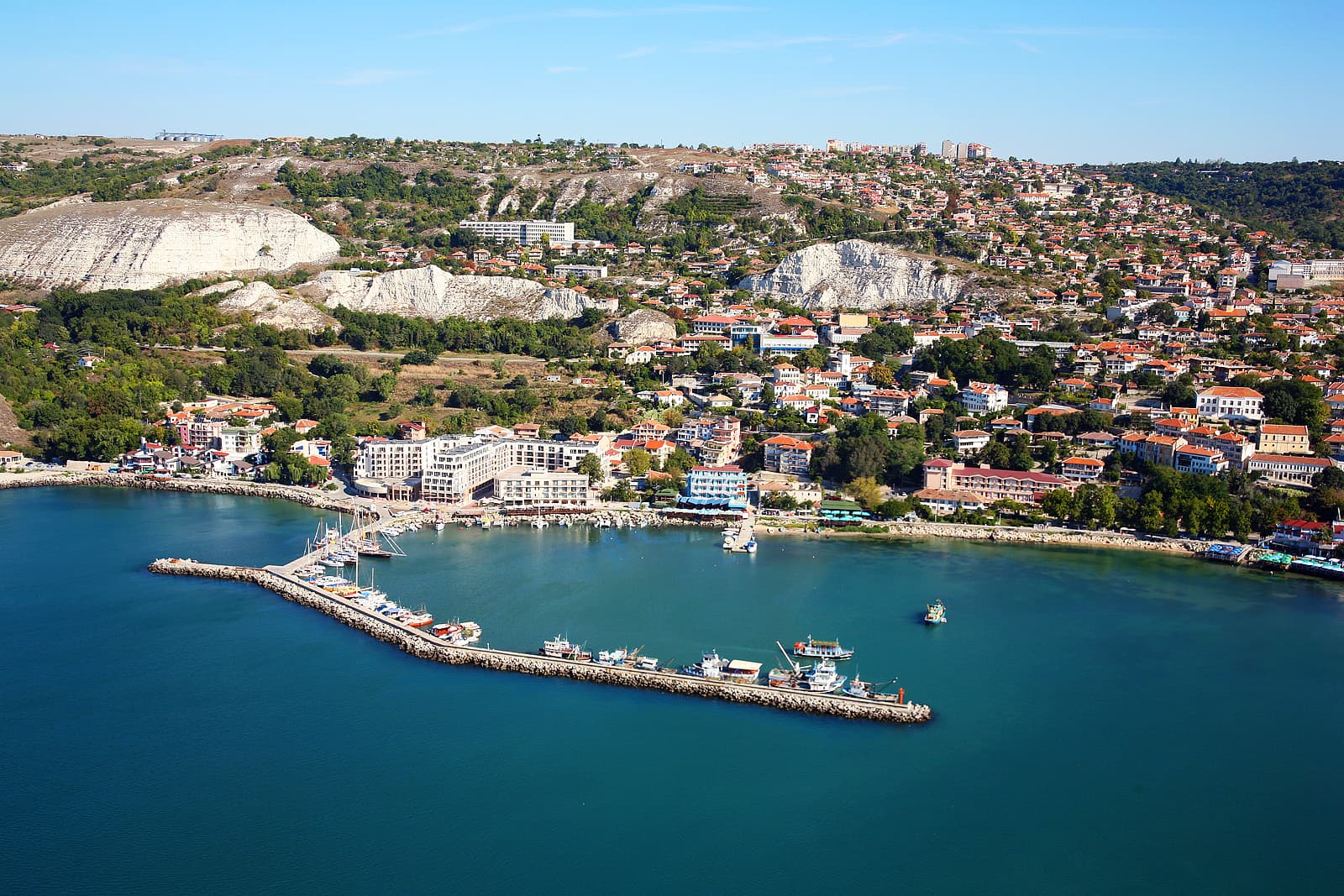
The town is built amphitheatrically on hilly terraces that descend towards the sea, offering sweeping views from almost every vantage point. Its main draw is the Architectural Park Complex "The Palace," the former summer residence of Queen Marie of Romania, and the accompanying University Botanical Garden. Beyond these prominent sites, Balchik's charm lies in its quiet lanes, the scent of grilled fish from the quay, and the enduring sense of a cherished seaside pause.
Balchik is more than just a day trip; it is a destination that encourages lingering, whether you are drawn to its historical layers, its impressive botanical diversity, or simply the serene rhythm of life by the Black Sea.
## Ancient Origins and Shifting Empires Balchik's story stretches back to antiquity, first established as a Thracian settlement. Around the 6th century BC, Greek colonists founded a settlement here, naming it Krounoi, meaning "Town of Springs." Later, it became Dionysopolis, named after the Greek god of wine, Dionysus, and flourished as an important center for trade and culture. Archaeological excavations have unearthed artifacts from these eras, including coins, pottery, and inscriptions, now housed in the Historical Museum of Balchik.
During Roman and Byzantine rule, Balchik continued to be a significant coastal settlement and a Byzantine Greek fortress. In the 7th century, under the name Karvuna, it became part of the First Bulgarian Empire. The town's current name, Balchik, is believed to be derived from the local nobleman Balik, adopted during the Ottoman rule, which began in the late 14th century and lasted for nearly 500 years. This period brought significant demographic and cultural changes, with Ottoman-era architecture still visible today.
## A Royal Interlude and Return to Bulgaria Balchik was liberated from Ottoman rule on January 31, 1878. However, its political landscape shifted again in the early 20th century. Following the Second Balkan War in 1913, Balchik became part of the Kingdom of Romania. It was during this period that Queen Marie of Romania discovered Balchik in 1921 and was captivated by its beauty, describing it as a place she had only imagined could be found in Italy. She decided to build her summer residence here, a complex known as "The Quiet Nest," which was constructed between 1924 and 1937. The palace, with its blend of Bulgarian, Romanian, and Ottoman Turkish architectural motifs, became a symbol of the town's cultural renaissance. The surrounding park was transformed into a magnificent botanical garden, further enhancing the royal retreat.
In 1940, with the Treaty of Craiova, Southern Dobruja, including Balchik, was ceded back to Bulgaria. The botanical garden was officially established in 1955 on the grounds of the palace park. Today, Balchik continues to be a popular seaside destination, attracting visitors with its historical landmarks, scenic coastal views, and engaging cultural scene.
The undisputed highlight of Balchik is the Architectural Park Complex "The Palace" and the University Botanical Garden. The palace, known as "The Quiet Nest," was Queen Marie of Romania's beloved summer residence, a unique architectural blend of Bulgarian, Romanian, and Ottoman styles. Explore the various villas, the smoking hall, and the wine cellar within the complex. Do not miss the Stella Maris Chapel, a small Orthodox chapel with a fascinating history connected to Queen Marie's heart.
Adjacent to the palace, the University Botanical Garden is a sprawling oasis with over 4,900 plant species. It is particularly known for its impressive collection of large cacti and succulents, displayed outdoors during warmer months, which is the second largest in Europe. Wander through terraced gardens, green tunnels, and arches, discovering exotic plants like ancient ginkgo, metasequoia, and various fruit trees. The "Divine Garden" features carpet-like flower arrangements.
Beyond the palace grounds, explore Balchik's town center with its small, picturesque churches like Saint George Church and the Church of Saints Constantine and Helena. The Historical Museum of Balchik houses artifacts from the town's ancient past, including finds from the Temple of Cybele, a pagan cult site dating back to the 3rd century BC. The seafront promenade is lively, especially in summer, with cafes and bars.
The most pleasant time to visit Balchik is during late spring (May to June) and early autumn (September to October). During these months, the weather is mild and comfortable, with average temperatures ranging from 18°C to 28°C. This period also offers fewer crowds compared to the peak summer months of July and August. The Botanical Garden is particularly alive in spring with blooming flowers, including over 60,000 tulips in April and May. Summer (June to September) brings warm temperatures, averaging 27°C, and limited rainfall, making it ideal for beach activities and local festivals, though it is the busiest time.
Balchik is generally considered a safe town, but it is always wise to be aware of your surroundings, especially in crowded areas, to guard against petty crime like pickpocketing. The local currency is the Bulgarian Lev (BGN). While major hotels and restaurants in urban areas accept credit and debit cards, cash is still widely used, particularly for smaller purchases, local transport, and in less urbanized areas. It is advisable to carry some cash and to choose to be charged in BGN when using ATMs or making card payments to ensure a fairer exchange rate.
Balchik does not have its own airport; the closest is Varna Airport (VAR), about 42 km away. From Varna, you can reach Balchik by bus, taxi, or rental car. The town center is compact and easily explored on foot. For longer distances or trips to nearby resorts, local buses, shared taxis (marshrutkas), or private taxis are available. Renting a car offers flexibility for exploring the wider region. Public Wi-Fi is generally available in hotels and cafes.
Balchik in Korean, in Chinese or in Hebrew — and 29 more languages, every stop narrated by a native voice. The widest language range of any self-guided audio tour.
Available in: