Plaza de Armas
Bronze statues in the main square commemorate a Spanish founder and a Mapuche warrior.
Full story unlocks in the tour
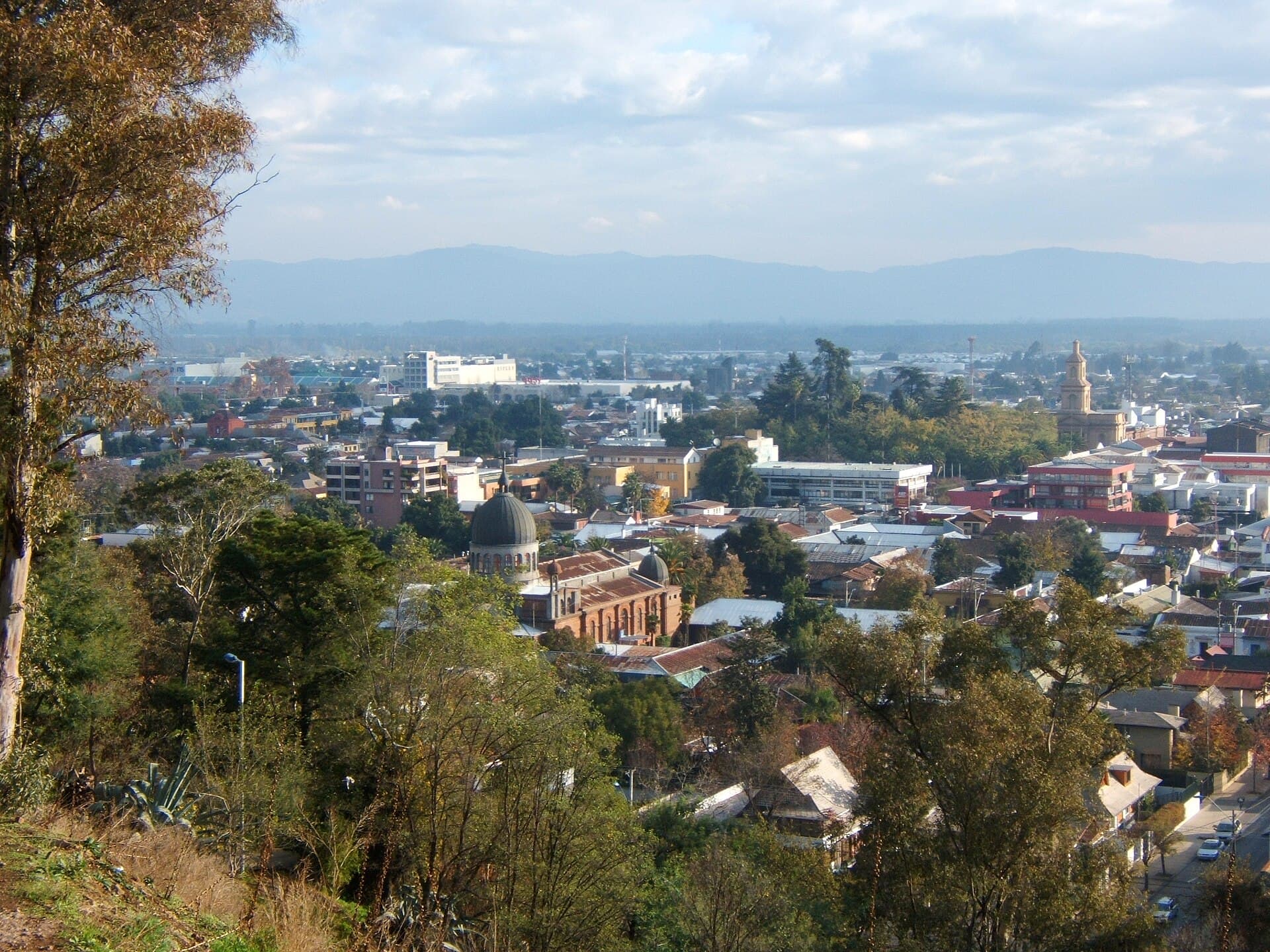 Ludwig / CC BY-SA 3.0, via Wikimedia Commons
Self-guided audio walking tour of Curicó — GPS route, offline playback, story-driven narration in 32 languages.
“Where the Central Valley's wine culture meets authentic Chilean life.”
Not the postcards. The stories even locals don't know — whispered in your ear, right where they happened.
Bronze statues in the main square commemorate a Spanish founder and a Mapuche warrior.
One of Chile's oldest newspapers once occupied a prominent spot, but its building is no longer there.
The city's official emblem almost wasn't adopted due to a historical conflict.
Discover every secret of Curicó
Every address, every reveal in full — in your ear, right where it happened.
You pick your stops. You walk. The voice reveals what the others miss.


Your self-guided audio tour of Curicó is ready — pick your landmarks, choose your language, and start the moment you arrive.
BuyLume has a built-in augmented-reality guide. Hold your phone up and its camera shows the street ahead of you, with a glowing arrow laid over the real view that always points to your next stop — no map to puzzle over, no wrong turns. Like everything in Lume, it works fully offline.
Curicó, a city in Chile's Central Valley, serves as the capital of the Curicó Province within the Maule Region. It rests on the Guaiquillo River, approximately 183 kilometers south of Santiago. Recognized as Chile's agro-industrial capital, Curicó is lauded for its consistent economic growth and functions as a significant nexus for communication, commerce, and the economy of nearby agro-industries.
The city is particularly noted for its distinctive products, including cakes, fruits, cement, sugar, tomato sauce, and exceptional export wines. Curicó lies at the heart of the Maule Valley wine region, making it a pivotal destination for those who appreciate fine wines. The region's fertile soil and ideal climate foster the production of high-quality wines, especially Carménère and Cabernet Sauvignon.
Beyond its agricultural and winemaking prowess, Curicó offers a fusion of natural scenery and cultural experiences. From exploring vineyards to visiting national parks, the city provides a more tranquil, authentic Chilean encounter. It is a place where you can immerse yourself in local life, traverse the scenic countryside, and appreciate the region's deeply rooted traditions.
The area now identified as Curicó was originally inhabited by the indigenous Curis people, who named themselves after the “black” color of their lands near streams and wetlands. The name “Curicó” itself translates to “black waters” in Mapudungun, the native Mapuche language.
The city received its official foundation on October 9, 1743, as San José de Buena Vista de Curicó. This establishment was sanctioned by José Antonio Manso de Velasco, then the governor of Chile and later viceroy of Peru. Land for the burgeoning town was donated by residents such as Captain Pedro Nolasco Solorza and Mónica Donoso y Navarro. However, the initial location proved too humid, prompting Governor Domingo Ortiz de Rozas to relocate the city three kilometers east in 1747. The city's true expansion commenced after an earthquake in 1751, which compelled people to move to the new site.
Curicó achieved city status in 1830. The oldest and most valuable edifice in the city is La Iglesia San Francisco (San Francisco's Church), constructed in 1734 and moved to its current location in 1759. The city developed into a significant center for communication, commerce, and the economy of nearby agro-industries. The central square, Plaza de Armas, has remained a focal point of the city for centuries, enduring an earthquake in 1928. It was designated a “Typical Zone” in 1986, acknowledging its extraordinary beauty and historical importance.
The 2010 Chilean earthquake profoundly impacted Curicó, causing widespread destruction. The historic district suffered particularly, with sixty percent of houses and ninety percent of the district remaining unreconstructed. The earthquake also led to the collapse of the historic San Francisco church and the offices of La Prensa de Curicó, one of Chile's oldest newspapers. Despite this devastation, Curicó has demonstrated a strong local identity and a sense of community, with ongoing efforts to rebuild and recover.
The Curicó Valley possesses a winemaking tradition dating back to the 19th century, with vine cuttings from Europe first planted in the mid-1800s. However, the contemporary wine industry in the region truly began in 1979 when Spanish wine visionary Miguel Torres invested in Chilean wine. Torres introduced modern winemaking techniques and technologies, such as stainless steel tanks and temperature-controlled fermentation, which significantly influenced the Chilean wine industry and catalyzed its quality revolution. Today, Curicó Valley is recognized as one of Chile's most diverse and largest winegrowing areas, known for its reliable and exceptional wines.
Begin your exploration at the Plaza de Armas, a designated "Typical Zone" adorned with sixty phoenix palm trees from the Canary Islands. At its core stands an Eiffel-style iron kiosk, declared a National Monument, alongside bronze busts of the city's founder, José Antonio Manso de Velasco, and a monument to the Mapuche toqui Lautaro. The main parish church and other administrative buildings frame the square.
For expansive city views, ascend Cerro Condell, a hill featuring a monument to the Immaculate Conception and walking paths. The San Francisco Church, though damaged in the 2010 earthquake, remains a significant historical structure, originally built in 1734.
Curicó serves as a gateway to the Curicó Valley Wine Route, where you can visit numerous wineries and sample local wines, particularly Carménère and Cabernet Sauvignon. Miguel Torres Winery is a notable stop, offering various tours and tastings.
Beyond the city, those who appreciate nature can visit Parque Nacional Radal Siete Tazas, approximately 70 kilometers southeast of Curicó. This reserve is known for its waterfalls and natural pools along the Río Claro, including the Salto Velo de la Novia (Bridal Veil Falls) and Salto de la Leona (Lioness Falls). Birdwatchers might observe black woodpeckers, hawks, eagles, and the rare loro tricahue parrot. Another option is the Laguna Torca National Reserve, a sanctuary for diverse wildlife and walking trails.
The optimal time to visit Curicó for general outdoor activities and warm-weather experiences extends from late November to mid-March, with a peak in the second week of January. During this period, the weather is warm and dry, with average daily temperatures reaching up to 32°C (90°F) in the warmest days of summer (December to February).
Spring (September to November) and autumn (March to May) also offer excellent times to visit, providing mild weather and fewer crowds. Fall, in particular, coincides with the grape harvest season, making it ideal for wine enthusiasts interested in vineyard tours and tastings. Winters (June to August) are milder and offer a quieter experience, though they are more humid.
Curicó is situated approximately 183 kilometers south of Santiago. You can reach the city by car, driving about two hours along Route 5 South from Santiago, or by taking a direct bus or the EFE train from Estación Central. To fully explore the scenic countryside and vineyards, traveling by car is recommended.
While in Curicó, be sure to savor local specialties such as Chilean empanadas, pastel de choclo, and the city's renowned tortas de Curicó (local pastries). A gratuity of around 10% in restaurants is customary. Major supermarkets and many restaurants accept cards, but it is wise to carry Chilean pesos for smaller shops and taxis. ATMs are readily available at banks and malls.
For wine tours, it is advisable to book in advance. If you plan to sample wines, consider hiring a tour or designating a driver, as operating a vehicle under the influence of alcohol is prohibited. The local Ruta del Vino office can provide information and arrange various tours, from half-day winery visits to packages that include hiking, biking, and rafting.
Curicó in Korean, in Chinese or in Hebrew — and 29 more languages, every stop narrated by a native voice. The widest language range of any self-guided audio tour.
Available in: