Derby Arboretum
The blueprint for one of the world's most famous parks can be found in Derby.
Full story unlocks in the tour
 GR77 / cc by-sa 4.0, via Wikimedia Commons
Self-guided audio walking tour of Derby — GPS route, offline playback, story-driven narration in 32 languages.
“Where industry's dawn met artistic light.”
Not the postcards. The stories even locals don't know — whispered in your ear, right where they happened.
The blueprint for one of the world's most famous parks can be found in Derby.
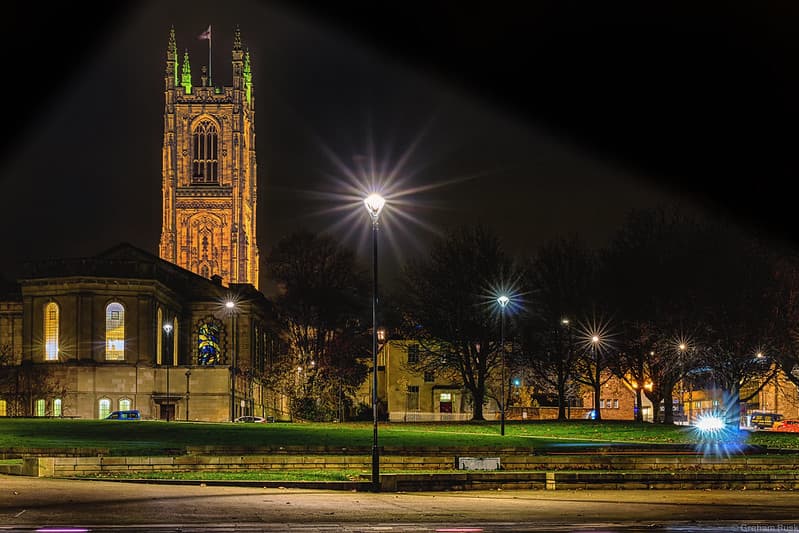
A Georgian cathedral in Derby holds a secret from centuries before its construction, and an unexpected modern resident.
Beneath the streets of Derby lies a chilling reminder of its past, complete with tales of the supernatural.
Discover every secret of Derby
Every address, every reveal in full — in your ear, right where it happened.
You pick your stops. You walk. The voice reveals what the others miss.


Your self-guided audio tour of Derby is ready — pick your landmarks, choose your language, and start the moment you arrive.
BuyLume has a built-in augmented-reality guide. Hold your phone up and its camera shows the street ahead of you, with a glowing arrow laid over the real view that always points to your next stop — no map to puzzle over, no wrong turns. Like everything in Lume, it works fully offline.
Derby, a city at the heart of England, offers a compelling blend of industrial heritage, artistic legacy, and verdant spaces. Once a tranquil market town, it ascended to prominence as a crucible of the Industrial Revolution, pioneering manufacturing in silk, porcelain, and steam engines. Its geographical position, framed by the Derbyshire Dales and at the threshold of the Peak District National Park, makes it a gateway to striking natural landscapes.
Beyond its industrial past, Derby offers a rich cultural fabric. The city centre, particularly the Cathedral Quarter, invites exploration with its historic buildings, independent shops, and lively real ale scene. From ancient Roman and Viking remnants to the masterpieces of Joseph Wright of Derby and the enduring influence of Florence Nightingale, the city reveals layers of history waiting to be uncovered.
Derby today is a dynamic city that continues to innovate, especially in advanced transport manufacturing. Whether you are drawn to its museums, theatres, or welcoming pubs, Derby provides a lively and accessible destination in the Midlands.
## From Roman Fort to Industrial Powerhouse Derby's story begins long before its industrial fame, as a Roman fort named Derventio, established around 50 AD to protect a river crossing. This settlement, now known as Little Chester, grew into a small town and was a crucial hub at the intersection of five Roman roads. After the Romans departed in 407 AD, the area saw the arrival of the Danes, who founded 'Deoraby' around 873 AD, meaning 'village of the deer'—a name that evolved into modern-day Derby. It became one of the 'Five Boroughs' of the Danelaw, a fortified town that played a significant role in Anglo-Saxon England until its recapture by Lady Æthelflæd of Mercia in 917 AD.
By the 10th century, Derby was a bustling market town with a mint and various craftsmen. Its population reached approximately 2,000 by the time of the Domesday Book in 1086, a considerable size for the era. The medieval period saw the establishment of All Saints Church, the precursor to Derby Cathedral, founded around 943 AD.
The 18th century marked Derby's true ascent into the annals of history as a birthplace of the Industrial Revolution. In 1717, Lombe's Mill became Britain's first water-powered silk mill, a testament to early industrial innovation. This pioneering spirit continued with Jedediah Strutt's Derby Rib Attachment in 1759, which revolutionized hose manufacturing. The city also became renowned for its porcelain production, with the Royal Crown Derby factory earning its royal patronage in 1773 from George III.
Derby's industrial prowess attracted and nurtured talent, including the celebrated painter Joseph Wright of Derby, who vividly captured the scientific and technological marvels of his time. The 19th century brought the railways, solidifying Derby's position as a centre of the British rail industry. Despite its long and significant history, Derby officially gained city status only in 1977, though its cathedral had been elevated in 1927.
Begin your exploration in the Cathedral Quarter, where historic buildings house independent retailers and cafes. Ascend Derby Cathedral's tower for panoramic city views. Inside, marvel at the tomb of Bess of Hardwick and the intricate wrought-iron screen by Robert Bakewell.
Delve into Derby's industrial past at the Museum of Making at Derby Silk Mill, part of the Derwent Valley Mills UNESCO World Heritage Site, which showcases 300 years of innovation. For a glimpse into Georgian life, visit Pickford's House Museum, the preserved home of architect Joseph Pickford.
Art enthusiasts should not miss the Derby Museum and Art Gallery, home to the world's largest collection of paintings by Joseph Wright of Derby, renowned for his dramatic use of light. For a more chilling experience, explore Derby Gaol, a historic prison with a reputation for being one of the UK's most haunted sites.
Visit Derby Arboretum, England's first purpose-built public park, which famously inspired New York's Central Park. Alternatively, Markeaton Park offers expansive gardens, woodlands, and a craft village. For a unique perspective, take a Derby Riverboat Trip along the River Derwent, complete with audio commentary on the city's history.
Beyond the city centre, consider day trips to stately homes like Kedleston Hall, Calke Abbey, and Sudbury Hall, or explore the rugged beauty of the Peak District National Park.
The most pleasant time to visit Derby for general outdoor activities and exploring is from late June to late August, when the weather is mild and clear. The warmer months from May through September are ideal for enjoying the city's parks and outdoor attractions. For those seeking fewer crowds and potentially better value, the cooler months of December through March are an option. Derby also hosts a lively cultural calendar year-round, ensuring there is always something happening.
Derby is well-connected and easily accessible. It sits close to the M1, A38, A52, and A50, and direct train services run from major cities like London, Birmingham, Nottingham, and Sheffield. East Midlands Airport is a convenient 25-minute drive away.
Once in Derby, getting around is straightforward. The city has a reliable public transportation network of buses and trains, with Derby Station serving as the main hub for connections. For those who prefer walking, many central attractions are within easy reach, especially within the compact Cathedral Quarter.
Accommodation options in Derby cater to various budgets, from boutique hotels to well-known brands and charming countryside retreats nearby. The city offers a diverse food scene, with options ranging from international cuisine to traditional pubs serving local real ales.
Derby in Korean, in Chinese or in Hebrew — and 29 more languages, every stop narrated by a native voice. The widest language range of any self-guided audio tour.
Available in: