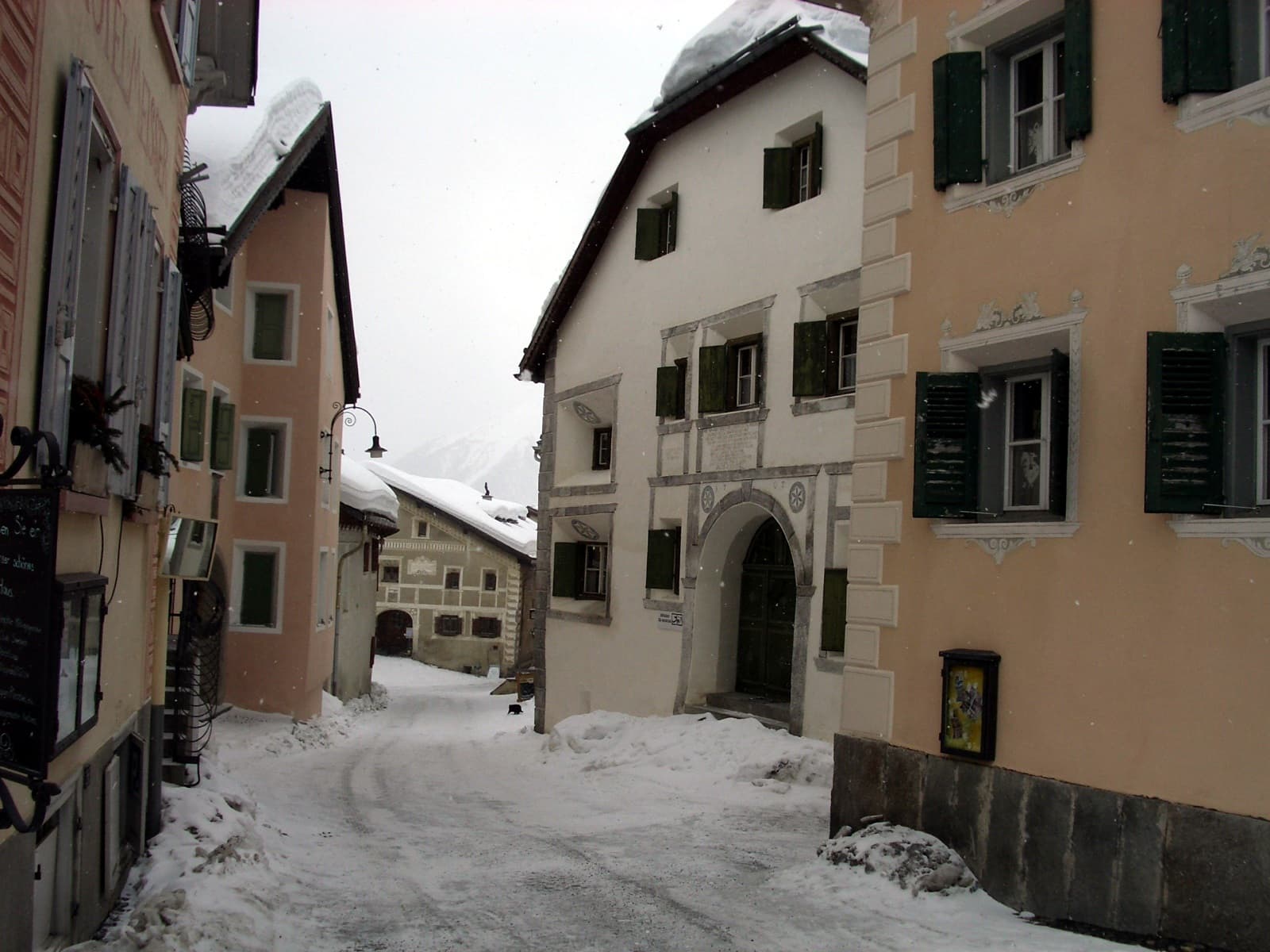
Les maisons de l'Engadine
Observez attentivement les motifs complexes sur les maisons du village ; ce sont plus que de simples décorations.
L'histoire complète se débloque dans le tour
 Paebi / CC BY-SA 3.0, via Wikimedia Commons
Visite audio autoguidée de Guarda — parcours GPS à pied, lecture hors ligne, narration en 32 langues.
“Là où les histoires sont gravées dans la pierre et l'hiver est chassé par l'enchantement.”
Pas les cartes postales. Les histoires que même les habitants ignorent — soufflées à l'oreille, là où elles se sont passées.
Observez attentivement les motifs complexes sur les maisons du village ; ce sont plus que de simples décorations.
Chaque 1er mars, les enfants de Guarda font un joyeux tapage, mais ce n'est pas seulement pour s'amuser.
Every March 1st, the children of Guarda make a joyful racket, but it's not just for fun.
Découvrez tous les secrets de Guarda
Chaque adresse, chaque révélation en entier — dans ton oreille, là où elle s'est passée.
Tu choisis tes lieux. Tu marches. La voix te révèle ce que les autres ignorent.


Votre visite audioguidée de Guarda vous attend — choisissez vos lieux, votre langue, et lancez-vous dès votre arrivée.
AcheterLume intègre un guide en réalité augmentée. Levez votre téléphone : sa caméra montre la rue devant vous, avec une flèche lumineuse posée sur l'image réelle qui pointe toujours vers votre prochain arrêt — aucune carte à déchiffrer, aucun mauvais virage. Comme tout dans Lume, ça fonctionne entièrement hors-ligne.
Guarda, un village de la Basse-Engadine en Suisse, donne l'impression d'un voyage dans le temps. À une altitude de 1 650 mètres (5 423 pieds) sur une terrasse ensoleillée au-dessus de la rive gauche de l'Inn, il offre des vues imprenables sur les Alpes environnantes. Le village est célébré pour son patrimoine architectural remarquablement préservé, ce qui lui a valu le prestigieux Prix Wakker en 1975 de la part de Patrimoine Suisse. Avec ses rues sinueuses pavées de pierre, ses maisons engadinoises traditionnelles ornées de sgraffites complexes et son centre de village sans voitures, Guarda invite les visiteurs à ralentir et à s'immerger dans son charme particulier.
Guarda est peut-être surtout connu comme le cadre du livre pour enfants suisse bien-aimé, Schellen-Ursli (Une clochette pour Ursli), une histoire qui a captivé des générations depuis sa publication en 1945. Le village embrasse ce lien, offrant un sentier thématique qui permet aux familles de suivre les traces d'Ursli et de découvrir les paysages qui ont inspiré le livre. Au-delà de son attrait de livre de contes, Guarda sert de retraite tranquille pour ceux qui recherchent la quiétude, de base pour les amateurs de randonnée et de fenêtre sur la culture vivante des Grisons.
Les origines de Guarda remontent à 1160, date à laquelle il a été documenté pour la première fois sous le nom de 'Warda'. Pendant des siècles, le village a conservé son caractère, façonné par son environnement alpin et la langue romanche, qui était presque universellement parlée jusqu'aux années 1980. Le dialecte vallader du romanche reste une partie importante de l'identité locale, l'école du village soutenant activement sa préservation.
Entre 1939 et 1945, Guarda a fait l'objet d'un important projet de rénovation de bâtiments dirigé par l'architecte suisse Iachen Ulrich Könz. Cette initiative a non seulement préservé les maisons historiques grâce à des améliorations sur mesure, mais a également modernisé l'infrastructure du village, assurant la pérennité de son caractère authentique. Contrairement à de nombreux autres villages de la Basse-Engadine, Guarda a été en grande partie épargné par les grands incendies de village, contribuant à la préservation exceptionnelle de ses bâtiments des XVIe et XVIIe siècles.
En reconnaissance de ses efforts exemplaires pour maintenir son patrimoine architectural, Guarda a reçu le prestigieux Prix Wakker de Patrimoine Suisse en 1975. Cette distinction a consolidé la réputation de Guarda comme l'un des villages les plus précieux architecturalement et les mieux préservés de Suisse. Aujourd'hui, le village continue de maintenir ses traditions, ses quelque 200 habitants se consacrant à la préservation de la scène villageoise originale.
Promenez-vous dans les rues étroites et pavées de Guarda, en admirant les maisons engadinoises distinctives. Chaque façade est une toile pour les sgraffites, des motifs gravés complexes qui racontent souvent des histoires ou affichent des motifs symboliques. Cherchez la maison n° 51, célèbrement représentée comme la maison des parents d'Ursli dans le livre pour enfants Schellen-Ursli.
Visitez l'Église réformée de Guarda, une église de la fin du XVe siècle avec une tour décorative frappante et un beau plafond en bois installé dans les années 1900. Le terrain de l'église comprend également un cimetière avec les pierres tombales d'anciens habitants.
Pour les familles, le Schellen-Ursli-Weg (Sentier de Schellen-Ursli) offre un voyage interactif à travers le village et la nature environnante, suivant les traces du personnage bien-aimé du livre pour enfants. Le musée Schellen-Ursli offre un aperçu plus approfondi de l'histoire du livre et de son lien avec Guarda, exposant des artefacts et la première édition du livre de 1945.
Au-delà du village, explorez la vallée de la Basse-Engadine environnante. Randonnez dans le Val Tuoi jusqu'à la cabane Chamonna Tuoi ou découvrez des parties du Parc national suisse, offrant tous deux des opportunités de sports de montagne et d'expérience de la nature intacte. Une randonnée plus courte d'une heure le long de l'Inn relie Guarda au village voisin de Lavin, offrant des vues panoramiques.
Guarda offre des expériences distinctes tout au long de l'année. L'été (juin à août) est idéal pour la randonnée, avec des températures diurnes modérées atteignant en moyenne 16°C (61°F) en juillet, bien que juin puisse être le mois le plus humide. Le printemps (mars à mai) apporte des paysages dégelés et des fleurs sauvages, avec des températures passant de 5°C (41°F) à 15°C (59°F), parfait pour la randonnée et l'exploration des villes avec moins de touristes. L'automne (septembre à novembre) offre de magnifiques couleurs d'automne, des fêtes du vin et des opportunités continues de randonnée. L'hiver (décembre à avril) transforme Guarda en un paysage enneigé, propice aux sports d'hiver tels que le ski, le patinage sur glace, la luge et le ski de fond, janvier voyant des maximales moyennes de -5°C (23°F).
Envisagez de visiter le 1er mars pour vivre le festival traditionnel de Chalandamarz, où les enfants sonnent des cloches pour accueillir le printemps.
Guarda est accessible en voiture et en transports en commun. En train depuis Zurich, le trajet dure environ 2,5 à 3 heures, impliquant souvent un changement à Landquart. L'arrêt de train de Guarda est sur demande, alors n'oubliez pas d'appuyer sur le bouton à temps. Depuis la gare de Guarda, un car postal peut vous emmener au centre du village. Si vous conduisez, un parking public est disponible à l'entrée du village, car Guarda est en grande partie sans voitures. En hiver, sachez que les cols de montagne peuvent être fermés, nécessitant le transport des voitures par train via le tunnel de la Vereina.
Le village dispose d'un office d'information touristique non doté en personnel, ouvert tous les jours de 6h00 à 22h00, offrant des informations sur la région et une connexion directe à l'office d'information touristique de Scuol via un code QR. Le bureau de poste local est intégré au magasin Volg, offrant des heures d'ouverture prolongées. Pour une expérience interactive, envisagez de télécharger l'application de "visite du village de Guarda" basée sur le GPS.
Guarda en coréen, en chinois ou en hébreu — et dans 29 autres langues, chaque étape narrée par une voix native. La plus large gamme de langues de tous les audioguides autoguidés.
Disponible en :