Güssing Castle
This formidable fortress, standing on an extinct volcano, once offered refuge to thousands during a time of great peril. But what was the cost of such protection?
Full story unlocks in the tour
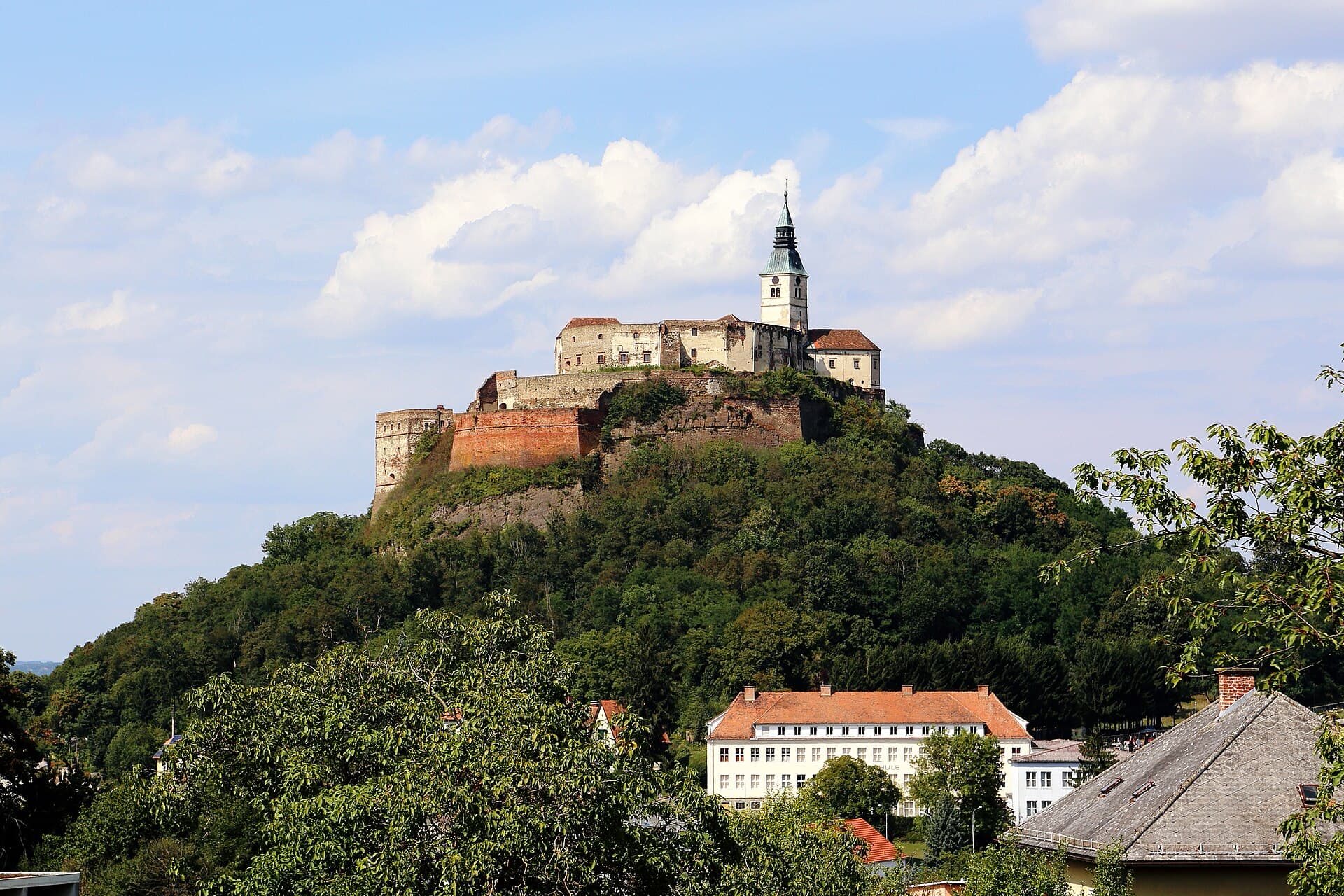 C.Stadler/Bwag / CC BY-SA 3.0 at, via Wikimedia Commons
Self-guided audio walking tour of Güssing — GPS route, offline playback, story-driven narration in 32 languages.
“Where ancient strongholds meet modern sustainability, Güssing guards stories whispered on volcanic winds.”
Not the postcards. The stories even locals don't know — whispered in your ear, right where they happened.
This formidable fortress, standing on an extinct volcano, once offered refuge to thousands during a time of great peril. But what was the cost of such protection?
Beyond its serene facade, the Franciscan Monastery holds a literary relic that predates many printed books.
Within the castle's Gothic chapel, a unique musical instrument speaks of centuries past.
Discover every secret of Güssing
Every address, every reveal in full — in your ear, right where it happened.
You pick your stops. You walk. The voice reveals what the others miss.
Your self-guided audio tour of Güssing is ready — pick your landmarks, choose your language, and start the moment you arrive.
BuyLume has a built-in augmented-reality guide. Hold your phone up and its camera shows the street ahead of you, with a glowing arrow laid over the real view that always points to your next stop — no map to puzzle over, no wrong turns. Like everything in Lume, it works fully offline.
Güssing presents a striking silhouette in Austria's southern Burgenland, rising from an extinct volcanic cone. This small town, with a population of around 3,600, is dominated by its ancient castle, the oldest in Burgenland, which has guarded the region for centuries. Güssing's strategic position on what was once the western edge of the Kingdom of Hungary has imbued it with a compelling and often turbulent past, evident in its architecture and the stories held within its walls.
Beyond its historical significance, Güssing has garnered international recognition as an 'Eco-city,' a pioneer in renewable energy. What began as a local initiative to combat economic hardship in the 1980s transformed into a globally recognized model for energy self-sufficiency, attracting visitors and experts alike. This blend of deep historical roots and forward-thinking sustainability creates a unique atmosphere, where the echoes of ancient battles mingle with the hum of modern innovation.
A visit to Güssing offers a journey through time, from medieval fortifications to a modern, green future. The town's mild climate and appealing location, surrounded by rolling hills and the Weinidylle Nature Park, make it a pleasant destination for those seeking cultural immersion, scenic beauty, and a glimpse into a community that has successfully reinvented itself.
The origins of Güssing trace back to 1157, when Hungarian King Géza II granted Count Wolfer the 'Kyscen' mountain and its surroundings. Wolfer, a German knight, recognized the strategic value of the volcanic cone and built a wooden castle and a monastery, laying the foundation for what would become Burgenland's oldest castle. This early fortification, known as Novum Castrum (New Castle), quickly became a crucial border defense for the Kingdom of Hungary against the Holy Roman Empire.
Over the centuries, Güssing Castle changed hands multiple times, enduring periods of conflict and shifting allegiances. In the late 13th century, the powerful Counts of Güssing, descendants of Wolfer, engaged in wars against royal dynasties, leading to widespread unrest until their power was curtailed. A significant turning point arrived in 1524 when the castle came into the possession of the Batthyány family, one of Hungary's most distinguished magnate families. For nearly 500 years, the Batthyánys have been inextricably linked with Güssing, making it their ancestral seat and transforming it into a formidable fortress.
The 16th and 17th centuries marked a period of intense expansion and fortification for Güssing Castle, primarily to counter the escalating threat of Ottoman invasions. The Batthyánys invested heavily in transforming the medieval structure into an impenetrable, brick-walled stronghold, successfully repelling multiple Turkish advances. During these perilous times, the castle provided refuge for thousands of people from the surrounding areas. The town itself was encircled by a defensive wall in 1619, divided into four distinct districts, reflecting its growing importance as a fortified settlement.
Beyond its military role, Güssing also flourished as a cultural center. As early as 500 years ago, theater held significant importance, a tradition that continues with the annual Burgspiele (Castle Plays). However, with the modernization of warfare, the castle gradually lost its strategic significance, and by the 18th century, its military importance waned, leading to its eventual abandonment and disrepair due to a 'roof tax' that made maintenance prohibitively expensive. In 1870, Prince Philipp Batthyány-Strattmann established a foundation that continues to own and preserve the castle today.
The 20th century brought new challenges. Until 1920/21, Güssing was part of Hungary, and its Hungarian name, Németújvár, was enforced due to Magyarization policies. After the First World War, it was ceded to Austria and became part of the newly formed state of Burgenland. Economically, Güssing struggled in the latter half of the 20th century, particularly due to its proximity to the Iron Curtain during the Cold War. This hardship, however, sparked an innovative spirit, leading to Güssing's remarkable transformation into a global leader in renewable energy in the early 1990s, a testament to its enduring resilience and adaptability.
The most prominent sight in Güssing is undoubtedly Güssing Castle, majestically situated on an extinct volcanic cone. As the oldest castle in Burgenland, it offers a captivating journey through centuries of history. Explore the castle museum with its ancestral portrait gallery of the Batthyány family, a weapons collection, and various art treasures. Don't miss the Gothic castle chapel with its unique chest organ and the bell tower for sweeping views of the surrounding landscape and the Güssing fish ponds. An inclined elevator provides easy access to the castle's summit.
At the foot of the castle, the Franciscan Monastery is another significant landmark. Founded in 1648, it once served as a bastion of the town wall. The monastery church, Maria Heimsuchung, features Renaissance architectural elements and houses a valuable library with ancient texts. Beneath the church lies the second-largest family crypt in Austria, the resting place of the Batthyány family, including the revered Blessed Ladislaus Batthyány-Strattmann.
East of the town, discover Schloss Draskovich, a classicist mansion with Empire-style furnishings. Its chapel contains the only Gothic winged altar in Burgenland, dating back to 1469. For those interested in the region's rural heritage, the Gerersdorf Open-Air Museum Ensemble, located in the district of Güssing, is the largest open-air museum in Burgenland, showcasing traditional Pannonian rural life through 36 rescued historic structures.
Beyond historical sites, Güssing is also known as an 'Eco-city' for its pioneering efforts in renewable energy. While not a traditional tourist attraction, understanding this aspect of Güssing's modern identity adds another layer to its unique character.
The best time to visit Güssing for general outdoor activities is from mid-June to early September, with a peak in the second week of August. During these months, the weather is warm, with average daily high temperatures above 70°F (21°C), and skies are clearer. July is the hottest month, with an average high of 78°F (26°C), and also the clearest.
For those interested in cultural events, Güssing Castle hosts a 'Summer of Culture' in July, featuring musical performances, cinema screenings, and other events. The castle itself is typically open from March 15 to October 31, Tuesday to Sunday. The colder months, from November to February, bring snowy and very cold conditions, with January being the coldest month.
Güssing is located in Burgenland, Austria. While the town itself does not have an active rail connection, it is accessible by car, with frequent bus services running from Vienna. If driving from Vienna, take the A2 and exit at Lafnitztal, then follow the B57 for approximately 30 minutes. From Graz, also take the A2, exiting at Ilz/Fürstenfeld, followed by another 30-minute drive to Güssing.
Many of Güssing's attractions, including the castle and monastery, are within walking distance of each other in the town center. The inclined elevator at Güssing Castle provides a convenient way to reach the hilltop fortress. Guided tours of the castle are available for groups of 10 or more by prior arrangement. The Burgenland Card offers free admission to Güssing Castle and a tour of the castle museum. Local amenities include various restaurants and shopping opportunities.
Güssing in Korean, in Chinese or in Hebrew — and 29 more languages, every stop narrated by a native voice. The widest language range of any self-guided audio tour.
Available in: