The Fishing Harbor
Every morning, before the first light truly breaks, a quiet ritual unfolds at the heart of Imsouane.
Full story unlocks in the tour
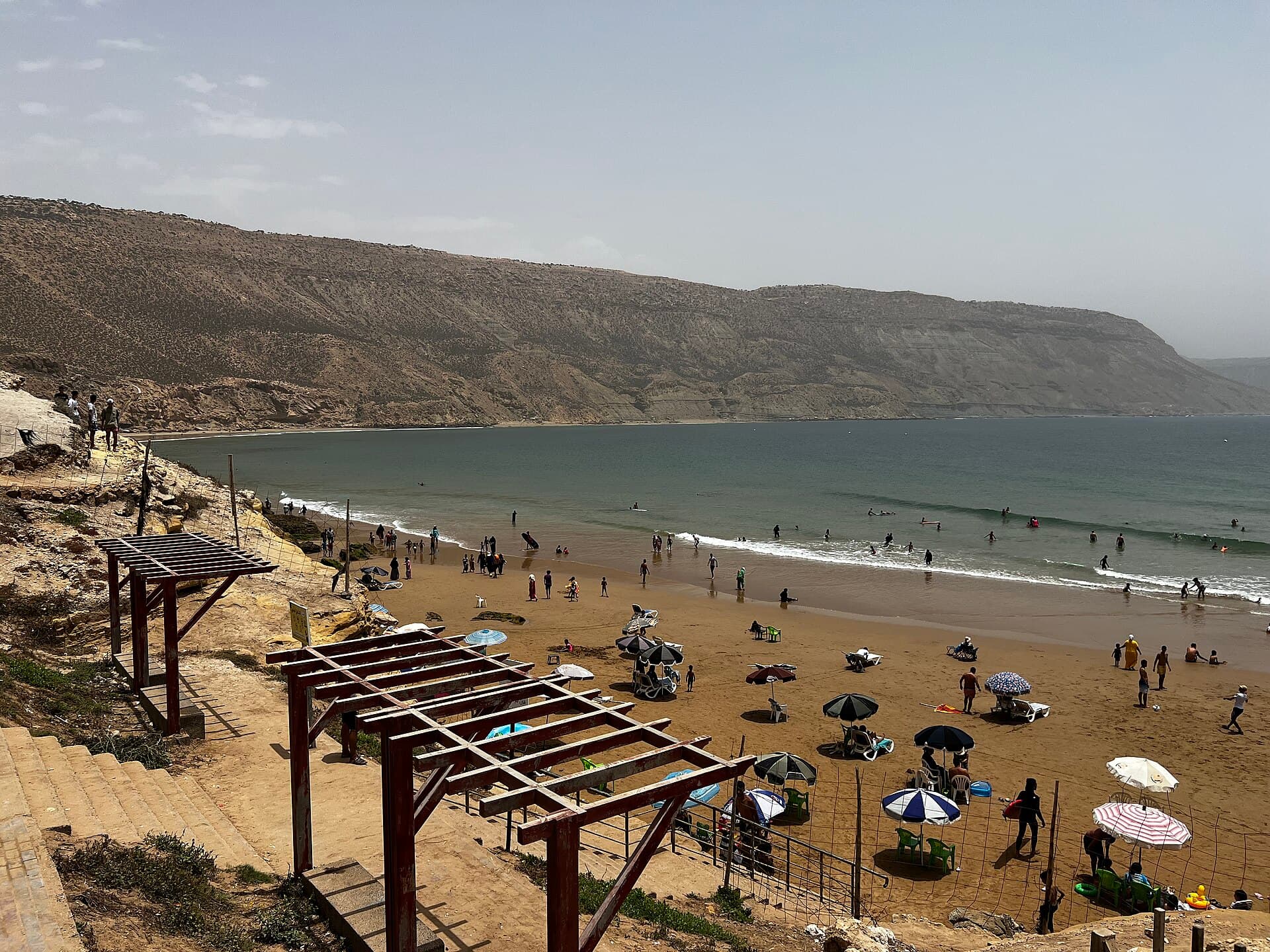 Hamza Izourane / CC BY 4.0, via Wikimedia Commons
Self-guided audio walking tour of Imsouane — GPS route, offline playback, story-driven narration in 32 languages.
“Where the Atlantic breathes long, slow waves and ancient Berber rhythms endure.”
Not the postcards. The stories even locals don't know — whispered in your ear, right where they happened.
Every morning, before the first light truly breaks, a quiet ritual unfolds at the heart of Imsouane.
The precious liquid gold of Morocco isn't just a beauty secret; it's a centuries-old tradition deeply woven into the fabric of Imsouane's surrounding region.
Beyond the famed surf breaks, a geological marvel awaits, revealing chambers and arches at a specific tidal window.
Discover every secret of Imsouane
Every address, every reveal in full — in your ear, right where it happened.
You pick your stops. You walk. The voice reveals what the others miss.


Your self-guided audio tour of Imsouane is ready — pick your landmarks, choose your language, and start the moment you arrive.
BuyLume has a built-in augmented-reality guide. Hold your phone up and its camera shows the street ahead of you, with a glowing arrow laid over the real view that always points to your next stop — no map to puzzle over, no wrong turns. Like everything in Lume, it works fully offline.
Imsouane, a small coastal village on Morocco's Atlantic coast, occupies a unique space where ancient Berber traditions meet a burgeoning international surf culture. Situated between the larger cities of Agadir and Essaouira, its dramatic coastline and consistent waves have earned it a global reputation, particularly for its exceptionally long right-hand point breaks. Yet, beyond the allure of the surf, Imsouane maintains a distinctive rhythm, rooted in its history as a fishing community.
Life here unfolds at a slower pace, centered around the daily comings and goings of colorful fishing boats and the natural beauty of its protected bay. The village, predominantly Amazigh (Berber), offers a window into a culture that has thrived along this stretch of the Atlantic for millennia, distinct from the Arab urban centers of Morocco. While recent developments have brought changes to its landscape, Imsouane continues to captivate visitors with its authentic character, striking sunsets, and a welcoming atmosphere that encourages both adventure and tranquility.
## Roots in the Haha Region Imsouane's history is deeply intertwined with the Berber (Amazigh) communities of the Haha region, a stretch of Atlantic coastline that has been home to these indigenous peoples for millennia. The Haha Berbers were historically both a maritime and mountain people, engaging in fishing, coastal trade, and maintaining a cultural identity distinct from both Morocco's Arab urban centers and the nomadic Berber traditions of the Saharan south.
## A Fishing Village Endures For generations, Imsouane remained a quiet fishing village, with families relying on the Atlantic waters and cultivating argan trees. The bay's unique geography, which creates its renowned surf breaks, also provides a sheltered anchorage, a dual function that has defined the village's character throughout its history. Traditional fishing practices, with boats whose designs have remained essentially unchanged for centuries, continue to be an integral part of daily life.
## The Rise of Surf Culture The 20th century saw Imsouane gradually open to the outside world. Its pristine bay, featuring one of Africa's longest rideable waves, began attracting surfers from across the globe, particularly since the 1960s and 1980s. This discovery transformed Imsouane into a legendary spot in the global surfing community, earning its main break the moniker "Magic Bay" for its exceptionally long, peeling right-hand wave. Despite the influx of visitors, Imsouane largely managed to retain its authentic character, with narrow streets, whitewashed houses, and a welcoming local population.
## Recent Transformations In January 2024, Imsouane experienced significant changes when authorities carried out demolitions of numerous structures, including old fishing shanties, surf camps, and cafes, citing their location on the maritime public domain without proper titles. This operation, part of a broader initiative along Morocco's coast, displaced residents and businesses, sparking concern among locals and the international surf community. While the demolitions aimed to clear the way for planned tourism development, including new accommodations and facilities, they also led to the loss of some of the village's rustic character and raised questions about the preservation of Amazigh heritage. Despite these changes, the resilience of the community and the enduring nature of its waves continue to define Imsouane.
Imsouane's allure lies in its natural beauty and authentic village life. Begin at the Fishing Harbor, the bustling heart of the village, especially in the early morning when colorful boats return with the day's catch. Witness the informal fish auction and observe traditional boat maintenance, a practice passed down through generations. Adjacent to the harbor is Magic Bay (La Baie), known for one of Africa's longest right-hand waves, perfect for longboarders and beginners. For more experienced surfers, Cathedral Point, on the other side of the village, offers faster, more powerful waves and dramatic cliff views.
Explore the village's narrow alleyways and admire the traditional Berber architecture, characterized by flat-roofed houses of local stone and tadelakt plaster. Seek out the "Blue Passage" for a unique photo opportunity. Take a scenic walk along the coastal paths to discover secluded rock pools, especially at low tide, offering peaceful solitude and sweeping ocean views. For a different kind of adventure, venture to the Timlalin Dunes near Tamri for sandboarding. Do not miss the spectacular sunsets over the Atlantic, best enjoyed from a clifftop café.
Imsouane enjoys a mild, sunny climate year-round, making it a pleasant destination almost any time. The ideal period for a visit, balancing comfortable temperatures and optimal surf conditions, is generally from September to May.
For surfing, the peak season with the biggest and most consistent swells for intermediate and advanced surfers runs from October to April, with November to March offering particularly powerful waves. Beginners will find milder conditions and forgiving waves from May to September, with spring (March-May) being especially recommended for learning.
Summer (June-September) is warm and dry, averaging 25-30°C, and is popular with Moroccan families. Winter (December-February) is mild and sunny, around 18-22°C, with fewer tourists and often better prices. For a balance of good waves and fewer crowds, consider October-November and March-May.
Imsouane is a small, walkable village, so a car isn't essential for getting around once you've arrived. However, if you plan day trips to surrounding areas like Essaouira or Paradise Valley, arranging a taxi is advisable. The local currency is the Moroccan Dirham (MAD). There are no ATMs in Imsouane, so it's crucial to bring sufficient cash from larger cities like Agadir or Essaouira, where exchange rates are also generally better. While tap water is generally fine for washing, it's recommended to drink bottled water, which is readily available and affordable. Morocco uses European two-pin plugs (220-volt system), so bring an adapter if needed.
Alcohol consumption by Muslims is prohibited in Islam, and while it's not widely available in Imsouane, you can find it in a few bars or purchase it in Agadir. English is increasingly common in tourist areas, but learning a few basic Arabic or Berber phrases will be appreciated. Travel insurance is highly recommended.
Imsouane in Korean, in Chinese or in Hebrew — and 29 more languages, every stop narrated by a native voice. The widest language range of any self-guided audio tour.
Available in: