Kėdainiai Minaret
This singular minaret, an unexpected architectural flourish in Lithuania, holds a tender secret beyond its official purpose.
Full story unlocks in the tour
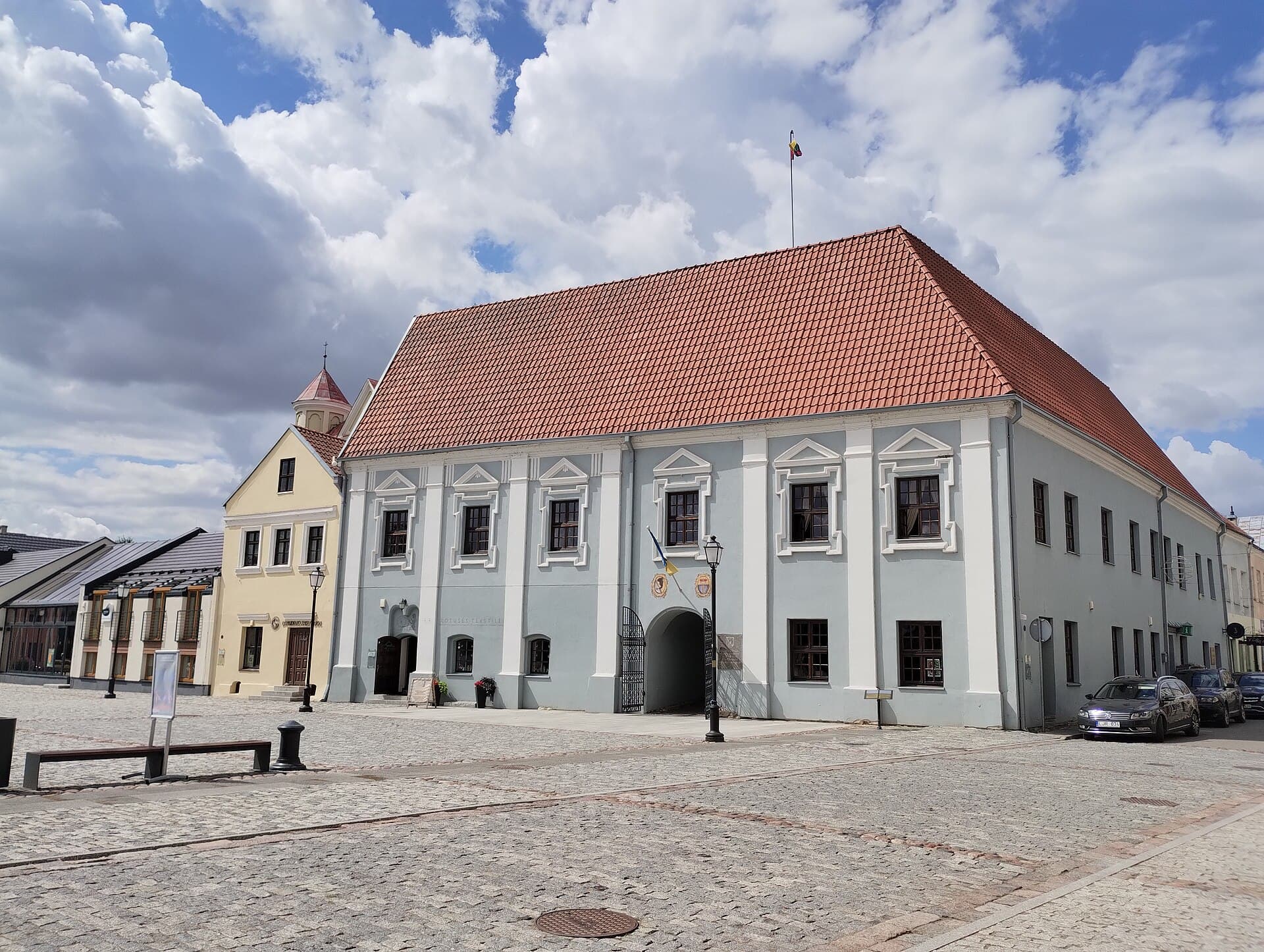 Michał Derela / CC BY-SA 4.0, via Wikimedia Commons
Self-guided audio walking tour of Kėdainiai — GPS route, offline playback, story-driven narration in 32 languages.
“Where centuries of diverse cultures converge on historic lanes.”
Not the postcards. The stories even locals don't know — whispered in your ear, right where they happened.
This singular minaret, an unexpected architectural flourish in Lithuania, holds a tender secret beyond its official purpose.
Beneath the refined Renaissance lines of this church lies a profound echo of Lithuania's aristocratic lineage.
This ancient square once pulsed with Jewish intellectual life, drawing a prodigy who would become one of the most revered figures in Jewish scholarship.
Discover every secret of Kėdainiai
Every address, every reveal in full — in your ear, right where it happened.
You pick your stops. You walk. The voice reveals what the others miss.

Your self-guided audio tour of Kėdainiai is ready — pick your landmarks, choose your language, and start the moment you arrive.
BuyLume has a built-in augmented-reality guide. Hold your phone up and its camera shows the street ahead of you, with a glowing arrow laid over the real view that always points to your next stop — no map to puzzle over, no wrong turns. Like everything in Lume, it works fully offline.
Kėdainiai, situated in the heart of Lithuania, is a town where centuries of diverse cultures have left an indelible mark, creating an Old Town so remarkably preserved it stands as an open-air architectural museum. Unlike many larger cities that endured extensive damage during conflicts, Kėdainiai's historic center largely remained intact, offering an authentic window into Lithuania's layered past.
Stroll its ancient lanes and you will encounter a captivating blend of Gothic, Renaissance, Baroque, and Classicist structures, reflecting the influence of Lithuanian nobility, Scottish merchants, Jewish communities, and German settlers who once made Kėdainiai their home. This singular multicultural heritage, fostered by the influential Radziwiłł family, makes Kėdainiai a compelling destination for those seeking meaningful travel beyond the major capitals.
Kėdainiai's narrative begins in 1372, first mentioned in the Livonian Chronicle of Hermann de Wartberge, making it one of Lithuania's oldest settlements. By the 15th century, it had evolved into a regional trading post. For approximately 300 years, the town was under the private ownership of the formidable Radziwiłł family, Lithuanian noblemen who profoundly shaped its growth.
The 17th century marked Kėdainiai's golden era, as the Radziwiłłs cultivated an environment of economic and religious liberty. This drew a diverse influx of foreign merchants and craftsmen, transforming Kėdainiai into a lively multicultural center. Scottish traders, German Lutherans, and Jewish communities established their quarters, contributing to the town's distinctive identity. It became one of the foremost centers of the Reformation in Lithuania, hosting Arian, Evangelical Reformed, and Evangelical Lutheran communities, alongside Protestant scholars. This period saw the establishment of a Protestant Gymnasium with esteemed lecturers and a printing house for Reformation literature.
Kėdainiai also played a role in significant historical events. In 1655, during "The Deluge" – a conflict between the Polish-Lithuanian Commonwealth and Sweden – the Union of Kėdainiai, a short-lived treaty with Sweden, was signed by two members of the Radziwiłł family at their castle. Later, in the 18th century, the Catholic faith gained prominence, marked by the construction of St. Joseph's Wooden Catholic Church. The town also gained renown for Talmudic studies, with its Jewish community being the largest and most influential in Samogitia.
The 19th century brought changes with Russian Imperial rule, leading to the construction of the Orthodox Church of Christ's Transfiguration. The Kėdainiai Minaret, a distinctive Ottoman-style structure, was erected in 1880 by Russian General Eduard Totleben, then owner of the Kėdainiai manor, commemorating his service in the Russian-Turkish War. The 20th century saw periods of Soviet and Nazi occupation, with the tragic annihilation of Kėdainiai's Jewish community during World War II. Despite these tumultuous periods, much of Kėdainiai's historic core has been remarkably preserved, allowing its rich and diverse past to continue to engage visitors today.
Begin your exploration in Kėdainiai's Old Town, one of Lithuania's seven protected Old Towns, where Gothic, Renaissance, Baroque, and Classicist architecture stand together. Wander through Didžioji Street, one of the 29 historical thoroughfares, and discover the Great Market Square (Didžiosios Rinkos aikštė), a rare surviving Renaissance-era market square. Here, you will find the restored Town Hall and the "Chest" monument to the Radvilas family.
Do not overlook the Evangelical Reformed Church, an impressive 17th-century Protestant church, which houses the Radziwiłł Mausoleum with its aristocratic sarcophagi. Nearby, explore the former Jewish Quarter with its preserved synagogues, including the Great Summer Synagogue, now an art school, and the Small Winter Synagogue, which hosts a Multicultural Centre.
Seek out the Kėdainiai Minaret in the city park, the only free-standing minaret in Lithuania, offering a distinctive architectural sight. Visit St. Joseph's Wooden Catholic Church, an 18th-century marvel of wooden craftsmanship. The Kėdainiai Regional Museum, housed in a former Carmelite Monastery, offers insights into the town's history and features an impressive collection of folk crosses by Vincas Svirskis. For art enthusiasts, the Janina Monkutė-Marks Museum-Gallery showcases textile and graphic art.
The ideal time to visit Kėdainiai extends from late spring (May) through early autumn (September). During these months, the weather is most agreeable for exploring the Old Town and outdoor attractions, with comfortable temperatures and longer daylight hours. June, July, and August offer the warmest and sunniest conditions, perfect for sightseeing. The shoulder seasons of May and September provide pleasant weather with fewer tourists and potentially lower accommodation prices. While winter offers a unique, snowy charm, many outdoor activities are limited, and rural areas can be challenging to access.
Kėdainiai is centrally located in Lithuania, making it easily accessible. It lies approximately 45 km north of Kaunas and around 130 km from Vilnius. If traveling by car, parking is generally available and often free around the Old Town. From Kaunas, buses run frequently, taking about an hour. From Vilnius, direct trains are available, with a journey time of around 1.5 hours. Once in Kėdainiai, the compact Old Town is best explored on foot, with most major sights within a one-kilometer radius of the Town Hall Square. Bank cards are widely accepted in shops, cafes, and museums, though some cash might be useful for smaller markets. English is commonly spoken by younger residents. The Kėdainiai Tourism and Business Information Centre offers guided tours in several languages, including English.
Kėdainiai in Korean, in Chinese or in Hebrew — and 29 more languages, every stop narrated by a native voice. The widest language range of any self-guided audio tour.
Available in: