Törli (Upper Gate)
The Törli city gate, a symbol of Liestal, holds a secret within its painted facade that goes beyond mere decoration.
Full story unlocks in the tour
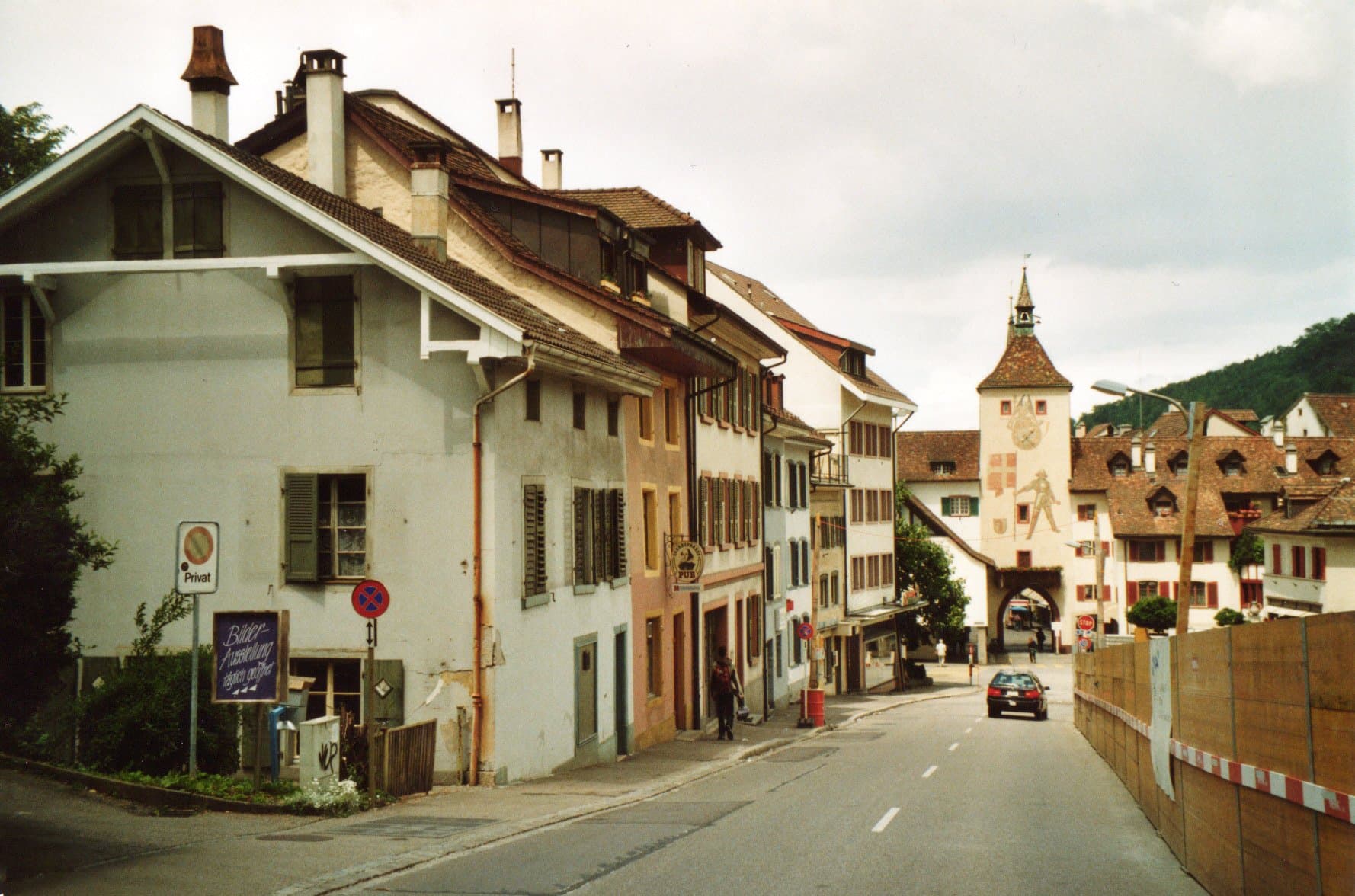 User:Umschattiger / CC BY-SA 3.0, via Wikimedia Commons
Self-guided audio walking tour of Liestal — GPS route, offline playback, story-driven narration in 32 languages.
“Where ancient traditions burn bright amidst enduring medieval grace.”
Not the postcards. The stories even locals don't know — whispered in your ear, right where they happened.
The Törli city gate, a symbol of Liestal, holds a secret within its painted facade that goes beyond mere decoration.
Liestal has a particular etiquette when it comes to carnival confetti that might surprise visitors accustomed to a free-for-all.
The Chienbäse fire parade, a spectacular highlight of Liestal's carnival, has a surprising origin story tied to a common profession.
Discover every secret of Liestal
Every address, every reveal in full — in your ear, right where it happened.
You pick your stops. You walk. The voice reveals what the others miss.


Your self-guided audio tour of Liestal is ready — pick your landmarks, choose your language, and start the moment you arrive.
BuyLume has a built-in augmented-reality guide. Hold your phone up and its camera shows the street ahead of you, with a glowing arrow laid over the real view that always points to your next stop — no map to puzzle over, no wrong turns. Like everything in Lume, it works fully offline.
Liestal, the capital of the canton of Basel-Landschaft, rests 17 kilometers south of Basel, cradled by the Ergolz and Orisbach rivers and the Jura Mountains. This charming, animated town, with a population of around 15,000, offers a blend of historic architecture and a welcoming atmosphere. Its medieval old town features paved streets, stone houses, and gentle arches, reflecting centuries of history.
While Liestal is recognized as an industrial town, its historical core provides a striking contrast with its well-preserved buildings and picturesque market square. The town's strategic location on the road between Basel and the St. Gotthard Pass contributed significantly to its development. Today, Liestal serves as an active administrative and economic center, offering a relaxed sense of everyday Swiss life alongside its cultural offerings.
Visitors can explore a variety of attractions, from medieval fortifications to museums, and enjoy the surrounding natural splendor of the Jura Mountains, which provide opportunities for hiking and outdoor activities. The town's unique customs and festivals, such as the fiery Chienbäse parade, offer a glimpse into its distinct cultural identity.
Liestal's history stretches back to Roman times, with its name first appearing in records in 1225. The town's growth was significantly influenced by its strategic position on the trade route connecting Basel, with its first Rhine bridge, and the St. Gotthard Pass. In 1240, Count Hartman IV of Froburg fortified Liestal, elevating it to a city with defensive walls, gates, towers, a rampart, and a moat, along with a market and customs house.
Throughout the centuries, Liestal was often under the influence of Basel. Citizens of Liestal participated in the Burgundian Wars in the late 15th century. In 1501, the mayor swore allegiance to the Swiss Confederation, leading to repeated conflicts with neighboring Rheinfelden, which was under Habsburg control. The town faced devastation from the 1356 earthquake and a major fire in 1381, undergoing extensive reconstruction until 1415.
The 17th century saw Liestal rebel against Basel during the Farmers' Rebellion, resulting in the occupation of the town by Basel's troops and the execution of three rebellion leaders. The French Revolution in 1789 brought enthusiasm for freedom and equality to Liestal, with celebrations for Napoleon's visit in 1797. However, after Napoleon's downfall, the town reverted to Basel's control. The French July Revolution of 1830 once again sparked upheaval in Liestal, leading to the establishment of a provisional government. On March 17, 1832, Liestal was chosen as the capital of a new canton, a significant step towards its independence.
Today, Liestal remains the seat of the cantonal government since 1832/1833. Significant historical sites, including the Depot of Archeology of Basel-land, the Frenkenbrücke (an old bridge), the Roman farmhouse of Munzach, and a Roman aqueduct, are recognized as Swiss heritage sites of national significance. The town's medieval center, with its well-preserved buildings and the iconic Törli (Upper Gate), continues to define the townscape.
Begin your exploration in Liestal's well-preserved medieval Old Town, characterized by its paved streets and historic buildings. The iconic Törli (Upper Gate), a remnant of the medieval fortifications, stands as Liestal's landmark. Its facade features paintings by Otto Plattner from 1949/50, depicting the Rütli oath and Saint George the dragon slayer on the inside, and Chronos and a warrior with a Swiss banner on the outside.
Delve into local history and culture at the Museum.BL (Kantonsmuseum Baselland), which offers exhibits on the canton's past, including a focus on silk ribbon weaving. For literary enthusiasts, the Dichter:innen- und Stadtmuseum (Poetry and Town Museum) is housed in the fresco-adorned late-Gothic Rathaus (Town Hall). Liestal was the home of Carl Spitteler, the only Swiss Nobel Peace Prize laureate in literature. Another unique stop is the Harmonium Museum, showcasing over 100 working musical instruments from two centuries.
For expansive views of the Liestal valley, the Rhine, and even the Alps on clear days, ascend the Schleifenberg Tower, a 30-meter-high observation tower. The surrounding region also offers attractions like the Roman city of Augusta Raurica, 13 km away, one of the best-preserved ancient Roman settlements north of the Alps with its theater and museum. Additionally, Wildenstein Castle near Bubendorf, with its impressive oak grove, provides a glimpse into the Middle Ages.
The best time to visit Liestal for pleasant weather and outdoor activities is from May through September. During these months, temperatures are comfortable, ranging from average daytime highs of 20°C to 26°C, and there is not excessive rain. July is typically the sunniest month, with approximately 7.9 hours of sunshine per day. For warm-weather activities, late June to early September is particularly ideal. While May is the wettest month, precipitation is fairly consistent throughout the year.
Liestal is well-connected by public transport. The town is on the main train route from Basel SBB to Olten, with direct connections to major Swiss cities like Lucerne, Zurich, Bern, Interlaken, and Saint Gallen. The railway station also serves as the terminus for the narrow-gauge Waldenburgerbahn to Waldenburg, a unique 13 km route. Buses also provide connections to surrounding villages and from Basel. If arriving by car, Liestal is accessible via Highway A1 from Bern, A2 from Milan, and A5 from Paris. The closest airport is EuroAirport Basel-Mulhouse-Freiburg, about 23 km away, with train connections from Basel SBB.
Within Liestal, the town is walkable, especially the old town. The local dialect is Alemannic Swiss German, though Standard German is the official language. Luggage lockers are available at the train station for a fee.
Liestal in Korean, in Chinese or in Hebrew — and 29 more languages, every stop narrated by a native voice. The widest language range of any self-guided audio tour.
Available in: