Merkinė Hillfort
This earthwork was once part of a crucial defensive triangle for the Grand Duchy of Lithuania. What secret did it hold regarding the founding of a capital city?
Full story unlocks in the tour
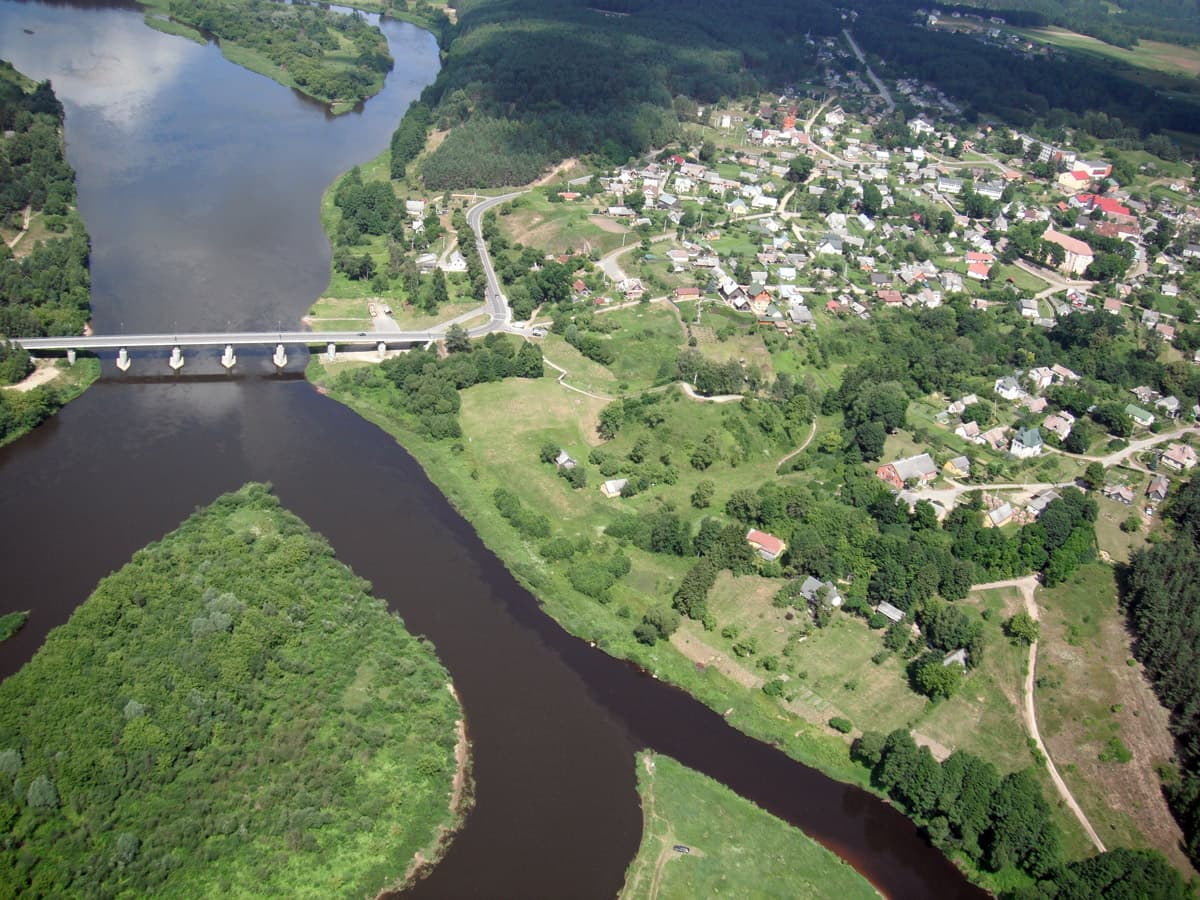 Arunas Gineitis user:Watas (uploading under a new name -- the file mistakenly overwrote existing file:Merkine.jpg) / CC BY-SA 3.0, via Wikimedia Commons
Self-guided audio walking tour of Merkinė — GPS route, offline playback, story-driven narration in 32 languages.
“Where ancient rivers carry forgotten royal tales.”
Not the postcards. The stories even locals don't know — whispered in your ear, right where they happened.
This earthwork was once part of a crucial defensive triangle for the Grand Duchy of Lithuania. What secret did it hold regarding the founding of a capital city?
The church's Gothic-Baroque facade holds a clue to a royal tragedy. Which monarch's final moments are forever linked to this sacred place?
Beneath the modern town square lies a ghost of Merkinė's former glory. What powerful symbol of civic pride once stood here, only to be erased and later rediscovered?
Discover every secret of Merkinė
Every address, every reveal in full — in your ear, right where it happened.
You pick your stops. You walk. The voice reveals what the others miss.
Your self-guided audio tour of Merkinė is ready — pick your landmarks, choose your language, and start the moment you arrive.
BuyLume has a built-in augmented-reality guide. Hold your phone up and its camera shows the street ahead of you, with a glowing arrow laid over the real view that always points to your next stop — no map to puzzle over, no wrong turns. Like everything in Lume, it works fully offline.
Merkinė, a town cradled at the confluence of the Merkys and Nemunas rivers, is one of Lithuania's most ancient settlements, with human presence dating back to the 9th-10th century BC. This strategic location, within the Dzūkija National Park, has ensured its enduring significance throughout history. Today, Merkinė offers a compelling blend of natural beauty, profound historical narratives, and a quiet allure that invites deeper exploration.
Once a vital defensive stronghold and a thriving center of trade and culture, Merkinė has witnessed the ebb and flow of empires and the resilience of the Lithuanian spirit. Its historic sites evoke the lives of Grand Dukes, royal visits, and the daily routines of its diverse inhabitants. From its commanding earthwork offering panoramic views to its sacred spaces and unique spiritual sites, Merkinė provides a captivating journey through time and tradition.
## From Paleolithic Settlement to Grand Duchy Stronghold Merkinė's story begins long before written records, with the first settlers inhabiting the confluence of the Merkys and Nemunas rivers in the 9th-10th century BC. By the 13th century, a crucial wooden castle stood atop the Merkinė hillfort, forming a strategic defense line against the Teutonic Order. This castle was so vital that it was frequently attacked and burned, only to be rebuilt each time.
## A Royal Hub and Economic Powerhouse Merkinė's importance grew significantly during the Grand Duchy of Lithuania era. Grand Duke Jogaila himself signed the document granting Vilnius its city rights in Merkinė Castle in 1387. The town flourished in the 15th-17th centuries, becoming an economic, cultural, and spiritual center of the Dainava land, thanks to its location at the crossroads of important trade routes. In 1569, Merkinė was granted Magdeburg rights, a testament to its growing status, and even had its own town hall and a river port on the Nemunas. It was a favored holiday spot for King Władysław IV Vasa of Poland and Grand Duke of Lithuania, who eventually died here in 1648.
## Decline, Resistance, and Modern Revival The 17th and 18th centuries brought hardship, with Merkinė suffering greatly during wars with Russia and Sweden, losing much of its strategic and economic significance. The town was burned again during the 1794 Uprising. In the 19th century, Merkinė was still noted as a river trade center, and it played a role in the clandestine distribution of banned Lithuanian press against Russification. The 20th century brought further devastation, including the tragic annihilation of its large Jewish community during World War II and the Battle of Merkinė in 1945, a significant partisan engagement against Soviet occupation. Despite these challenges, Merkinė has re-emerged as an important point for domestic tourism, preserving its unique history and natural heritage within the Dzūkija National Park.
Begin your exploration at the Merkinė Hillfort, a commanding site where a 13th-century wooden castle once stood. From its summit, you'll be treated to expansive views of the Merkys and Nemunas river confluence and the surrounding Dzūkija National Park. Descend to the town square to visit the Church of the Assumption of the Blessed Virgin Mary, a Gothic-Baroque edifice dating back to the early 15th century, with an interior rich in history and art. In the basement of the Merkinė Regional Museum, located in the central square, you can view the excavated remains of the 16th-century Town Hall. Seek out the surviving 16th-century town boundary pillars on the outskirts, unique markers of Merkinė's former city rights.
For a different perspective, ascend the Merkinė Observation Tower, a 26-meter-high structure offering sweeping views of the Nemunas Valley. Just outside the town, in the village of Česukai, lies the intriguing Merkinė Bioenergetic Pyramid, a glass-domed structure built in 2002, drawing visitors seeking spiritual and healing experiences. Do not overlook the Merkinė Hill of Crosses, a poignant memorial north of the village center dedicated to those who fought for Lithuanian independence. You can also visit the Orthodox Church, built in 1885, which replaced the former town hall.
Merkinė is particularly appealing from late spring to early autumn (May to September), when the weather is mild and the Dzūkija National Park is lush and green. This period is ideal for outdoor activities like hiking, cycling, and enjoying the river views. The Merkinė Bioenergetic Pyramid is open year-round, but the natural surroundings are best appreciated in warmer months.
Merkinė is located in the Varėna district municipality, within Alytus County. It's easily accessible by road, approximately 105 km west of Vilnius via the A4 highway. Buses run regularly from Vilnius, Kaunas, and Druskininkai, with stops at the A4 roundabout or the main square. Most points of interest within the town are walkable. For the Merkinė Bioenergetic Pyramid and the Vincas Krėvė-Mickevičius Museum, you might consider having a vehicle. The Dzūkija National Park visitor center in Merkinė provides information and guided tours. Accommodation options include local homesteads and guesthouses.
Merkinė in Korean, in Chinese or in Hebrew — and 29 more languages, every stop narrated by a native voice. The widest language range of any self-guided audio tour.
Available in: