Arc de Triomphe, Paris
A Polish city's name is etched onto one of France's most iconic monuments, a testament to a forgotten Napoleonic victory.
Full story unlocks in the tour
 Piotr Brichacek (Briho) / CC BY-SA 3.0, via Wikimedia Commons
Self-guided audio walking tour of Ostrołęka — GPS route, offline playback, story-driven narration in 32 languages.
“On the Narew River, a city unfolds centuries of resilience and verdant forest lore.”
Not the postcards. The stories even locals don't know — whispered in your ear, right where they happened.
A Polish city's name is etched onto one of France's most iconic monuments, a testament to a forgotten Napoleonic victory.
The people of Ostrołęka's surrounding forest region possess a distinct identity, even a unique dialect, setting them apart from typical Polish culture.
Examine the exterior of Ostrołęka's oldest church, and you might discern unusual historical 'decorations' embedded in its walls.
Discover every secret of Ostrołęka
Every address, every reveal in full — in your ear, right where it happened.
You pick your stops. You walk. The voice reveals what the others miss.

Your self-guided audio tour of Ostrołęka is ready — pick your landmarks, choose your language, and start the moment you arrive.
BuyLume has a built-in augmented-reality guide. Hold your phone up and its camera shows the street ahead of you, with a glowing arrow laid over the real view that always points to your next stop — no map to puzzle over, no wrong turns. Like everything in Lume, it works fully offline.
Ostrołęka, a city in northeastern Poland alongside the Narew River, presents a compelling blend of historical depth and natural beauty. Approximately 120 kilometers northeast of Warsaw, it functions as a significant administrative and industrial core within the Masovian Voivodeship. The city's strategic placement on the Narew, a vital waterway, has shaped its development from a medieval stronghold to a modern urban center.
While Ostrołęka is recognized for its energy, cellulose-paper, building, and food industries, it also guards a profound cultural heritage, particularly its connection to the distinctive Kurpie region. Visitors can explore historical sites that speak to centuries of trade, conflict, and endurance, all while experiencing the singular traditions of the surrounding Green Forest. The city, with a population of around 51,000, provides an entryway to understanding a lesser-known yet historically significant part of Poland.
From the echoes of Napoleonic battles to the spirited folk culture of the Kurpie people, Ostrołęka invites a deeper exploration beyond the well-trodden tourist paths. Its fusion of industrial importance and historical resonance, framed by the Narew River, establishes it as a destination for those seeking authentic Polish experiences.
## From Medieval Stronghold to Industrial Hub Ostrołęka's origins trace back to the late 11th century, when a defensive outpost was established on a sandy island near the mouth of the Omulew River, around which a village grew. The earliest documented mention of Ostrołęka as a city dates to 1373. Its strategic position on the Narew River fostered its growth into an important economic center within the Duchy of Masovia, facilitating trade, particularly in wood, amber, and honey, with the neighboring Teutonic Order by the early 15th century.
## Royal Patronage and Turbulent Times In 1526, the Duchy of Masovia was incorporated into the Polish Kingdom, ushering in what is often considered Ostrołęka's Golden Age, marked by an economic boom. Queen Bona Sforza played a significant role during this period, establishing a folwark (a large farm) in the nearby settlement of Pomian, now within the city's modern borders. However, this prosperity was not without interruption. The city endured a plague and a devastating fire, and its population significantly declined after conflicts with the Swedes in the 17th century. The 18th century saw further destruction from Swedish, Russian, and Saxon armies, hindering economic development for decades.
## Napoleonic Echoes and National Uprisings Ostrołęka gained international recognition during the Napoleonic Wars. In 1807, a significant battle between French and Russian armies took place here, resulting in a French victory. The city's name is notably inscribed on the Arc de Triomphe in Paris, a testament to this event. Later, in 1831, Ostrołęka was the site of a major battle during the Polish November Uprising against Russian forces, a conflict that left the city extensively damaged. A monument commemorating the Russian victory in this battle was erected in 1847.
## Modern Development and Cultural Revival The 20th century marked Ostrołęka's most dynamic period of development. After suffering extensive damage during World War II, the city underwent significant rebuilding and industrialization. The construction of a cellulose and paper factory in 1959, followed by a power station and other industries, transformed Ostrołęka into an important industrial center. Despite its industrial growth, Ostrołęka has also seen a strong revival of its Kurpie cultural heritage, particularly after 1989, with efforts to preserve and promote its unique traditions and dialect.
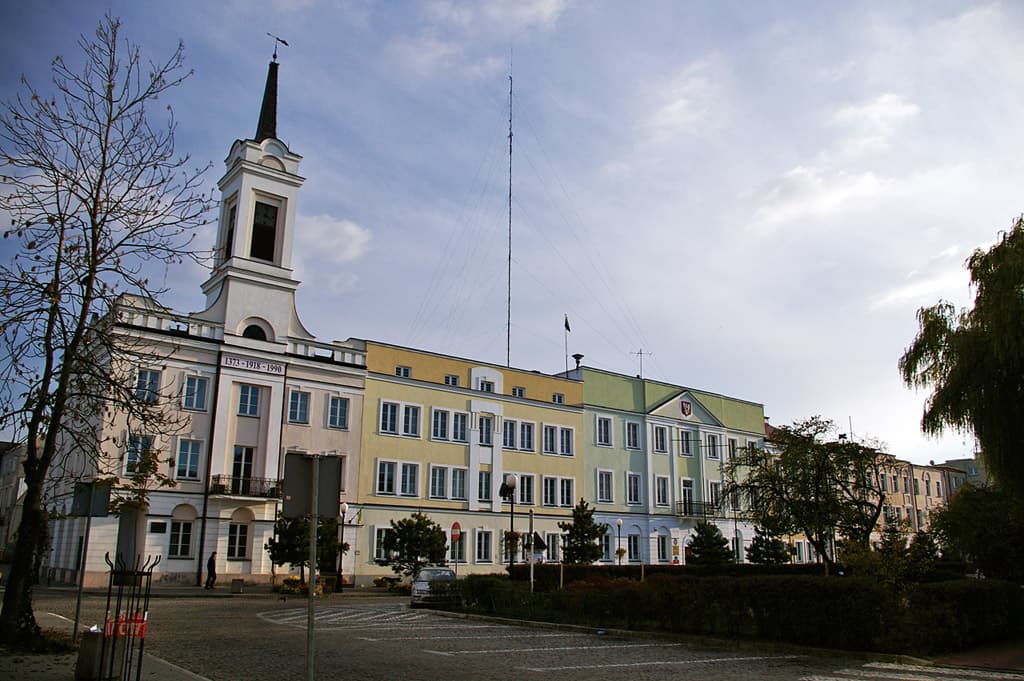
Begin your exploration in Plac Bema, the city's central square, where you'll find the classicist Town Hall, a building that has been rebuilt several times since its original construction in the 1820s. Adjacent to the square is the Kurpie Culture Museum, housed in a 1928 former post office building. This museum is dedicated to collecting and showcasing the profound cultural heritage of the Kurpie region, with permanent exhibitions on local history and temporary displays.
A short walk will lead you to the Saint Mary's Visitation Parish Church on ul. Farna, the oldest shrine in Ostrołęka, dating back to 1399. This Gothic-Baroque church has endured destruction and rebuilding over centuries, with remnants like cannonballs still visible on its exterior. Another significant religious site is St. Anthony of Padua's Church, a spectacular baroque monastic complex built between 1666 and 1696, featuring a unique cloister courtyard known as the Calvary.
For those interested in military history, the Monument and Mausoleum of the 1831 Ostrołęka Battle, situated on the former battlefield, commemorates the largest battle of the November Uprising. Nearby, a monument honors General Józef Bem's heroic cavalry charge. Don't miss the Antoni Madaliński's Bridge, an arc-shaped bridge built in 1995 and modeled after a bridge in Seville, which has become a recognizable symbol of the city.
Other points of interest include the Ostrołęka Art Gallery, located in a former merchant's townhouse, offering exhibitions and cultural workshops, and St. Wojciech's Church, a former Orthodox church converted to Catholic use. The Narew River itself provides opportunities for relaxation, with a city beach and gondola rides available.
The best time to visit Ostrołęka for general outdoor tourist activities is from mid-June to late August, with a peak in the first week of August, when temperatures are comfortable and skies are often clear. July is typically the warmest month, with an average high of 74°F (23°C). For those who prefer milder weather and fewer crowds, late spring (May-June) and early autumn (September-October) are also excellent choices, offering pleasant temperatures for sightseeing. Precipitation is highest in June, while February is the driest month.
Ostrołęka is well-connected by road, approximately 120 km (75 miles) northeast of Warsaw. Direct bus services are available from Warsaw, with the journey taking around 2.5 hours. While there isn't a direct train from Warsaw, connections are possible with a transfer. The city also serves as a local railway junction with lines connecting to Białystok, Warsaw, Olsztyn, and Małkinia Górna.
Within Ostrołęka, local transport options include buses and carpools. For those seeking private transport or airport transfers, VIP transport services are available within a 50 km radius of the city. Accommodation options range from hotels like Inter Hotel, Elba Hotel, and Korona Hotel to guesthouses and apartments, catering to various budgets. Many hotels offer amenities such as free WiFi, restaurants, and private parking.
Ostrołęka in Korean, in Chinese or in Hebrew — and 29 more languages, every stop narrated by a native voice. The widest language range of any self-guided audio tour.
Available in: