Pułtusk Market Square
Imagine a marketplace so grand it stretches almost half a kilometer. It holds a secret that ties it to a pivotal moment in European history.
Full story unlocks in the tour
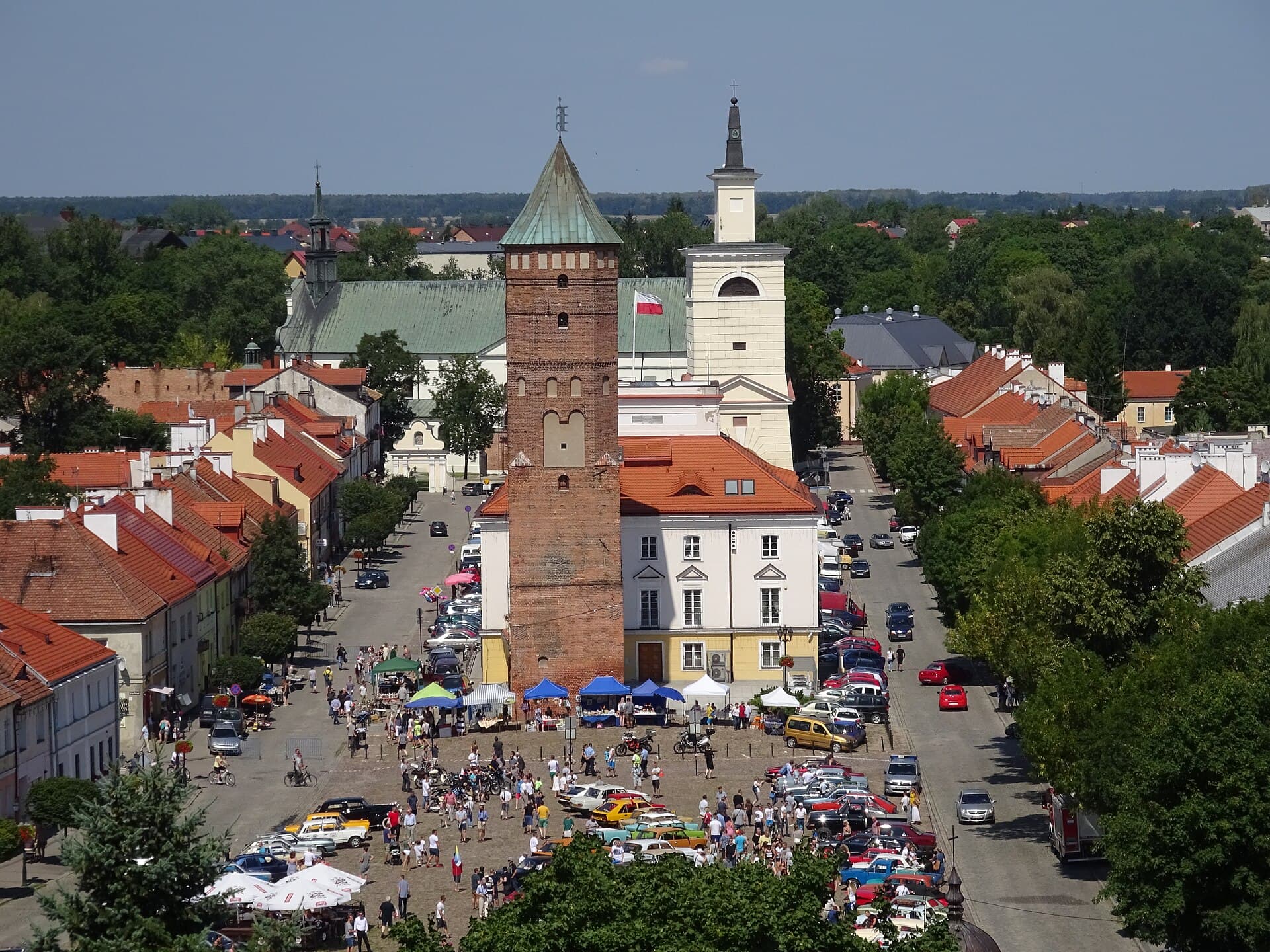 Sylwester Górski / CC BY-SA 4.0, via Wikimedia Commons
Self-guided audio walking tour of Pułtusk — GPS route, offline playback, story-driven narration in 32 languages.
“Where a medieval past meets cosmic wonders, and Europe's longest market square invites you to linger.”
Not the postcards. The stories even locals don't know — whispered in your ear, right where they happened.
Imagine a marketplace so grand it stretches almost half a kilometer. It holds a secret that ties it to a pivotal moment in European history.
Within a 15th-century church, a Renaissance secret lay for centuries, only to be rediscovered in recent times.
This castle has witnessed centuries of power struggles, but one particular resident left his mark in a way that is etched into the very fabric of Paris.
Discover every secret of Pułtusk
Every address, every reveal in full — in your ear, right where it happened.
You pick your stops. You walk. The voice reveals what the others miss.

Your self-guided audio tour of Pułtusk is ready — pick your landmarks, choose your language, and start the moment you arrive.
BuyLume has a built-in augmented-reality guide. Hold your phone up and its camera shows the street ahead of you, with a glowing arrow laid over the real view that always points to your next stop — no map to puzzle over, no wrong turns. Like everything in Lume, it works fully offline.
Pułtusk, a historic town in Poland's Mazovian Voivodeship, offers a captivating journey through centuries of Polish history and culture. Situated approximately 70 kilometers north of Warsaw on the Narew River, it's a popular destination for those seeking a blend of architectural marvels, natural beauty, and intriguing anecdotes. The town is perhaps best known for its exceptionally long paved market square, a testament to its medieval trading prowess.
Beyond the market square, Pułtusk reveals layers of history through its impressive Collegiate Basilica, a former bishop's castle now serving as a cultural center, and the remnants of a once-influential Jesuit college. The town's strategic location on the Narew River has shaped its development, from a defensive stronghold in the Middle Ages to a significant economic hub. Despite enduring numerous invasions and extensive destruction throughout its millennium of existence, Pułtusk has been meticulously reconstructed, preserving its unique character and historical landmarks. Today, it invites visitors to explore its charming streets, discover its secrets, and experience the enduring spirit of this remarkable Polish town.
## From Stronghold to Economic Powerhouse Pułtusk's roots stretch back to the 9th or 10th century, initially as a Proto-Slavic stronghold. Its strategic location by a ford on the Narew River quickly made it an important center for trade and defense. By the 11th century, it came under the ownership of the bishops of Płock, who would govern the area for over six hundred years, styling themselves as the princes of Pułtusk. The town was granted civic rights in 1257, modeled after Chełmno Law, marking a significant step in its development.
## Golden Age and Academic Excellence The 15th and 16th centuries are considered Pułtusk's 'golden age.' During this period, the town flourished economically, with merchants among the wealthiest in Poland, thanks to grain exports along the Narew to Gdańsk. This prosperity led to the construction of stone fortifications, a collegiate church, a hospital, and pharmacies. In 1530, the first printing house in Masovia was established here. A pivotal moment for education and culture was the founding of the Jesuit College in 1566, which became one of the largest and most influential schools in the Polish Kingdom, even hosting one of Poland's first public theaters.
## Wars, Partitions, and Reconstruction Pułtusk's strategic importance also made it a frequent target of conflict. It suffered destruction from Lithuanian raids in the 13th and 14th centuries, and later during the Swedish Deluge in the 17th century. The town was a battlefield during the Napoleonic Wars, notably the Battle of Pułtusk in 1806, which is commemorated on the Arc de Triomphe in Paris. In the 19th century, it fell under Russian rule as part of Congress Poland. A devastating fire in 1875 destroyed much of the city, and in 1868, it was the site of the largest stony meteorite shower in recorded history. The 20th century brought further hardship, including German occupation and significant destruction during World War II, with 85% of its buildings ruined. Despite these challenges, Pułtusk has been painstakingly reconstructed, preserving its historical essence and continuing to draw visitors with its enduring appeal.
Begin your exploration at the Market Square, reputedly the longest paved marketplace in Europe, stretching nearly 400 meters. In its center stands the Town Hall with its 15th-century tower, which now houses the Regional Museum, offering insights into Pułtusk's past, including fragments of the famous Pułtusk meteorite. At the northern end of the market square, discover the Collegiate Basilica of the Annunciation. This Gothic church, dating from the 15th century, contains remarkable Renaissance barrel vaults with intricate floral and geometric patterns, rediscovered in 1994.
Overlooking the Narew River on an artificial hill, the Pułtusk Castle, now operating as the Dom Polonii hotel and cultural center, offers much to explore. Discover its history, from a medieval stronghold to a bishop's residence, and imagine Napoleon walking its grounds. Nearby, you can find the Chapel of St. Mary Magdalene. For a glimpse into the town's Jewish heritage, visit the Jewish Cemetery, a quiet site reflecting a once-active community. Don't miss the Ogródek Jordanowski, one of the first children's playgrounds in Poland. For those interested in literature, Opiniogóra, a short distance away, hosts the Romanticism Museum, dedicated to the Krasiński family, particularly the poet Zygmunt Krasiński.
The best time to visit Pułtusk for general outdoor activities and pleasant weather is from mid-June to late August, with July being the warmest month. During this period, average daily high temperatures are above 66°F (19°C), often reaching 74°F (23°C) in July. The skies are also clearer during the summer months, with July being the clearest. Late spring (May-June) and early autumn (September) also offer comfortable temperatures and fewer crowds, with average highs in the low 20s°C (mid-60s°F). While winters are freezing and snowy, December can be a festive time to visit, especially for those interested in holiday markets.
Pułtusk is located approximately 70 kilometers north of Warsaw, making it an accessible day trip or weekend getaway from the capital. The town is well-connected by road. While there isn't a direct train line, bus services from Warsaw are available. Once in Pułtusk, the town center and its main attractions are easily walkable, particularly the long Market Square that connects many key sites. The Dom Polonii hotel, located in the historic Pułtusk Castle, offers accommodation and amenities, including water equipment rental for the Narew River, tennis courts, and gondola cruises. The local Regional Museum, housed in the Town Hall Tower, provides valuable historical context. Standard Polish currency (Złoty) is used, and Polish is the official language, though English may be spoken in tourist-oriented establishments.
Pułtusk in Korean, in Chinese or in Hebrew — and 29 more languages, every stop narrated by a native voice. The widest language range of any self-guided audio tour.
Available in: