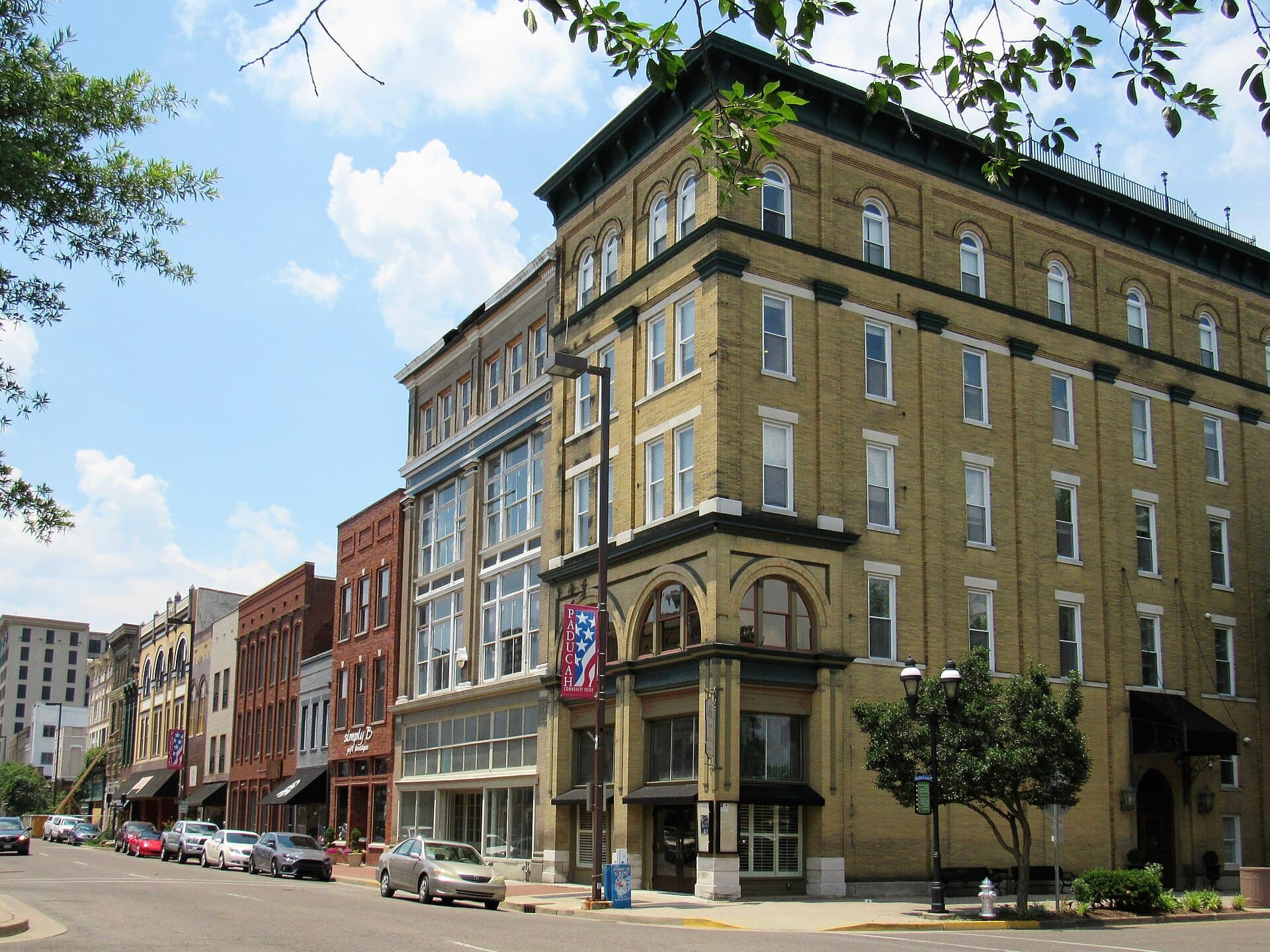
Paducah, United StatesFarragutful / CC BY-SA 4.0, via Wikimedia Commons
US

Paducah

Self-guided audio walking tour of Paducah — GPS route, offline playback, story-driven narration in 32 languages.

Where rivers converge, creativity flows.

The secrets of Paducah

Paducah, as no one tells it.

Not the postcards. The stories even locals don't know — whispered in your ear, right where they happened.

3 secrets below. Many more wait inside the tour.
The Riverfront Floodwall Murals

The colorful murals lining Paducah's riverfront tell a vivid story, but they are more than just art; they are a monument to a devastating event that reshaped the city.

Full story unlocks in the tour
Hotel Metropolitan Museum

During a time of segregation, a particular hotel in Paducah offered a rare haven for Black travelers, hosting some of the biggest names in American music.

Full story unlocks in the tour
The National Quilt Museum

Paducah is known globally as 'Quilt City USA,' but the story of how a small Kentucky city became a world-renowned quilting hub is a tale of deliberate artistic cultivation.

Full story unlocks in the tour
The full tour

Discover every secret of Paducah

Every address, every reveal in full — in your ear, right where it happened.

Get the key to Paducah

You pick your stops. You walk. The voice reveals what the others miss.

Choose your time

How long do you have in Paducah?

Your self-guided audio tour of Paducah is ready — pick your landmarks, choose your language, and start the moment you arrive.

Buy
About Paducah

The story of Paducah

Paducah, Kentucky, sits at the influential confluence of the Ohio and Tennessee Rivers, a strategic location that has shaped its identity from a 19th-century river and rail hub to a thriving cultural destination today. This western Kentucky city, with a population of around 27,000, has earned international recognition as a UNESCO Creative City of Crafts & Folk Art, a testament to its active artistic community and deep-rooted creative spirit.

Often called 'Quilt City USA,' Paducah is celebrated for its fiber art, but its charm extends far beyond the National Quilt Museum. Visitors can explore a historic downtown district listed on the National Register of Historic Places, stroll along a riverfront adorned with captivating murals, and delve into a past that includes Civil War stories and significant African American heritage. With its blend of Southern hospitality, artistic endeavors, and access to natural beauty, Paducah offers a unique and inspiring experience.

History

## From Pekin to Paducah: A River City's Evolution Paducah's story begins around 1815, when it was first settled as 'Pekin' by European Americans James and William Pore. Its strategic location at the confluence of the Ohio and Tennessee Rivers quickly attracted settlers, recognizing its potential as a hub for trade and transportation. In 1827, the famed explorer and surveyor William Clark, of the Lewis and Clark Expedition, plotted out the town and renamed it Paducah. While local legend long attributed the name to a Chickasaw chief 'Paduke,' historians now believe Clark named it after the Comanche people, known to regional settlers as the 'Padoucas.' Paducah officially became an incorporated town in 1830 and a city in 1838.

The city quickly flourished as a vital river and rail hub. Steamboats regularly traversed the river system, making Paducah's port facilities crucial for trade. The arrival of railroads further solidified its importance as a transportation center, leading to the establishment of factories for bricks and locomotive components. Notably, in 1924, the Illinois Central Railroad built its largest locomotive workshop in the country in Paducah, employing thousands and contributing significantly to the city's economy.

Paducah also played a role in the Civil War, and its past includes the devastating 1937 flood, which prompted the construction of the floodwall that now features the city's iconic murals. In the mid-20th century, Paducah became the site of a uranium enrichment plant, contributing to the nation's nuclear fuel production. More recently, the city has undergone a creative renaissance, particularly with the establishment of the National Quilt Museum in 1991 and the Artist Relocation Program in 2000, which revitalized the Lower Town Arts District. This artistic growth culminated in Paducah being designated a UNESCO Creative City of Crafts & Folk Art in 2013, solidifying its reputation as a cultural center.

What to see

Begin your exploration in Historic Downtown Paducah, where 20 blocks are recognized as a historic district. Wander along engaging streets lined with elegant 19th-century buildings, browsing antique stores, art galleries, and local restaurants. Do not miss the Riverfront Floodwall Murals, an open-air gallery depicting Paducah's history on the floodwalls protecting the city. An audio tour is available to enhance your understanding of the downtown area.

For art enthusiasts, the Lower Town Arts District is a compelling visit. This revitalized neighborhood is home to numerous galleries, studios, and the Yeiser Art Center. The National Quilt Museum showcases award-winning quilts and rotating exhibitions, drawing visitors from around the world. You can also find the quirky World's Largest Quilting Needle nearby. Delve into Paducah's past at the River Discovery Center, which tells the story of the rivers' ongoing role in the city, or explore the Hotel Metropolitan Museum, a significant site for African American history during segregation. The Market House Museum, with its 1905 facade, and the Lloyd Tilghman House & Civil War Museum offer further historical insights.

Beyond the city center, enjoy the outdoors at Bob Noble Park, a large park with a lake, skatepark, and trails. The Greenway Trail provides a paved path connecting parks and the riverfront for walking, jogging, or biking. Paducah is also a short drive from the Land Between the Lakes National Recreation Area, offering extensive opportunities for hiking, boating, and wildlife viewing.

When to visit

The best times to visit Paducah for comfortable weather and outdoor activities are from mid-May to late June and from late July to early October. During these periods, temperatures are mild, ranging from 65°F to 86°F, and humidity is lower. Spring (April and May) and Fall (September and October) are particularly pleasant, with less extreme temperatures and various festivals taking place. While summers can be hot and humid, and winters cold, Paducah hosts events year-round, so check the local calendar for festivals like the AQS QuiltWeek in April or BBQ on the River in the fall.

Practical

Paducah is conveniently located between St. Louis, Missouri, and Nashville, Tennessee, and is easily accessible by highway. Barkley Regional Airport (PAH) offers daily non-stop flights to and from Chicago O'Hare, or you can fly into Nashville International Airport (BNA) and drive approximately two hours. Once in Paducah, the historic downtown and riverfront are highly walkable. For exploring further afield, a complimentary trolley operates from April through August, Monday to Friday, and on Saturdays, connecting the Historic Downtown and Lower Town Arts District.

Parking in downtown Paducah is generally easy, with over 500 on-street spaces and more than 1000 free public off-street parking spaces available. Paducah offers a range of accommodation options, from hotels to vacation rentals. Information on current events, dining, and shopping can be found through the Paducah Visitors Bureau, which provides guides and interactive maps.

Good to know
What is Paducah most famous for?
Paducah is most famous for its active arts scene, particularly quilting, earning it the nickname 'Quilt City USA.' It is also recognized as a UNESCO Creative City of Crafts & Folk Art.
Is Paducah a walkable city?
Yes, Paducah's historic downtown and riverfront areas are very walkable, allowing visitors to easily explore shops, restaurants, murals, and museums on foot.
What rivers converge in Paducah?
Paducah is located at the confluence of the Ohio and Tennessee Rivers.
Are there any public transportation options in Paducah?
Yes, the Paducah Area Transit System Trolley offers complimentary rides around the Historic Downtown and Lower Town Art District from April through August.
What is the best time of year to visit Paducah for festivals?
Paducah hosts festivals throughout the year, with major events like the AQS QuiltWeek in April, the Lower Town Arts & Music Festival in May, and BBQ on the River in the fall.
Does Paducah have any connections to famous historical figures?
Yes, Paducah was surveyed by William Clark of the Lewis and Clark Expedition. It was also the birthplace of renowned writer Irvin S. Cobb and home to Vice President Alben W. Barkley.
On the map
Paducah
€9.90
No booking · activate anytime · 12h to walk it
Load on Wi-Fi, then walk offline — no roaming abroad
Get the key to Paducah