The Lupercal Cave
Beneath the surface of Palatine Hill lies a grotto tied to Rome's mythical origins.
Full story unlocks in the tour
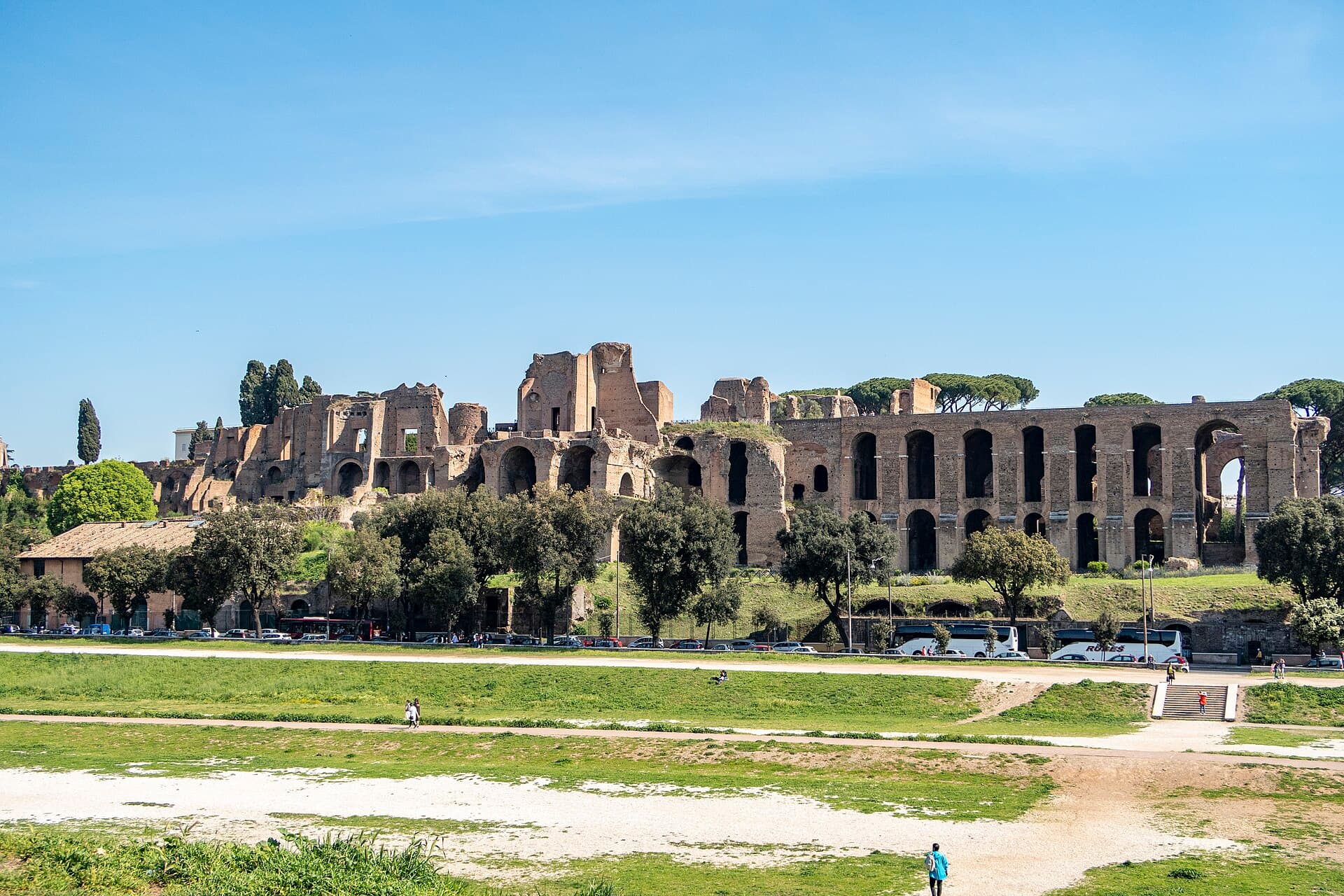 Lil Herodotus / CC BY-SA 4.0, via Wikimedia Commons
Self-guided audio walking tour of Palatine Hill — GPS route, offline playback, story-driven narration in 32 languages.
“Where emperors built their dreams and Rome began.”
Not the postcards. The stories even locals don't know — whispered in your ear, right where they happened.
Beneath the surface of Palatine Hill lies a grotto tied to Rome's mythical origins.
Amidst ancient ruins, a Renaissance cardinal created a 'secret garden' that was a world first.
There's a dimly lit, underground passage that connects imperial residences, rumored to be the scene of a notorious assassination.
Discover every secret of Palatine Hill
Every address, every reveal in full — in your ear, right where it happened.
You pick your stops. You walk. The voice reveals what the others miss.


Your self-guided audio tour of Palatine Hill is ready — pick your landmarks, choose your language, and start the moment you arrive.
BuyLume has a built-in augmented-reality guide. Hold your phone up and its camera shows the street ahead of you, with a glowing arrow laid over the real view that always points to your next stop — no map to puzzle over, no wrong turns. Like everything in Lume, it works fully offline.
Palatine Hill, the most central of Rome's seven hills, is a sprawling open-air museum that offers a profound journey into the city's foundational myths and imperial grandeur. Rising above the Roman Forum and the Circus Maximus, it provides expansive views that sweep across centuries of history. This archaeological complex is where legend and history intertwine, from the mythical founding of Rome by Romulus to the opulent residences of its most powerful emperors.
Visitors to Palatine Hill can explore the remnants of lavish palaces, ancient temples, and serene gardens that once defined the elite Roman lifestyle. It's a place where every stone has a story, inviting you to imagine the lives of emperors, aristocrats, and the very first Romans who walked these grounds. Often visited as part of a combined ticket with the Colosseum and Roman Forum, Palatine Hill is an essential stop for anyone seeking to understand the origins and evolution of the Eternal City.
The history of Palatine Hill is deeply rooted in Roman mythology, believed to be the site where Romulus founded Rome in 753 BCE after a dispute that led to the death of his brother, Remus. Archaeological evidence supports early human settlement on the hill as far back as the 10th century BCE, with discoveries of Iron Age huts and fortifications. This strategic location, offering control over the Tiber River, made it a desirable place for early communities.
During the Republican period (circa 509 BCE – 44 BCE), Palatine Hill became a coveted residential area for Rome's aristocracy and wealthy citizens, including notable figures like the orator Cicero. The clear air and elevated position were thought to offer a healthier environment away from the lower-lying areas. With the transition to an Empire, the hill transformed into the exclusive domain of emperors. Augustus, Rome's first emperor, established his residence here, setting a precedent for his successors. Emperors like Tiberius, Nero, and Domitian further expanded the imperial complex, constructing sprawling palaces, temples, and intricate passageways. The Flavian Palace, built by Emperor Domitian in 92 AD, was for over 300 years the largest palace in the city.
After the fall of the Roman Empire, the Palatine Hill saw various transformations. In the Middle Ages, churches and convents were built among the ruins. Later, during the Renaissance, Cardinal Alessandro Farnese acquired a portion of the hill and established the Farnese Gardens, one of Europe's first private botanical gardens, integrating lush greenery with the ancient structures. Today, ongoing archaeological work continues to uncover new layers of its past, making Palatine Hill a dynamic site of discovery.
Begin your exploration with the far-reaching views from the Palatine, offering sweeping vistas of the Roman Forum, the Colosseum, and the Circus Maximus. Wander through the remains of the Flavian Palace, a vast imperial residence built by Emperor Domitian. Adjacent to it, discover the Stadium of Domitian, an elongated structure whose exact purpose, whether for races or as an ornamental garden, remains debated.
Visit the House of Augustus and the House of Livia, the well-preserved homes of Rome's first emperor and his wife, notable for their intricate frescoes. Access to these specific sites may require separate tickets or advance reservations due to preservation efforts. Explore the Farnese Gardens (Orti Farnesiani), a 16th-century Renaissance garden with terraces, stairs, and a nymphaeum, offering a serene contrast to the ancient structures. Finally, the Palatine Museum houses a collection of artifacts unearthed from the hill, including pottery, statues, and decorative paintings, providing deeper context to the site's history.
The best times to visit Palatine Hill are during the shoulder seasons of April to May and September to October, when the weather is milder and crowds are more manageable. To avoid the busiest periods, aim for early mornings right after opening or the last two hours before closing, especially on weekdays. Weekdays, particularly Tuesday to Thursday, are generally quieter than weekends. Be aware that free entry days (the first Sunday of every month, April 25th, June 2nd, and November 4th) can be exceptionally crowded.
Palatine Hill is part of the Colosseum Archaeological Park, and a single ticket grants access to the Colosseum, Roman Forum, and Palatine Hill. Tickets often include timed entry for the Colosseum, with access to the Roman Forum and Palatine Hill valid for 24 hours before or after your Colosseum visit. It is highly recommended to purchase tickets online in advance. Allow at least 1.5 to 2 hours to explore Palatine Hill thoroughly; if combined with the Roman Forum and Colosseum, plan for half a day or 3-4 hours.
The site involves walking on uneven paths, so wear comfortable shoes. There is limited shade, so bring water and a hat, especially during warmer months. Small pets (5-10kg) are allowed in the Roman Forum and Palatine Hill if kept in a carrier. The Palatine Hill is easily accessible on foot from the Colosseum or Roman Forum, and public transport options include the Colosseo Metro station (Line B) and various bus routes.
Palatine Hill in Korean, in Chinese or in Hebrew — and 29 more languages, every stop narrated by a native voice. The widest language range of any self-guided audio tour.
Available in: