Lapis Niger
Beneath a black marble slab, something ancient and forbidden was discovered.
Full story unlocks in the tour
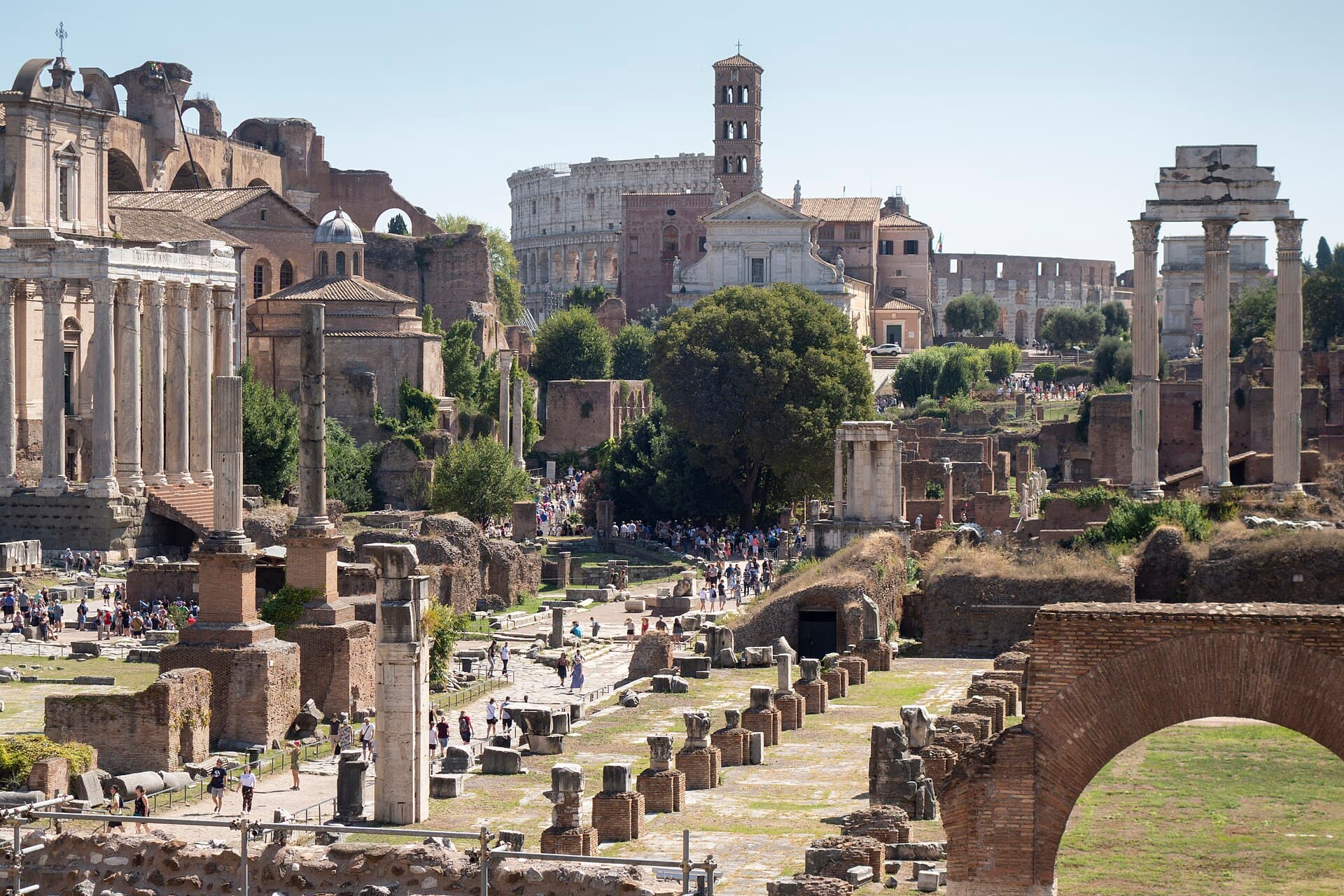 Nicholas Hartmann / cc by-sa 4.0, via Wikimedia Commons
Self-guided audio walking tour of Roman Forum — GPS route, offline playback, story-driven narration in 32 languages.
“Walk through the echoes of empire.”
Not the postcards. The stories even locals don't know — whispered in your ear, right where they happened.
Beneath a black marble slab, something ancient and forbidden was discovered.
Imagine a Roman bank, not with vaults, but with a surprising location.
This speaking platform saw some of Rome's most dramatic orations, and some gruesome displays.
Discover every secret of Roman Forum
Every address, every reveal in full — in your ear, right where it happened.
You pick your stops. You walk. The voice reveals what the others miss.


Your self-guided audio tour of Roman Forum is ready — pick your landmarks, choose your language, and start the moment you arrive.
BuyLume has a built-in augmented-reality guide. Hold your phone up and its camera shows the street ahead of you, with a glowing arrow laid over the real view that always points to your next stop — no map to puzzle over, no wrong turns. Like everything in Lume, it works fully offline.
The Roman Forum, or Forum Romanum, was the beating heart of ancient Rome, a sprawling valley situated between the Capitoline and Palatine Hills. For centuries, this was the epicenter of daily life, where citizens gathered for political debates, legal proceedings, religious ceremonies, and commerce. Today, its evocative ruins – a collection of temples, basilicas, and triumphal arches – offer a profound glimpse into an empire that shaped Western civilization.
While the Colosseum often captures immediate attention, the Roman Forum provides a more intimate and expansive journey through time. It's a place where you can quite literally walk in the footsteps of figures like Julius Caesar and Augustus, imagining the bustling activity that once filled these now-silent spaces. Though it may appear as a disorderly collection of ruins to the uninitiated, with a little imagination, the Forum reveals its layered past, inviting visitors to reconstruct the grandeur of ancient Rome.
The area that became the Roman Forum was initially a marshy burial ground. Around 600 BC, the construction of the Cloaca Maxima, one of the world's earliest sewage systems, drained the land, making it suitable for development. By approximately 500 BC, with the founding of the Roman Republic, the open-air Forum began to serve as a public meeting place. Over centuries, it evolved organically, rather than being a planned space, which contributes to its somewhat chaotic yet fascinating layout.
During the Roman Republic and Empire, the Forum flourished as the central hub for civic, religious, commercial, and political activities. It hosted triumphal processions celebrating military victories, served as a venue for public speeches and criminal trials, and was a bustling marketplace. Key structures like the Temple of Saturn, the Curia (Senate House), and the Arch of Titus were erected, each playing a vital role in Roman society. Many of the structures visible today were built during the reigns of Julius Caesar and his successor, Augustus.
As the Roman Empire began its decline, particularly after 410 AD, the Roman Forum fell into disrepair. By the Middle Ages, the once-grand center had degraded into pasture land, earning the name 'Campo Vaccino,' or 'Cow Field,' and its stone and marble were extensively plundered. The Forum remained largely neglected and overgrown until its rediscovery by archaeologist Carlo Fea in 1803. Systematic excavations began in the 18th and 19th centuries and continued for over a hundred years, gradually reintroducing this remarkable window into the past to the modern world. Ongoing archaeological discoveries continue to reveal new insights into the site.
The Roman Forum offers a captivating array of ruins, each with its own story. The Arch of Titus, standing at the highest point of the Via Sacra, commemorates Emperor Titus's victory in Jerusalem, with detailed carvings depicting Roman legions carrying spoils. Nearby, the Temple of Saturn, one of the Forum's oldest structures, famously served as the state treasury.
Walk along the Via Sacra, the Forum's main thoroughfare, to encounter the remains of significant temples and basilicas. Look for the Curia Julia, the ancient Senate House, and the Arch of Septimius Severus, which celebrates Roman conquests. The Temple of Vesta and the House of the Vestal Virgins offer a glimpse into the lives of the priestesses who tended Rome's sacred fire. Do not overlook the Temple of Julius Caesar, built on the spot where Caesar was cremated after his assassination. The sheer density of historical remnants here means that every turn reveals another layer of ancient Roman life.
The best times to visit the Roman Forum are during the shoulder seasons of spring (April to early June) and autumn (September to October). During these periods, the weather is pleasant, and the crowds are generally smaller than in peak summer. Arriving early in the morning, right at opening, or in the late afternoon (after 3:30 PM) will help you avoid the largest crowds and the midday heat, especially in summer. Weekdays, particularly Tuesday through Thursday, are typically calmer than weekends. Allow one to two hours to explore the Forum thoroughly.
The Roman Forum is centrally located in Rome, adjacent to the Colosseum and Palatine Hill. Entry is typically included in a combined ticket that covers all three sites, which is the most economical option. Tickets are strongly recommended to be booked in advance online, as they often sell out, especially during summer. Booking online also allows you to select a specific entry time.
The site is large, with uneven and cobbled ground, so comfortable walking shoes are essential. While much of the site has uneven terrain, there is a paved, mobility-friendly route with ramps that connect different levels, making some areas accessible for wheelchairs. Informational signs are limited, so a guide or audio guide is highly recommended to fully appreciate the historical significance of the ruins.
Roman Forum in Korean, in Chinese or in Hebrew — and 29 more languages, every stop narrated by a native voice. The widest language range of any self-guided audio tour.
Available in: