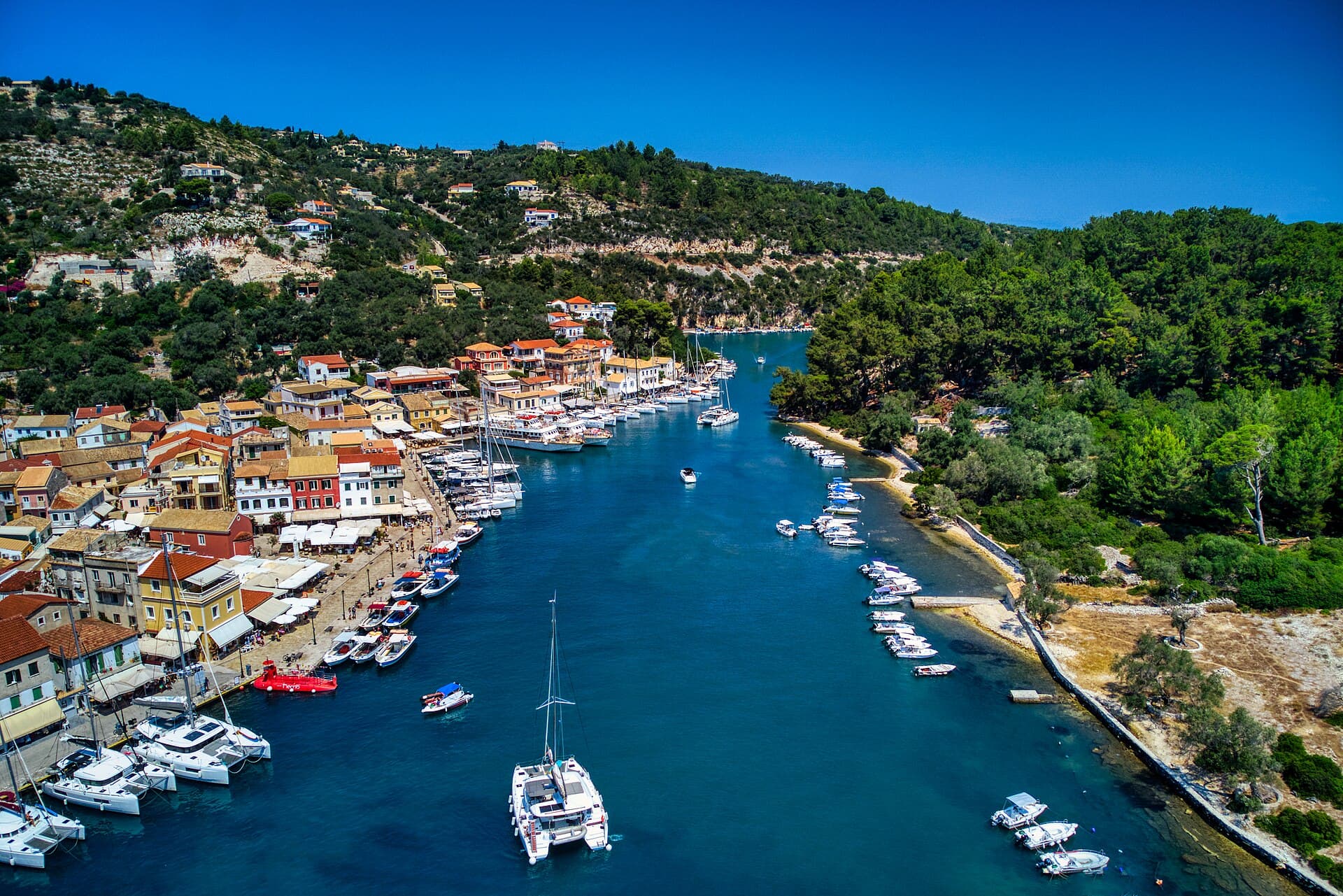
Paxos, GreeceHagai Agmon-Snir حچاي اچمون-سنير חגי אגמון-שניר / CC BY-SA 4.0, via Wikimedia Commons
GR

Paxos

Self-guided audio walking tour of Paxos — GPS route, offline playback, story-driven narration in 32 languages.

Where emerald groves meet turquoise depths, a tranquil Ionian escape.

The secrets of Paxos

Paxos, as no one tells it.

Not the postcards. The stories even locals don't know — whispered in your ear, right where they happened.

3 secrets below. Many more wait inside the tour.
Gaios

Gaios, the primary port of Paxos, presents itself as a charming Greek harbor town. However, a local hero's monument hints at a surprising act of defiance during a pivotal historical period.

Full story unlocks in the tour
Paxos' olive groves

Ancient olive trees blanket the island, speaking to centuries of cultivation. The sheer density and age of these trees, however, reveal a deliberate, long-term agricultural strategy introduced by a foreign power.

Full story unlocks in the tour
The Ionian Sea surrounding Paxos

The clear waters around Paxos are celebrated for their beauty. Yet, this seemingly peaceful marine environment once hosted a significant naval battle that shaped the region's ancient history.

Full story unlocks in the tour
The full tour

Discover every secret of Paxos

Every address, every reveal in full — in your ear, right where it happened.

Get the key to Paxos

You pick your stops. You walk. The voice reveals what the others miss.

Choose your time

How long do you have in Paxos?

Your self-guided audio tour of Paxos is ready — pick your landmarks, choose your language, and start the moment you arrive.

Buy
About Paxos

The story of Paxos

Paxos, often referred to as Paxi alongside its smaller sister island Antipaxos, is a small Greek island in the Ionian Sea, just south of Corfu. It is celebrated for its natural beauty, characterized by ancient olive groves, dramatic limestone cliffs, and exceptionally clear turquoise waters. Unlike some of its larger Ionian counterparts, Paxos has largely avoided mass tourism due to the absence of an airport, preserving its authentic character and serene atmosphere. This low-built island, with a population of around 2,500, offers a tranquil escape for those seeking harmony, relaxation, and picturesque seaside scenery.

History

Ancient Roots and Mythological Origins

The history of Paxos stretches back thousands of years, with evidence of human habitation dating to the Neolithic period. According to Greek mythology, Paxos was created when Poseidon, the god of the sea, struck Corfu with his trident to break off a piece of land, forming a secluded retreat for himself and his lover, Amphitrite. The island's name is thought to derive from the Phoenician word 'Pax,' meaning 'trapezoidal,' or from an ancient Greek word for 'peace,' reflecting its tranquil nature. In antiquity, Paxos was strategically important as a maritime outpost and was inhabited by the ancient Greeks. It played a role in the First Illyrian War in 229 BC, when a significant naval battle occurred off its coast, leading to Roman intervention in the region.

Roman, Byzantine, and Venetian Influence

Paxos came under Roman rule in 229 BC, experiencing a period of relative peace and serving as a naval base. Following the fall of the Roman Empire, the island was governed by the Goths for nearly 600 years, a time marked by frequent pirate attacks. During the Byzantine era, Paxos was part of the Byzantine Despotate of Epirus and its strategic location made it a target for various invaders. By the end of the 14th century, the Venetians gained control of Paxos, ushering in a period of profound influence that lasted over four centuries. They encouraged extensive olive cultivation, built fortifications against Ottoman and pirate attacks, and left a lasting legacy on the island's architecture and culture.

French, British, and Greek Unification

After the fall of Venice in 1797, Paxos briefly fell under French control, followed by a Russo-Turkish alliance in 1799, which established the Septinsular Republic. The French regained control in 1807 under Napoleon, but their rule was short-lived. In 1814, Paxos surrendered to the British fleet, and in 1815, it became part of the United States of the Ionian Islands, a British protectorate. The British improved infrastructure, including roads and schools. Despite the ruling power's objections, Paxos participated in the Greek War of Independence in 1821. Finally, in 1864, Paxos and the rest of the Ionian Islands were officially united with the new Kingdom of Greece. The island was occupied by Italian and German forces during World War II, before being liberated by the Allied Forces in 1944.

What to see

Paxos offers a blend of natural beauty and charming villages. Gaios, the island's capital and primary port, is a lively waterside town with Venetian architecture, narrow streets, and a pedestrianized square. Here, visitors discover a range of restaurants, cafes, and shops. Loggos, another picturesque village, features a crescent-shaped waterfront lined with tavernas. Lakka, the northern port, is defined by its sheltered horseshoe-shaped bay, surrounded by olive and cypress trees.

The island's coastline is dotted with secluded pebble bays and coves, ideal for swimming and snorkeling in the clear waters. A boat trip around the west coast of Paxos allows exploration of dramatic limestone cliffs, sea caves, and unspoiled beaches like Erimitis Bay. Day trips to the nearby islet of Antipaxos are popular, offering even more pristine beaches, such as Voutoumi and Vrika, known for their vivid blue waters. Beyond the coast, the interior of Paxos is covered with ancient olive groves, perfect for leisurely walks.

When to visit

The optimal time to visit Paxos is between May and October. Late spring (May-June) offers pleasant temperatures (20-25°C), fewer crowds, and blooming wildflowers, with all facilities open. Summer (July-August) is peak season, with temperatures reaching 30-31°C and the warmest sea for swimming, though it is also the busiest and most expensive period. Early autumn (September-October) is considered by many to be the best time, with warm seas, comfortable temperatures (22-26°C), and significantly fewer tourists. The olive harvest also runs from October through December.

Practical

To reach Paxos, most travelers fly into Corfu International Airport (CFU) and then take a ferry or hydrofoil to Gaios, the primary harbor on Paxos. The ferry journey from Corfu can take between 45 minutes to 2.5 hours, depending on the vessel. Alternatively, regular car ferries connect Igoumenitsa on the Greek mainland to Paxos in about 90 minutes.

Once on the island, you can get around by local buses, taxis, or rental vehicles. A local bus connects the three main villages of Gaios, Loggos, and Lakka, with increased services in summer. Taxis are available but limited, so booking ahead is advisable during busy periods. Renting a car or scooter offers more freedom to explore the island's narrow, winding roads and secluded spots. Sea taxis are a convenient way to travel between coastal villages and to Antipaxos.

Good to know
How big is Paxos Island?
Paxos is the smallest of the seven main Ionian Islands, with an area of 25.3 square kilometers (9.8 sq mi).
Is Paxos a good island for families?
Paxos is often described as a haven for relaxing holidays and is suitable for families seeking tranquility and marine activities.
Are there good hiking opportunities on Paxos?
Yes, Paxos offers opportunities for hiking, especially through its ancient olive groves and along its craggy, rocky terrain. It's advisable to carry water and sunscreen, particularly in summer.
Can you visit Antipaxos from Paxos?
Yes, numerous tourist boats and sea taxis operate daily from the villages of Gaios, Lakka, and Loggos in Paxos to Antipaxos, with the trip typically taking 15-20 minutes.
What kind of food is Paxos known for?
Paxos, influenced by its Venetian past, offers traditional Greek cuisine, with fresh seafood being a highlight.
Is there an airport on Paxos?
No, Paxos does not have its own airport, which has contributed to its preservation from mass tourism. Visitors typically fly to Corfu and then take a ferry.
On the map
Paxos
€9.90
No booking · activate anytime · 12h to walk it
Load on Wi-Fi, then walk offline — no roaming abroad
Get the key to Paxos