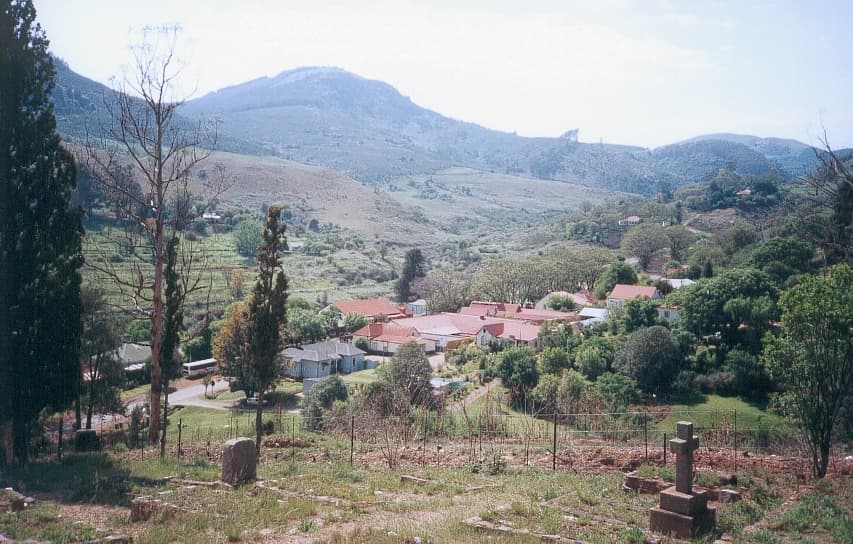
In a cemetery where every grave faces the same direction, one stands defiantly perpendicular. Why was this person buried differently?
Original uploader was Georgio at fr.wikipedia / CC BY 1.0, via Wikimedia CommonsPilgrim's Rest
Self-guided audio walking tour of Pilgrim's Rest — GPS route, offline playback, story-driven narration in 32 languages.
“Where the echoes of a golden past still shimmer in the air.”
Pilgrim's Rest, as no one tells it.
Not the postcards. The stories even locals don't know — whispered in your ear, right where they happened.
This historic bar holds a surprising past, quite removed from the boisterous gold rush it witnessed.
The grand former mine manager's residence is said to host a permanent, ethereal resident.
Discover every secret of Pilgrim's Rest
Every address, every reveal in full — in your ear, right where it happened.
You pick your stops. You walk. The voice reveals what the others miss.


How long do you have in Pilgrim's Rest?
Your self-guided audio tour of Pilgrim's Rest is ready — pick your landmarks, choose your language, and start the moment you arrive.
BuyThe story of Pilgrim's Rest
Step into a living monument to South Africa's feverish gold rush days in Pilgrim's Rest, a small museum town in the Mpumalanga province. Declared a National Monument in 1986, the entire village is a destination, preserving the architectural style and atmosphere of the late 1800s and early 1900s. Here, you can walk down a single, main street, where original shopfronts and facades offer a tangible sense of the past, largely untouched by modern alterations.
Pilgrim's Rest is more than just a collection of old buildings; it's a time capsule that immerses visitors in the compelling history of South Africa's gold rush. The town is divided into an Upper and Lower Camp, reflecting its evolution from a digger's camp to a more established settlement. Surrounded by green hills, the town offers a quiet, sometimes eerily so, experience, inviting you to slow down and let the past seep in.
The Allure of Gold and the Rush of Prospectors
The history of Pilgrim's Rest is inextricably linked to the discovery of gold in 1873. While earlier, less significant gold deposits had been found in the region, the true rush began when Alec 'Wheelbarrow' Patterson uncovered abundant alluvial gold in a small stream, which became known as Pilgrim's Creek. He attempted to keep his find private, but it wasn't long before another prospector, William Trafford, also struck gold in the same creek. News of this abundant strike spread quickly, triggering South Africa's first major gold rush.
By September 1873, Pilgrim's Rest was officially declared a gold field, and within a year, approximately 1,500 diggers were working around 4,000 claims in and around Pilgrim's Creek. The valley proved to be exceptionally productive, with significant finds also made at locations like Starvation Gully, Peach Tree Creek, and Golden Point. During the initial decade, mining activities focused on recovering alluvial gold from streams and riverbanks using methods like sluice-boxes and cradles. It's estimated that R2 million worth of gold was retrieved during the first seven years of alluvial mining in the Pilgrim's Rest valley.
From Tents to Town: Evolution of a Goldfield
Pilgrim's Rest quickly transformed from a collection of tents and shacks into a more permanent settlement. By 1876, many temporary structures were replaced with buildings, often constructed with timber frames and corrugated iron, an easily transported material. The town became the social and commercial heart of the diggings, comprising Upper, Middle, and Lower Camps, which eventually evolved into the Uptown and Downtown areas seen today. Businesses flourished, supplying diggers with essential equipment and provisions.
As alluvial gold deposits began to diminish by the 1880s, many individual diggers moved on to new goldfields. This shift paved the way for better-funded mining companies that employed machinery to explore deeper for gold-bearing ore. By 1895, several smaller companies amalgamated to form the Transvaal Gold Mining Estates (T.G.M.E.), which became the first listed gold mining company in South Africa. The company played a significant role in the town's development, including the construction of the Alanglade House for its mine managers in 1915. The last gold mine in Pilgrim's Rest closed in 1972, and the entire village was subsequently sold to the government to be preserved as a national museum.
Pilgrim's Rest is essentially a living museum, with its main street offering a direct portal to the past. Start your exploration at the Pilgrim's Rest Museum / Living Town, where restored interiors and artifacts illustrate the lives of miners and shopkeepers from the 1870s to the early 1900s. The Information Centre in Uptown is a good first stop for maps, brochures, and tickets to the various museums. Here, you'll also find displays on the town's geology and gold-mining history.
Key historical buildings to visit include the Alanglade House Museum, the elegant Edwardian former residence of the mine manager, furnished with period pieces from 1915. The House Museum offers a glimpse into a well-preserved Victorian-era home, complete with period furniture. Do not miss the Diggings Site Museum just outside town, where you can watch gold-panning demonstrations and see early mining machinery. The Central Garage Transport Museum showcases antique cars, trucks, and horse-drawn wagons. The Printing Museum and the General Dealer Museum also offer unique insights into the town's past.
Take a walk between Uptown and Downtown to appreciate the various historic buildings and sites. The Old Cemetery is a poignant stop, particularly to seek out the famous Robber's Grave, which lies perpendicular to all the other headstones. For a different perspective, consider a ghost tour through the village, offered by the Friends of the Pilgrim's Rest Museum. You can also try your hand at gold panning with local guides.
Beyond the town itself, Pilgrim's Rest is ideally situated on the magnificent Panorama Route. Easily accessible day trips include attractions like God's Window, Bourke's Luck Potholes, and the spectacular Blyde River Canyon.
Pilgrim's Rest enjoys a mild climate year-round. The dry winter months, from May to September, offer crisp, clear skies, making it ideal for walking and exploring without the intense heat or sudden downpours common in summer. Mornings during this period often bring a soft mountain mist, adding to the town's nostalgic charm. Summer, from November to March, brings warmer days and lush green hills following afternoon rains. While it can be uncomfortably hot at times, the town can still be enjoyed. The annual gold panning championships are held each year in September.
Pilgrim's Rest is located on the R533, approximately 15km northwest of Graskop in the Mpumalanga province. The town is compact and highly walkable, with most attractions just a few minutes on foot. The Information Centre in Uptown is your first port of call for maps, brochures, and museum tickets. Guided tours, including ghost tours, can be booked through the tourism office or local operators.
Accommodation options in and around Pilgrim's Rest cater to various budgets, from backpackers to luxury guesthouses and lodges, including the famous Royal Hotel. Good walking shoes or hiking boots are essential for those planning to explore on foot. Always remember to bring plenty of sunblock and a hat, regardless of the season. While the town offers shops for antiques, arts, crafts, and curios, it's generally quieter than nearby Graskop or Sabie, especially after sunset.
- What is Pilgrim's Rest known for?
- Pilgrim's Rest is best known as a living museum and a provincial heritage site that preserves the history and architecture of the South African gold rush era of the late 1800s.
- Can you still pan for gold in Pilgrim's Rest?
- Yes, visitors can still try their hand at panning for gold in Pilgrim's Rest with local guides, offering a hands-on experience of the town's golden past.
- Is Pilgrim's Rest part of the Panorama Route?
- Yes, Pilgrim's Rest is a key stop on the magnificent Panorama Route in Mpumalanga, making it an easy drive to other major attractions like God's Window and the Blyde River Canyon.
- What is the significance of the Robber's Grave?
- The Robber's Grave is a unique burial site in the Pilgrim's Rest cemetery, notable because it lies perpendicular to all other graves. It marks the resting place of an unnamed individual who was buried facing north as a sign of disgrace for stealing a tent during the gold rush.
- Are there ghost stories associated with Pilgrim's Rest?
- Yes, Pilgrim's Rest is known for its ghost stories and offers ghost tours. Reports of paranormal activity include sightings at the Alanglade House Museum and the cemetery, which is said to be home to the spirits of tragic diggers.
- What kind of accommodation is available in Pilgrim's Rest?
- Pilgrim's Rest offers a range of accommodation, from budget-friendly backpackers to luxury guesthouses and lodges. The historic Royal Hotel is a popular choice for visitors.