The Rhine Gate (Rheintor)
Look closely at the Rhine Gate, and you'll spot two figures. They're not just decorative; they commemorate a rather sticky situation.
Full story unlocks in the tour
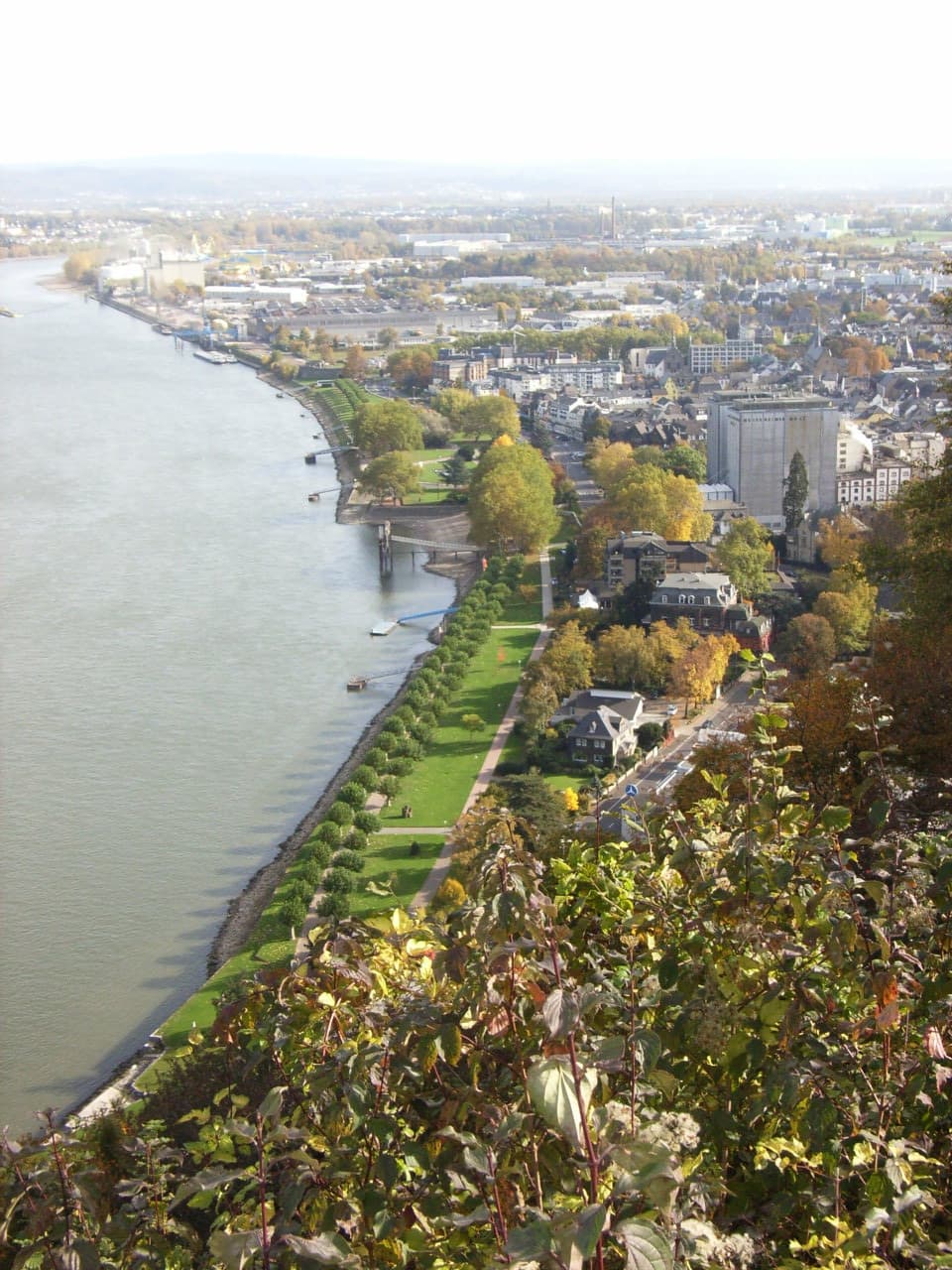 Maus-Trauden at German Wikipedia / CC BY-SA 3.0, via Wikimedia Commons
Self-guided audio walking tour of Andernach — GPS route, offline playback, story-driven narration in 32 languages.
“Where ancient walls meet a modern green revolution, and water dances to a volcanic rhythm.”
Not the postcards. The stories even locals don't know — whispered in your ear, right where they happened.
Look closely at the Rhine Gate, and you'll spot two figures. They're not just decorative; they commemorate a rather sticky situation.
Andernach's formidable Round Tower has a secret scar that tells a tale of resilience against a powerful king.
Wander through Andernach, and you might notice something unusual growing in public spaces. It's not just for show.
Discover every secret of Andernach
Every address, every reveal in full — in your ear, right where it happened.
You pick your stops. You walk. The voice reveals what the others miss.


Your self-guided audio tour of Andernach is ready — pick your landmarks, choose your language, and start the moment you arrive.
BuyLume has a built-in augmented-reality guide. Hold your phone up and its camera shows the street ahead of you, with a glowing arrow laid over the real view that always points to your next stop — no map to puzzle over, no wrong turns. Like everything in Lume, it works fully offline.
Andernach, a town of approximately 30,000 inhabitants in Rhineland-Palatinate, Germany, offers a compelling blend of ancient history and innovative modernity. Situated on the left bank of the Rhine, it is one of Germany's oldest towns, with roots tracing back to a Celtic settlement and a Roman foundation as Antunnacum in 12 BC. The town's strategic location on the Rhine has shaped its identity through millennia, from a Roman trading port to a medieval market town and a significant outpost of the Electorate of Cologne.
Beyond its well-preserved medieval fortifications, including a towering watchtower and ancient gates, Andernach is known for a unique natural phenomenon: the world's highest cold-water geyser. This geological marvel, coupled with the town's pioneering "Edible City" project, where public spaces yield communal harvests, showcases a community that respects its past while embracing a sustainable future. A visit to Andernach promises a journey through layers of history, punctuated by surprising natural wonders and forward-thinking urban initiatives.
## From Roman Outpost to Medieval Stronghold Andernach's story begins over two millennia ago, established by the Romans as Antunnacum in 12 BC upon an older Celtic settlement. The name itself, both Roman and Celtic, points to a "village or farm of Antunnos/us." Its strategic position on the Rhine River made it a vital Roman port for trade. The town's early importance is still visible today in remnants of Roman excavations found in the Historical Garden, providing a glimpse into daily life during that era.
Throughout the Middle Ages, Andernach flourished as a bustling market town and served as the southernmost outpost of the Electorate of Cologne from the 12th to the 19th century. This period saw the construction of its formidable defensive structures, many of which remain remarkably intact. The town's medieval walls, with their towers and gates, stand as a testament to its historical significance. The 12th-century archiepiscopal castle, though largely in ruins today, was a key fortification, later expanded with a powder tower and a keep. This castle, known as Stadtburg Andernach, was built by the Archbishopric of Cologne to secure the city's position and assert its sovereignty against local citizens.
One of the most iconic structures from this era is the Round Tower (Runder Turm), completed in 1453. Standing 56 meters high with walls up to 5 meters thick, it was the northwestern corner of the medieval city wall and one of the highest defense towers on the Rhine. Its height offered a commanding view of the Rhine Valley, allowing for early detection of approaching ships. The Rhine Gate (Rheintor), built around 1200, served as the main entrance from the river, facilitating the transport of goods. These structures, along with the Old Crane (Alte Krahnen), a 16th-century treadwheel crane that operated for 350 years, highlight Andernach's enduring legacy as a center of trade and defense on the Rhine.
Andernach's history also includes a significant Jewish community dating back to the late 12th century, with a 13th-century mikveh (ritual bath) still existing under the old town house. The town has faced periods of persecution, particularly during the 14th century and the Black Death, and tragically, no Jews lived in Andernach after 1945 due to the Holocaust. A memorial in the city center commemorates the victims of the Nazi regime's Action T4, where mentally ill patients and disabled people were sent to Hadamar Euthanasia Centre.
## The "Edible City" and the Geyser's Revival In more recent times, Andernach has gained international recognition for its "Edible City" project, launched almost 15 years ago. This innovative initiative transforms public green spaces into fruit and vegetable beds and wildflower meadows, making them accessible for all to harvest. This project not only promotes sustainability and biodiversity but also encourages community engagement and urban agriculture.
Another defining feature of modern Andernach is the world's highest cold-water geyser. First activated in 1903, it was shut down in 1957 but reactivated in the early 21st century as a major tourist attraction. The geyser, driven by carbon dioxide released from magma deep beneath the Eifel region, erupts to heights of up to 60 meters, discharging up to 8 cubic meters of water. This unique natural spectacle, combined with the town's historical tapestry and its forward-thinking environmental projects, makes Andernach a captivating destination.
Begin your exploration at the Andernach Geyser Adventure Centre (Erlebniszentrum Geysir Andernach), where interactive exhibits explain the science behind the world's highest cold-water geyser. A boat trip from the center takes you to the Namedyer Werth peninsula, where you can witness the geyser's impressive eruption, shooting water up to 60 meters into the air.
Back in the town center, walk along the well-preserved medieval city wall, one of the most complete in Germany. Discover the imposing Round Tower (Runder Turm), a 15th-century defensive structure offering panoramic views after climbing its 136 steps. Pass through the Rhine Gate (Rheintor), an ancient double gate that once served as the main entrance from the river, and look for the statues of the legendary Baker Boys.
Visit the ruins of the Archiepiscopal Castle (Stadtburg Andernach), a 12th-century fortification that once protected the town. Explore the Historical Garden, where Roman excavations are integrated into a modern green space, showcasing columns, latrines, and fountains from Andernach's Roman past. Do not miss the Old Crane (Alte Krahnen) on the Rhine riverbank, a 16th-century treadwheel crane that was operational for 350 years, a fascinating industrial monument. The St. Mary Assumption Parish Church (Mariendom), with parts dating back to the 11th century, is also a significant historical attraction.
As you wander, keep an eye out for the various public plantings that are part of Andernach's "Edible City" project, offering free-to-harvest fruits, vegetables, and herbs. Finally, delve into the town's Jewish history by visiting the ancient Mikveh, a 13th-century ritual bath located beneath the old town house.
The most pleasant time to visit Andernach for outdoor activities is from mid-June to early September. During these months, temperatures are comfortable, typically ranging from 19°C to 24°C (66°F to 75°F), with July being the warmest month. Spring (April to June) and fall (September to October) also offer agreeable weather, fewer crowds, and a chance to experience local festivals. While winters are cold and often cloudy, with temperatures around 0-4°C (31-40°F) in December, the town can still be explored, and Christmas markets in the region offer a festive charm.
Andernach is easily accessible, situated just 21 kilometers north of Koblenz on the left bank of the Rhine. The town has good rail and road connections. For exploring the town's attractions, many sites are within walking distance of each other in the historic center. Guided city tours are available to provide deeper insights into Andernach's 2000-year history. To visit the Andernach Geyser, plan for a 3-4 hour experience, which typically includes a visit to the Geyser Adventure Centre and a boat trip to the eruption site. Public parking is available, though it can be scarce in some areas. The town offers a range of dining options, from traditional German fare to Italian and Balkan cuisine.
Andernach in Korean, in Chinese or in Hebrew — and 29 more languages, every stop narrated by a native voice. The widest language range of any self-guided audio tour.
Available in: