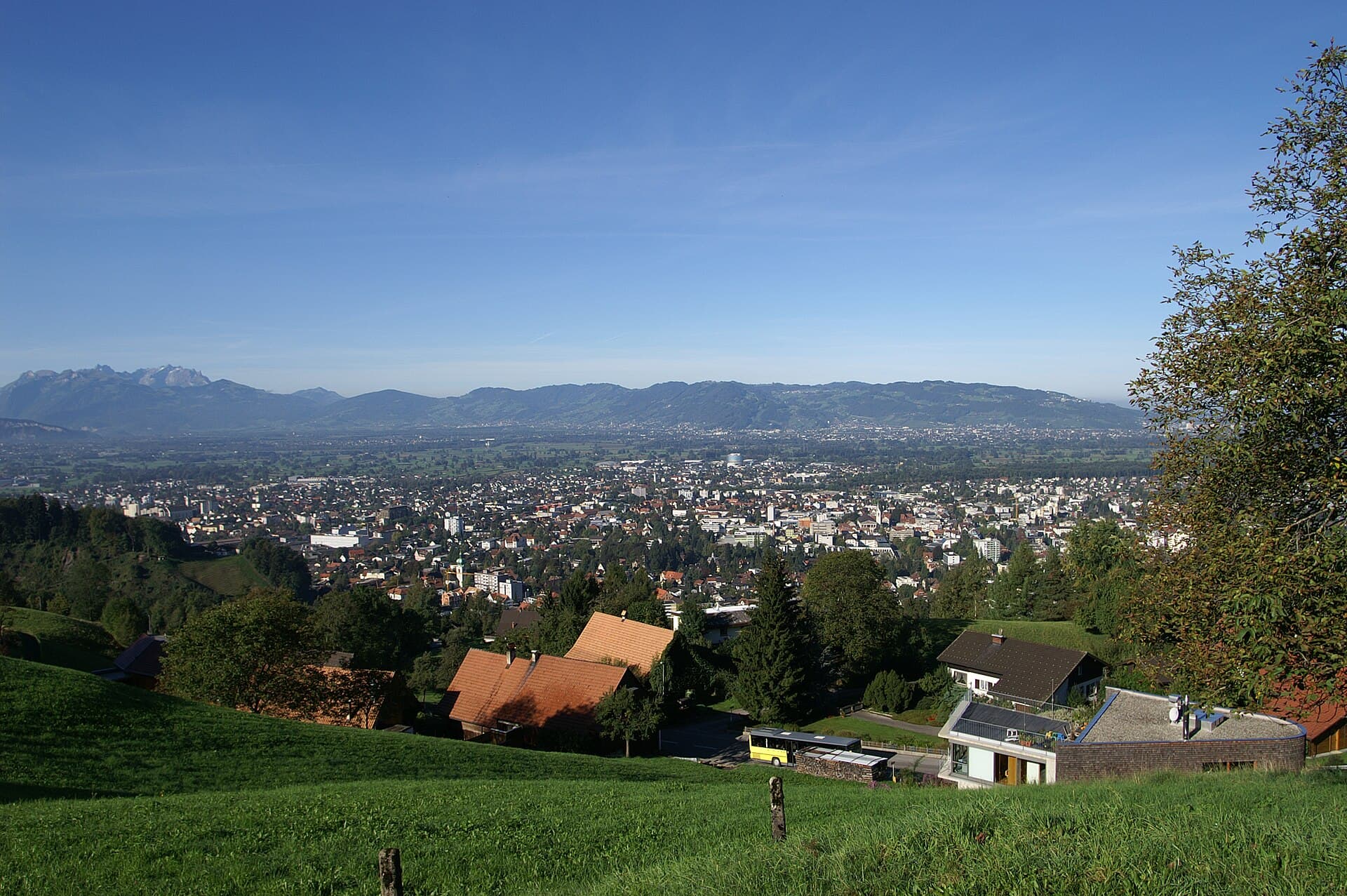
Dornbirn, AustriaFeel free to use my photos, but please mention me as the author and if you want send me a message. or (rufre@lenz-nenning.at) / CC BY-SA 2.5, via Wikimedia Commons
AT

Dornbirn

Self-guided audio walking tour of Dornbirn — GPS route, offline playback, story-driven narration in 32 languages.

Where Alpine grace meets the hum of industry.

The secrets of Dornbirn

Dornbirn, as no one tells it.

Not the postcards. The stories even locals don't know — whispered in your ear, right where they happened.

3 secrets below. Many more wait inside the tour.
Rotes Haus (Red House)

The striking red building in Dornbirn's market square is more than a pleasing facade; its unique color tells a story of enduring preservation and an unexpected historical ingredient.

Full story unlocks in the tour
Mohrenbräu Brewery

Dornbirn is home to Vorarlberg's oldest brewery, a family enterprise since 1763. Its name and emblem, however, have sparked a contemporary conversation.

Full story unlocks in the tour
Rolls-Royce Museum

One might not anticipate finding the world's most extensive collection of a certain luxury automobile brand in a modest Austrian city, yet Dornbirn holds this remarkable assembly.

Full story unlocks in the tour
The full tour

Discover every secret of Dornbirn

Every address, every reveal in full — in your ear, right where it happened.

Get the key to Dornbirn

You pick your stops. You walk. The voice reveals what the others miss.

Dornbirn — green grass field near body of water during daytime
Photo: Leonhard Niederwimmer / Unsplash
Dornbirn — aerial view of city during daytime
Photo: Shidza D. / Unsplash
Dornbirn — a person holding a light saber
Photo: David Küng / Unsplash
Choose your time

How long do you have in Dornbirn?

Your self-guided audio tour of Dornbirn is ready — pick your landmarks, choose your language, and start the moment you arrive.

Buy
About Dornbirn

The story of Dornbirn

Dornbirn, the largest city in Vorarlberg, Austria, offers a thoughtful blend of urban activity and the tranquility of nature. Situated in the Alpine Rhine Valley at the foot of the Karren mountain, it is a city with a substantial industrial past, particularly in textiles, now serving as a center for trade, electronics, and education. The city's inviting core, with its pedestrian zones and the lively Marktplatz, beckons visitors to wander and discover. Beyond its commercial appeal, Dornbirn acts as a gateway to the landscapes of the Bregenz Forest and is conveniently positioned near the borders of Switzerland, Germany, and Liechtenstein.

From interactive museums housed within former industrial structures to expansive mountain views accessible by cable car, Dornbirn provides varied experiences. It is a place where historical architecture stands alongside modern design, reflecting its journey from an Alemannic settlement to a significant regional center. Whether your interests lie in cultural heritage, outdoor pursuits, or simply soaking in the local atmosphere, Dornbirn presents a compelling destination in western Austria.

History

From Settlement to City Status

The earliest indications of human presence in the Dornbirn area reach back to the Mesolithic era. The name 'Dornbirn' itself originates from 'torrin puirron,' meaning 'the Settlement of Torro,' an Alemannic farmer, and was first documented in 895 in a record from St. Gallen, Switzerland. Despite the city's emblem featuring pears, the name holds no connection to the fruit.

Dornbirn became part of the Habsburg Monarchy in 1380. Over the centuries, it gradually gained more autonomy. A significant event in its early modern history was the 'Redemption of Ems' in 1771, when the people of Dornbirn repurchased their land from the Counts of Ems, freeing themselves from their lordship. Just a few years later, in 1793, Dornbirn was elevated to a market community.

Industrial Boom and Modern Development

The late 18th century marked the beginning of an economic surge for Dornbirn, propelled by the construction of a railway line and the expanding textile industry. By the mid-19th century, textiles became the primary economic engine in the region, establishing Dornbirn as a principal center for the Austrian textile industry. In 1901, Dornbirn, then the largest village in the Austro-Hungarian Monarchy with 13,000 inhabitants, was finally granted municipal status.

Throughout the 20th century, Dornbirn continued its growth. The mountain village of Ebnit was annexed in 1932, and in 1969, Dornbirn became the administrative seat of the new Dornbirn district. While the textile industry receded in the late 20th century, Dornbirn successfully transitioned its economy to focus on trade, commerce, tourism, and electronics companies. The establishment of the Vorarlberg University of Applied Sciences in the 1990s also solidified Dornbirn's role as an appealing university town. Today, Dornbirn stands as the tenth largest city in Austria, with a population exceeding 50,000.

What to see

Begin your exploration in Dornbirn's city center, a compact and pedestrian-friendly area. The Marktplatz (market square) is a natural starting point, surrounded by buildings showcasing architectural styles spanning centuries. Here, you'll find the Rotes Haus (Red House), a striking wooden building from 1639, notable for its red color and historical presence. Nearby, the Neoclassical parish church, built in 1493, features a detached belfry.

For a singular perspective of the city and the Rhine Valley, take the Karrenseilbahn cable car up to the Karren mountain. At the peak, the Panoramarestaurant Karren offers dining with sweeping views stretching to Lake Constance.

Delve into natural history at inatura – Erlebnis Naturschau Dornbirn, an interactive museum and science center housed in a former turbine and hydropower machine factory. This engaging museum encourages hands-on learning about the nature of Vorarlberg and the human body.

Automotive enthusiasts will appreciate the Rolls-Royce Museum, which presents a collection of over 70 vehicles, including those once owned by famous personalities. For a taste of local brewing heritage, visit the Mohren Biererlebniswelt, a museum dedicated to the history and craft of the Mohrenbräu brewery, Vorarlberg's oldest.

Nature lovers can explore the Rappenlochschlucht gorge, offering scenic hiking trails through dramatic rock formations and verdant growth.

When to visit

The most comfortable time to visit Dornbirn for outdoor activities is typically from late June to early September, when summers are warm and ideal for exploring. July is often the warmest month, with average daytime highs around 23°C (73°F). While May to August sees a distinct rainy season, each period offers its own allure. Spring brings mild temperatures and blooming landscapes, while late autumn is pleasant for strolling, shopping, and cable car rides. Winters are cold, with January being the coldest month with average lows around -5°C (23°F), but they offer opportunities for winter sports in nearby alpine areas.

Practical

Dornbirn is readily accessible. If arriving by air, an airport shuttle bus from Friedrichshafen stops at the Messepark on the outskirts of town. By rail, Dornbirn's main train station (Hauptbahnhof Dornbirn) is served by intercity trains, with frequent connections via Bregenz and Feldkirch. The city is also reachable by car via the A14 expressway.

Once in Dornbirn, the city center is compact and walkable, with many attractions within a 5-minute walk of the main train station. For destinations outside the center, Dornbirn has an efficient public transportation system with nine Stadtbus (city bus) lines operating within the city and Landbus lines connecting to neighboring towns. Night buses operate on Friday and Saturday nights and on the eves of holidays. Taxis are also available. The city and the broader Vorarlberg region are improving cycling infrastructure, making biking a viable option for getting around.

Good to know
What is the origin of the name Dornbirn?
The name 'Dornbirn' comes from 'torrin puirron', meaning 'the Settlement of Torro', an Alemannic farmer, and was first mentioned in 895. It has no connection to the German word for pears ('Birnen'), despite the fruit appearing on the city's emblem.
What is the Rotes Haus?
The Rotes Haus (Red House) is a historic wooden building in Dornbirn's Marktplatz, constructed in 1639. Its distinctive red color historically came from a protective coating of ox-blood and ox-bile. It served as a residence, guesthouse, and dance hall.
Is Dornbirn a good place for outdoor activities?
Yes, Dornbirn offers many opportunities for outdoor activities. The Karren mountain, accessible by cable car, provides hiking and panoramic views. The Rappenlochschlucht gorge offers scenic hiking trails.
What is inatura?
Inatura – Erlebnis Naturschau Dornbirn is an interactive natural history museum and science center. It is housed in a former industrial factory building and focuses on the nature of Vorarlberg and the human body, encouraging hands-on exploration.
How can I get around Dornbirn?
Dornbirn's city center is walkable. For longer distances, the city has an efficient public transportation system with Stadtbus (city bus) lines and Landbus lines connecting to surrounding areas. Taxis and cycling are also options.
What is the best time of year to visit Dornbirn?
The most comfortable time for warm-weather activities in Dornbirn is generally from late June to early September. July is the warmest month. Spring and late autumn are also pleasant for exploring the city.
On the map
Dornbirn
€9.90
No booking · activate anytime · 12h to walk it
Load on Wi-Fi, then walk offline — no roaming abroad
Get the key to Dornbirn