Grote Kerk, Oude Markt
Observe the rear of the Grote Kerk, across from the Carillon, for a glimpse of an 'invisible window.'
Full story unlocks in the tour
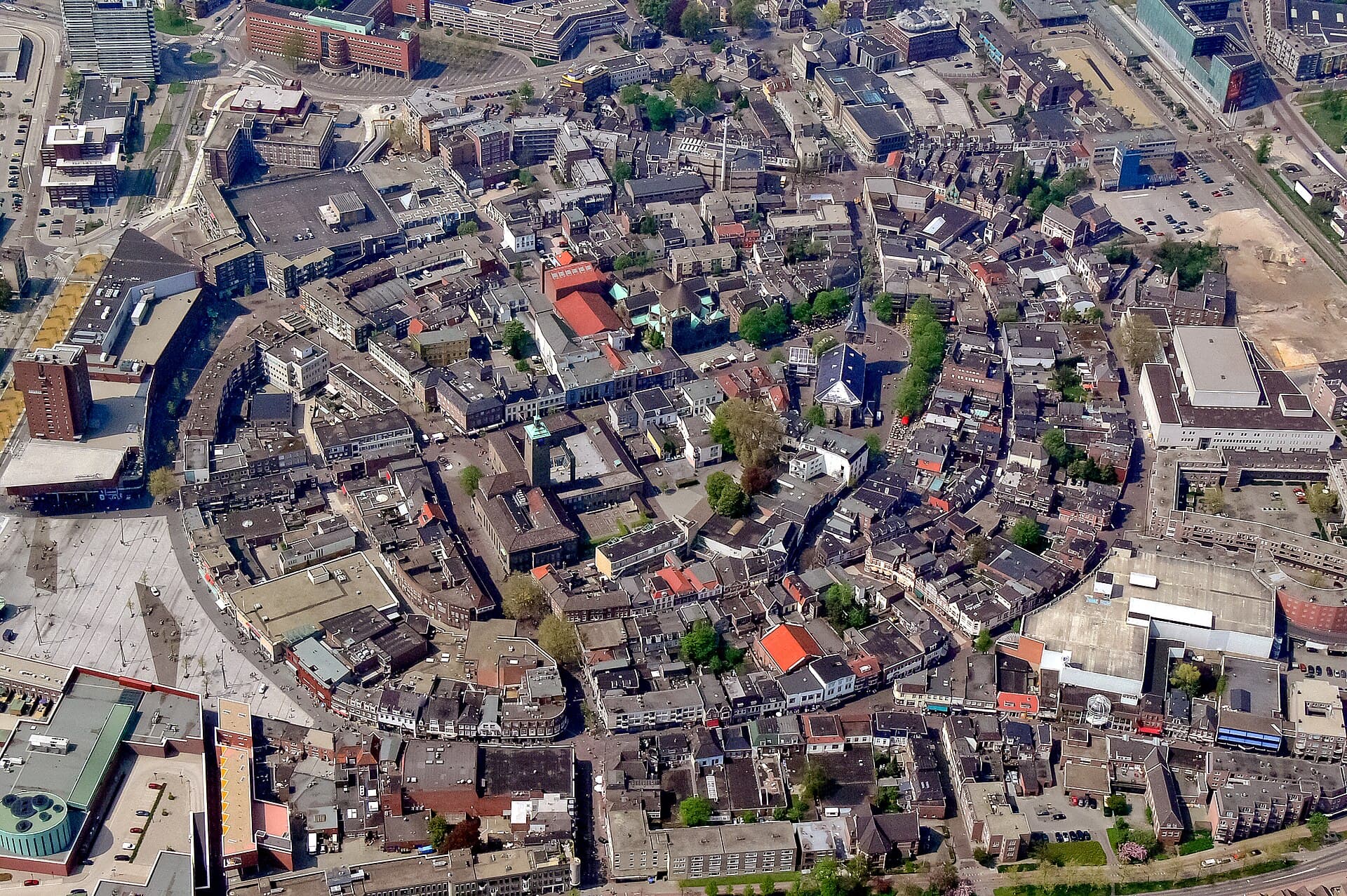 Archangel12 / CC BY 2.0, via Wikimedia Commons
Self-guided audio walking tour of Enschede — GPS route, offline playback, story-driven narration in 32 languages.
“Enschede: where enduring spirit rebuilds, and ingenuity ascends from the ashes.”
Not the postcards. The stories even locals don't know — whispered in your ear, right where they happened.
Observe the rear of the Grote Kerk, across from the Carillon, for a glimpse of an 'invisible window.'
As you stroll along Marktstraat toward the Oude Markt, you walk upon a piece of the city's forgotten infrastructure.
Direct your gaze to the roof of the ArtEZ Conservatory and you will discover a striking, six-meter-tall statue with a surprising dual identity.
Discover every secret of Enschede
Every address, every reveal in full — in your ear, right where it happened.
You pick your stops. You walk. The voice reveals what the others miss.


Your self-guided audio tour of Enschede is ready — pick your landmarks, choose your language, and start the moment you arrive.
BuyLume has a built-in augmented-reality guide. Hold your phone up and its camera shows the street ahead of you, with a glowing arrow laid over the real view that always points to your next stop — no map to puzzle over, no wrong turns. Like everything in Lume, it works fully offline.
Enschede, a city in the eastern Netherlands, stands as a testament to enduring spirit and constant reinvention. Once a small medieval settlement granted city rights around 1300, it transformed into a powerhouse of the textile industry in the 18th and 19th centuries. Despite facing numerous devastating fires, including a catastrophic one in 1862 that razed most of the city center, Enschede consistently rebuilt itself, embracing modernity and innovation.
Today, Enschede is recognized as a dynamic urban core with a youthful population and an international flair, showing a significant student presence thanks to institutions like the University of Twente. It is a city that skillfully balances its industrial legacy with a strong focus on technology, culture, and green spaces, earning it a reputation as one of the greenest cities globally. From its active Oude Markt to its innovative Roombeek district, Enschede offers a dynamic experience where history and contemporary life intertwine.
Enschede's origins can be traced back to early medieval times, with a settlement existing around the Old Marketplace. The name 'Anescede' or 'Enscede' likely meant 'near the border' or 'near the Es.' The city was granted rights around 1300, confirmed in 1325 by Bishop Jan III van Diest, allowing it to construct defenses. Lacking the funds for a stone wall, Enschede protected itself with a system of ditches, palisades, and hedges, a legacy still visible in street names like Noorderhagen and Zuiderhagen.
Due to its predominantly wooden architecture, Enschede was prone to fires, earning its inhabitants the nickname Brandstichters (arsonists) after major conflagrations in 1517, 1750, and 1862. The fire of May 7, 1862, was particularly devastating, destroying 633 homes, all public buildings, and eight factories, leaving thousands without shelter. Ironically, this disaster paved the way for modernization and rapid industrial growth.
The 18th and 19th centuries saw Enschede emerge as a major hub for the textile industry. The production of bombazijn, a blend of cotton and linen, became a successful export, leading to a significant population increase and the establishment of numerous factories. By the late 1950s, the textile and garment industries accounted for over 80% of all jobs in the city.
However, the 1960s brought a sharp decline as production shifted to lower-wage countries, leading to mass layoffs and the closure of most factories. Enschede faced another period of hardship, with large areas of industrial wasteland. The city demonstrated its enduring spirit once more, transforming these sites into new housing and cultural spaces, and establishing itself as a service-oriented city.
In 1961, Enschede was chosen as the location for a new technical university, the University of Twente, which opened in 1964 on a green campus donated by the city. This marked a shift towards innovation and education.
On May 13, 2000, Enschede experienced another profound tragedy: the Roombeek fireworks disaster. An explosion at a fireworks storage facility destroyed an entire neighborhood, claiming 23 lives. Yet again, the city responded with remarkable resilience, rebuilding Roombeek into a modern district renowned for its contemporary architecture and cultural offerings.
Begin your exploration in the Oude Markt, the city's lively central square, surrounded by cafes and restaurants, ideal for observing the city's pulse. Here, you will find the Grote Kerk, a historic church with distinctive stained-glass windows narrating Enschede's past. Do not overlook the Fire Monument on the Oude Markt, commemorating the devastating 1862 city fire.
For art and culture, visit the Rijksmuseum Twenthe, home to the largest art collection in the eastern Netherlands, spanning from medieval to contemporary works. Nearby, the Museumfabriek offers interactive exhibits. A true architectural marvel is the Synagogue of Enschede on Prinsestraat, a splendid 1928 building with distinctive domes and a profound Jewish history, considered one of the most beautiful synagogues in Europe. Guided tours are available to explore its intricate interior.
Take a walk through Roombeek Cultuurpark, a district rebuilt with innovative architecture and cultural spaces after the 2000 fireworks disaster. Retreat to nature at Volkspark, the oldest public park in the Netherlands, a serene green oasis. For a singular experience, discover Vliegveld Twenthe, a former military airbase transformed into a vast natural and recreational area, hosting events and offering a glimpse into its historic past.
The best time to visit Enschede for warm-weather activities and general outdoor exploration is from late June to late August, with a peak in the first week of August. During these months, temperatures are generally pleasant, averaging around 22.3°C (72.1°F), with extended daylight hours. The tourism score favors clear, rainless days between 65°F and 80°F. May and September also offer pleasant climates. For fewer crowds and potentially better value, consider visiting during the cooler months of December through March.
Enschede is a compact city best explored by bicycle, on foot, or by public transportation. The city center is largely car-free, and parking can be challenging, especially during peak hours. Public buses in Enschede are cashless, requiring debit or credit card payments. The Enschede train station is well-connected to the Dutch rail network, with intercity trains to major cities like Amsterdam and Utrecht, and is a short walk from the city center.
For information, maps, and city tours, visit the Tourist Info Enschede office on Langestraat 41. Public toilets are available in the city center, including facilities in the Van Heek garage, De Klanderij shopping center, Hema, and Koningsplein shopping center. While Enschede does not have a city card, students can benefit from the 'Study in Enschede' discount card.
Enschede in Korean, in Chinese or in Hebrew — and 29 more languages, every stop narrated by a native voice. The widest language range of any self-guided audio tour.
Available in: