Venlo Incident Site
During WWII, a seemingly minor border incident in Venlo had major international repercussions, becoming a Nazi justification for invading a neutral country.
Full story unlocks in the tour
 giggel / CC BY 3.0, via Wikimedia Commons
Self-guided audio walking tour of Venlo — GPS route, offline playback, story-driven narration in 32 languages.
“Where Dutch charm meets Hanseatic history on the Maas.”
Not the postcards. The stories even locals don't know — whispered in your ear, right where they happened.
During WWII, a seemingly minor border incident in Venlo had major international repercussions, becoming a Nazi justification for invading a neutral country.
This modern art museum in Venlo owes its entire collection to a single Amsterdam couple who had a unique vision for their legacy.
The prominent St. Martinuskerk in Venlo has a surprisingly ancient predecessor, built from timber around the turn of the first millennium.
Discover every secret of Venlo
Every address, every reveal in full — in your ear, right where it happened.
You pick your stops. You walk. The voice reveals what the others miss.


Your self-guided audio tour of Venlo is ready — pick your landmarks, choose your language, and start the moment you arrive.
BuyLume has a built-in augmented-reality guide. Hold your phone up and its camera shows the street ahead of you, with a glowing arrow laid over the real view that always points to your next stop — no map to puzzle over, no wrong turns. Like everything in Lume, it works fully offline.
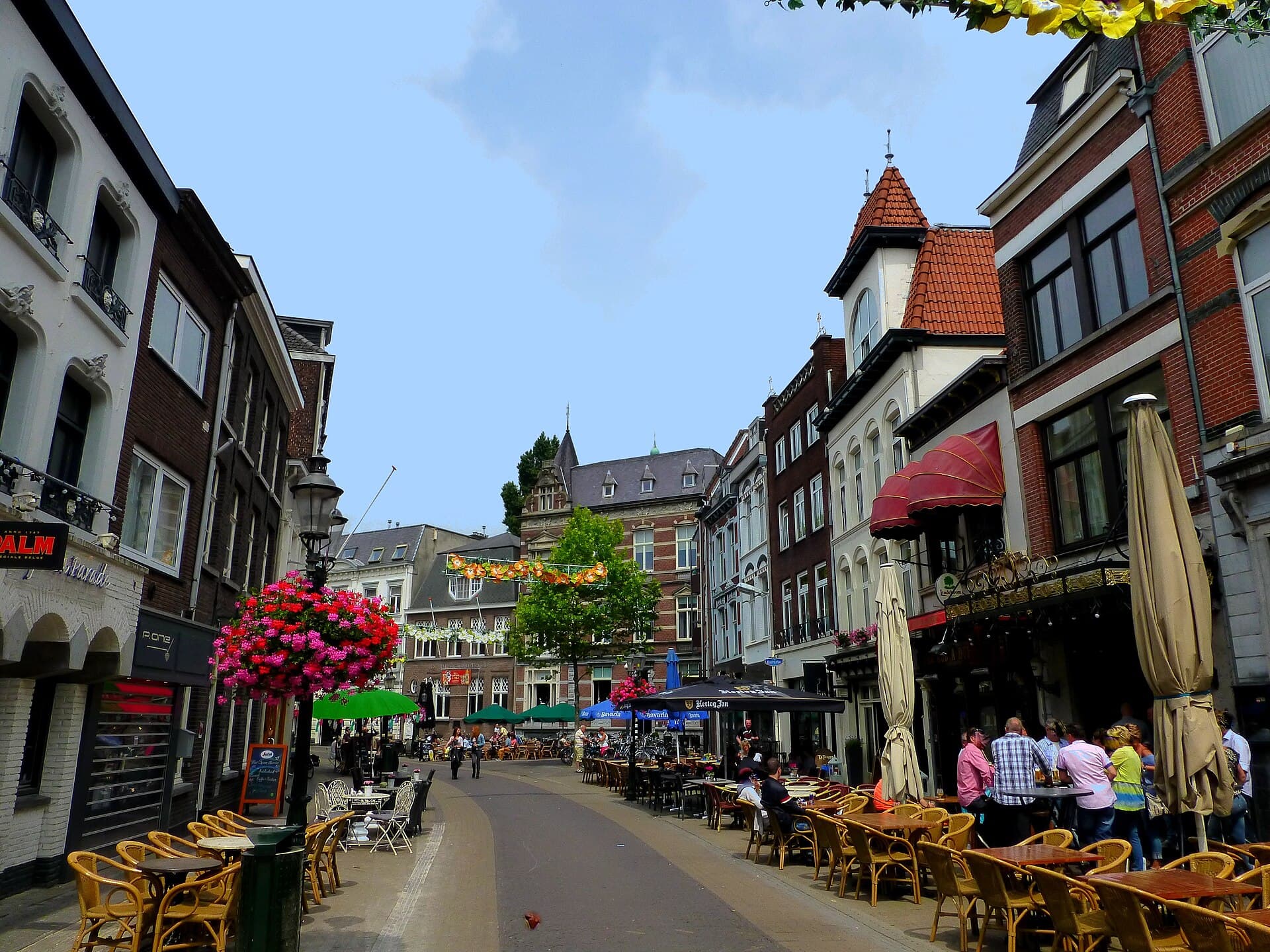
Venlo, a city in the southeastern Netherlands, rests along the Maas (Meuse) River, a short distance from the German border. This strategic location has shaped its identity as a significant trade, industrial, and transport hub, while also fostering a unique blend of Dutch and German influences. Despite suffering substantial damage during World War II, Venlo has been largely rebuilt and restored, maintaining a historic city center with inviting facades and animated squares.
Today, Venlo offers a welcoming atmosphere, combining its enduring past with contemporary amenities. The city center is a delightful place to explore on foot, with its historic street structure, numerous restaurants, and cafes. Beyond its urban core, Venlo and its surrounding villages, including Tegelen and Arcen, provide ample opportunities for outdoor activities like hiking and biking along the Maas and through various nature reserves.
The history of Venlo stretches back to antiquity, with archaeological evidence suggesting a Roman settlement, possibly known as Sablones, existed here. This early settlement served as a crucial military and logistical point due to its location on the Maas River, a natural transport artery. By the 9th century, Venlo was documented as a trade post, steadily growing in importance within the Meuse-Rhine area.
In 1343, Duke Reinoud II of Guelders officially granted Venlo city rights, a pivotal moment that allowed the construction of defensive fortress walls. The city's strategic position on the Maas made it a coveted target and a formidable fortress, influencing its dense urban development within the walls for centuries. In 1481, Venlo joined the Hanseatic League, marking a golden age for its economy. This membership solidified its status as an important trans-shipment point, where passing ships were obligated to unload and offer goods for sale, fostering a prosperous merchant class and a lively trade in cloth, wine, and ceramics.
Throughout its history, Venlo's strategic location meant it was frequently contested, falling under Spanish, Dutch, and French rule at various times. A significant event was the siege of 1702, led by Menno van Coehoorn, after which Venlo was incorporated into the Generaliteitslanden of the United Provinces by the Treaty of 1713. After the Napoleonic Wars, it became part of the newly formed United Kingdom of the Netherlands. The mid-19th century saw the demolition of the city walls, allowing Venlo to expand beyond its historic confines.
World War II brought immense devastation to Venlo. The city suffered heavily from Allied bombings, particularly targeting its strategic road and railway bridges over the Maas. Over a thousand inhabitants lost their lives, and while Allied attempts to destroy the bridges to cut German supply lines were unsuccessful, retreating German troops ultimately blew them up in 1945. In the aftermath, Venlo was rapidly rebuilt, with less emphasis on preserving heritage than on creating new infrastructure. Today, the city center, though largely reconstructed, retains its historical street plan and offers a tangible link to its resilient past through various heritage routes and preserved buildings.
Begin your exploration of Venlo at the Markt Square, the city's lively heart. Here, you'll find the impressive Renaissance-style Stadhuis (City Hall), a central landmark with ornate architecture. The square is surrounded by cafes with outdoor terraces, perfect for enjoying a coffee or a local Limburg beer.
A short stroll from the Markt Square leads to the St. Martinuskerk (St. Martin's Church), a Gothic basilica dating back to the 15th century. This church, rebuilt in the 1950s after wartime damage, houses Gothic sculptures, including the 'black Madonna of Venlo,' and offers a carillon with 53 bells.
For a deeper dive into the region's heritage, visit the Limburgs Museum, conveniently located near the central station. This engaging museum offers interactive exhibits on the natural and cultural history of the Limburg province, covering everything from archaeological finds to local folklore. Art enthusiasts should also explore the Museum van Bommel van Dam, the first modern art museum in Limburg, featuring diverse exhibitions of contemporary art and design.
Beyond the city center, consider a visit to Kasteeltuinen Arcen (Arcen Castle Gardens), located about 10 kilometers north of Venlo. These extensive gardens, surrounding a castle, are a highlight, especially in spring when they burst with a variety of blooms. You can also stroll along the Maas River promenade, where modern sculptures add artistic flair and reflections shimmer on the water, offering a peaceful escape.
The most pleasant time to visit Venlo for general outdoor activities is from mid-June to early September, with a peak in the first week of August. During these summer months, Venlo experiences warm, comfortable weather, with average daytime temperatures around 23-25°C (73-77°F). July is typically the sunniest month, offering around 7 hours of daily sunshine. While precipitation occurs year-round, rainfall intensity is generally low, though it's wise to bring an umbrella as overcast weather can be frequent. For those seeking fewer crowds and potentially better value, the quieter months from November to February offer cooler temperatures.
Venlo is easily accessible by various modes of transport. The city's central station offers convenient train connections from major Dutch cities like Amsterdam (approximately 2 hours), Eindhoven (30 minutes), and Utrecht (90 minutes with a change in Eindhoven). There are also direct train connections to German cities such as Duisburg, Cologne, and Düsseldorf. Long-distance buses also serve Venlo, arriving in front of the central train station.
Once in Venlo, the city center is compact and easily explored on foot. Bicycles are a popular mode of transport, and you can rent them locally to cycle along the Maas or through the surrounding green areas. While driving in the city center can be busy and parking expensive, various parking garages and lots are available in and around the center, including a park and ride (P+R) option at Stationsplein. Shops in Venlo are generally open seven days a week, with many German visitors coming on Sundays when shops across the border are closed.
Venlo in Korean, in Chinese or in Hebrew — and 29 more languages, every stop narrated by a native voice. The widest language range of any self-guided audio tour.
Available in: