Nikola Tesla Memorial Center
The birthplace of one of the world's most revolutionary minds holds a secret about his early education.
Full story unlocks in the tour
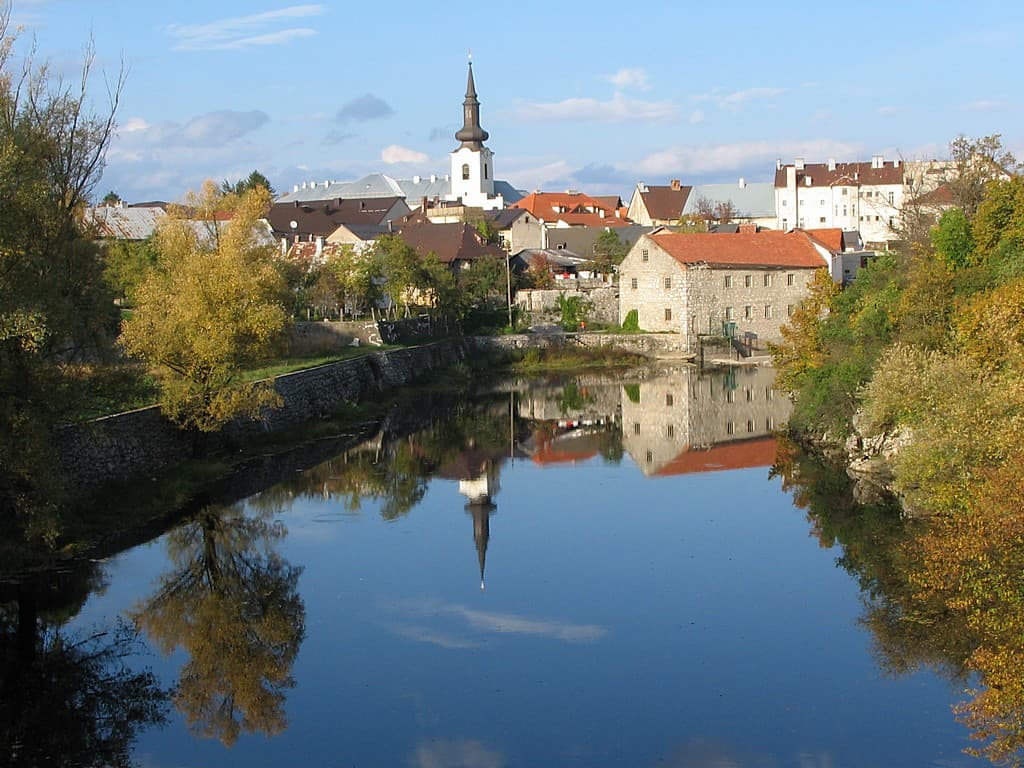 INekic / CC BY-SA 4.0, via Wikimedia Commons
Self-guided audio walking tour of Gospić — GPS route, offline playback, story-driven narration in 32 languages.
“Where Lika's wild heart beats to the rhythm of invention.”
Not the postcards. The stories even locals don't know — whispered in your ear, right where they happened.
The birthplace of one of the world's most revolutionary minds holds a secret about his early education.
The enduring symbol of Gospić, a woman drawing water, has a surprisingly practical origin story.
A popular local restaurant's name isn't merely a whimsical choice; it's a nod to its founder's past.
Discover every secret of Gospić
Every address, every reveal in full — in your ear, right where it happened.
You pick your stops. You walk. The voice reveals what the others miss.


Your self-guided audio tour of Gospić is ready — pick your landmarks, choose your language, and start the moment you arrive.
BuyLume has a built-in augmented-reality guide. Hold your phone up and its camera shows the street ahead of you, with a glowing arrow laid over the real view that always points to your next stop — no map to puzzle over, no wrong turns. Like everything in Lume, it works fully offline.
Gospić, the administrative and cultural heart of Lika-Senj County, rests on the western edge of the expansive Ličko polje, one of Croatia's largest karst fields. It is embraced by three rivers—the Lika, Novčica, and Bogdanica—and lies at the foot of the Velebit mountain range, Croatia's largest mountain. This central location makes it a natural crossroads connecting northern and southern Croatia, offering a unique blend of natural beauty and historical depth.
Despite its modest population, Gospić holds the distinction of being the largest city in Croatia by land area, encompassing over 967 square kilometers, making it geographically larger than cities like Berlin, Paris, or New York. This expansive territory includes around 50 surrounding settlements, contributing to its broad, yet tranquil, character. The town serves as a gateway to outdoor adventures, with opportunities for hiking, cycling, fishing, and exploring nearby national and nature parks.
The Gospić area has been inhabited since prehistoric times, with evidence of settlements dating back to the Neolithic period and the Iron Age, particularly by the Iapodes. The first written mention of the area dates to 1263, referred to as Kaseg or Kasezi, along the river Kaseg, now known as Novčica. The name Gospić itself first appeared in historical records in 1604, though it was mentioned as the village “Gospojina” as early as 1574.
During the Ottoman wars in Europe, Gospić was under Ottoman rule for a period, forming part of the Sanjak of Lika. The foundations of the modern town are built around two Ottoman forts, the towers of Aga Senković and Aga Alić, and an old bridge. These structures were instrumental in its development into an administrative, military, and cultural center.
Significant growth for Gospić began in the latter half of the 18th century when it was established as a military-administrative center for the Lika Regiment. Beyond its military role, Gospić also gained economic importance as a hub for crafts and trade. However, its development throughout the 19th and 20th centuries was often impacted by major global historical events.
Gospić suffered extensive damage during the Croatian War of Independence in the 1990s, particularly during the Battle of Gospić, fought from August 29 to September 22, 1991. The town was heavily bombarded by the Yugoslav People's Army (JNA) and Serb paramilitary forces, with over 50% of structures reportedly damaged. Croatian forces successfully defended the town, preventing its capture and securing a vital supply route. However, the aftermath of the battle saw tragic war crimes, including the Gospić massacre in October 1991, where between 100-120 predominantly Serb civilians were killed by Croatian military units. The town has since focused on rebuilding and preserving its heritage, with initiatives to boost tourism centered on its natural surroundings, traditional flavors, and cultural landmarks.
Begin your exploration at the Nikola Tesla Memorial Center in Smiljan, a short drive from Gospić. This site honors the renowned inventor, featuring his reconstructed birth home, a museum exhibition, and replicas of his inventions. In Gospić itself, visit the Lika Museum, which houses an interesting collection dedicated to the traditional culture of the Lika region. The Cathedral of the Annunciation of the Blessed Virgin Mary, built in 1783, is another significant historical landmark. Before the cathedral, you'll find the Marta Vodarica statue, a 19th-century sculpture symbolizing the town's water supply.
For those interested in history and local figures, a monument to Nikola Tesla stands in Nikola Tesla Square in downtown Gospić. Additionally, the Memorial Home of Dr. Ante Starčević in Veliki Žitnik commemorates another prominent Croatian figure, known as the "Father of the Homeland."
The surrounding region offers abundant natural attractions. The Velebit Nature Park, Croatia's largest mountain, provides opportunities for hiking and exploring unique karst formations. Nearby, you can also find the Grabovača Cave Park near Perušić, showcasing impressive underground karst formations.
Gospić experiences a moderately continental climate, characterized by warm summers and cold, snowy winters. The best time to visit for comfortable weather and outdoor activities is from mid-May to mid-September. During June, July, and August, daytime temperatures are pleasant, averaging around 25-28°C (77-82°F), with July being the sunniest month. While summers are warm, nights can be cool, so a light jacket is advisable. Autumn brings rich fall colors to the surrounding forests, making it ideal for scenic drives. Winter offers a quiet, snowy landscape, with cold temperatures and frequent snowfall.
Gospić is accessible by car, bus, and train. The nearest major airport is in Zadar, approximately 100 km away, with bus connections available to Gospić. Within the town, walking is a good way to explore the center. For accommodation, Gospić offers a range of options, including hotels like Hotel Stara Lika and Hotel Ana, as well as numerous private apartments and guesthouses. Many accommodations offer free parking. Dining options include restaurants serving traditional Croatian cuisine, such as Restoran Javor and Zlatna Potkova, known for its spit-roasted lamb. The Gospić Tourist Board and Tourist Information Center can provide further assistance and information, with offices open Monday to Friday.
Gospić in Korean, in Chinese or in Hebrew — and 29 more languages, every stop narrated by a native voice. The widest language range of any self-guided audio tour.
Available in: